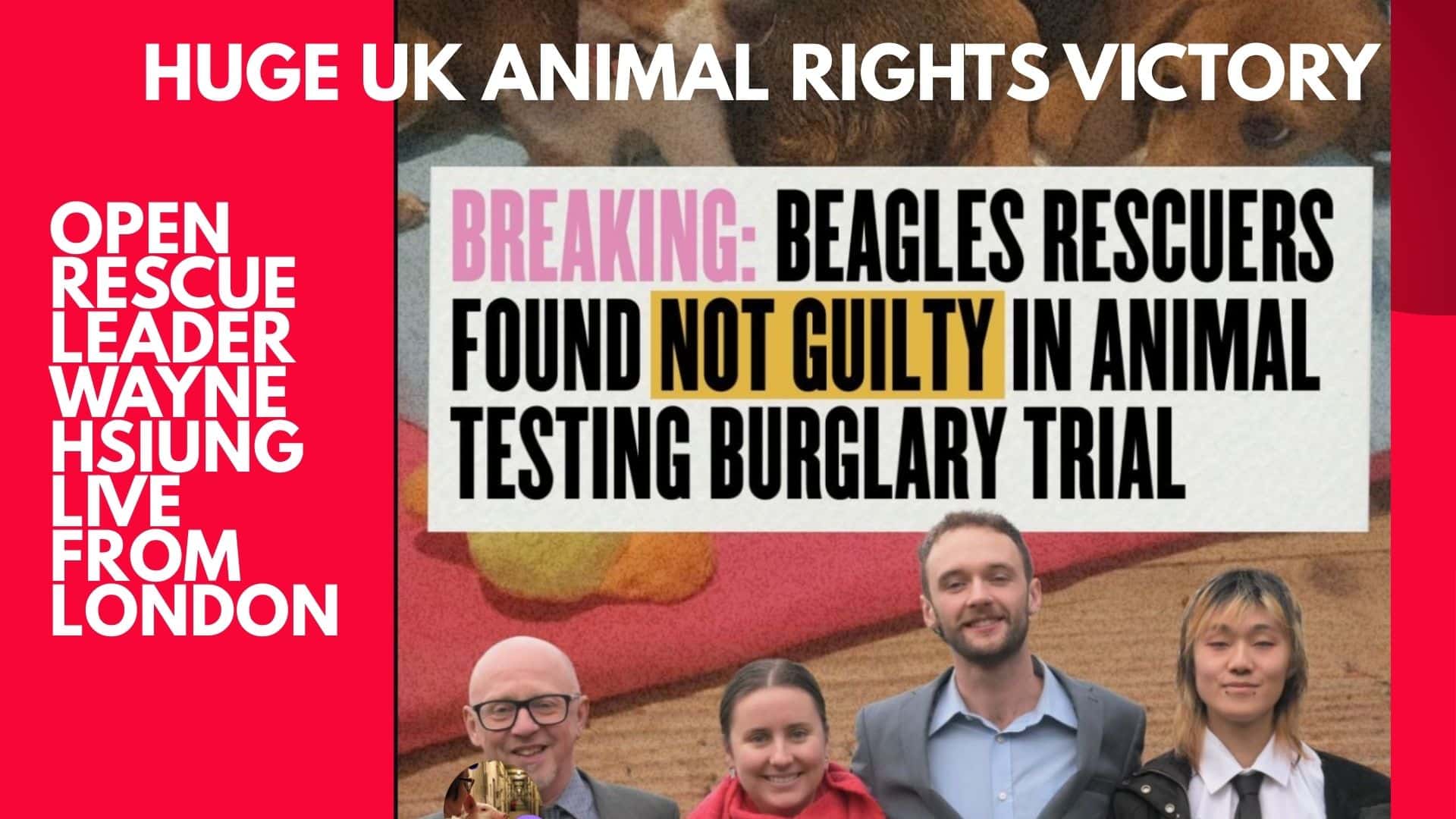
The not guilty verdicts in the UK Beagle Rescue Trial are a huge win for the animal rights movement in general and the “open rescue” movement in particular.
Los Angeles, California, January 12th, 2025 – A UK jury has delivered a major win for animal rights: four defendants in the second “Beagle Rescue” trial tied to Animal Rising have been found not guilty—a landmark result in a series of cases stemming from the December 2022 open rescue of beagle puppies from MBR Acres, a Cambridgeshire facility that supplies dogs for animal testing. The verdicts arrive after the first trial ended in convictions, and as additional trials remain ahead—with supporters saying the first case will be appealed, and new groups of defendants still scheduled to face court.
The rescue itself has been described in multiple official statements and court reporting as involving around 20 beagle puppies, with two recovered by authorities and 18 ultimately placed into safe homes, while 18 people were charged in connection with the action.
UnchainedTV covered the breaking news live from England with famed attorney Wayne Hsiung—known for his legal work in animal protection and widely credited with helping popularize “open rescue” tactics in the United States—calling the courtroom moment “a complete rollercoaster” as the not guilty verdicts landed.
WATCH WAYNE HSIUNG LIVE FROM LONDON WITH REACTION
“They tried to paint these people as extremists”
Hsiung, speaking shortly after the verdict, told UnchainedTV that the prosecutor worked aggressively to frame the defendants as dangerous radicals rather than rescuers acting from conscience. “He did everything he could to paint these people as extremists,” Hsiung said, describing a closing argument that warned “social order would break down…that there would be anarchy on the streets” if the jury acquitted.
Still, despite the pressure, the jury returned not guilty verdicts with striking speed—something Hsiung emphasized as rare in his decades of legal experience. “I’ve never seen a verdict come out this fast,” he said, attributing the quick decision to the defense’s ability to communicate motive and morality in human terms rather than sterile abstractions.
The “can of beans” argument—and why it backfired
One of the most memorable flashpoints in the trial, Hsiung said, came when the prosecution leaned on an analogy that has appeared again and again in cases where activists remove animals from farms or labs: comparing living beings to ordinary property.
Hsiung described a key moment when a self-represented defendant directly challenged the prosecution’s claim that the beagles were comparable to an inanimate object. The prosecutor, Hsiung said, argued that “the dogs were similar to a can of beans.”
The defendant’s rebuttal cut through the courtroom: “dogs are not cans of beans.” That line, Hsiung said, landed powerfully. “There were tears in everyone’s eyes,” he recalled, describing how the statement reframed the case from property law into moral clarity.
The “can” comparison echoed Hsiung’s own U.S. experience. In a prior case involving piglets rescued from a Smithfield-related factory farm, a prosecutor argued that “rescue” is nonsense—like “rescuing” a dented can from a grocery store. Hsiung’s reaction, hearing a version of that rhetoric resurface in the UK, was immediate: “My jaw just dropped. I couldn’t believe what I was hearing… it was like deja vu all over again.”
His conclusion: prosecutors make these comparisons because they must—legally and rhetorically—to sustain theft or burglary theories against rescuers. “For them to actually effectively accuse any animal rights activists who rescue animals of theft, they have to compare these animals to property, including a dented can,” he said.
And he argued that juries often resist that logic once forced to deliberate: “the jury just revolted against it.”
Why this trial ended differently than the first
The second trial’s acquittals diverge sharply from the first trial’s convictions—raising urgent questions about what changed, what juries respond to, and what future trials may hold.
Animal Rising has stated that the first trial ended with five defendants convicted of burglary, the first convictions in a set of trials the group has framed as a referendum on animal testing and transparency.
Hsiung, who said he was not present for the first trial, nonetheless offered a detailed analysis based on debriefs with the support team and lawyers. He identified two major shifts.
First, he said, the judge allowed more room for the defense to explain motivation and conditions.
In the first trial, he said, the court was so restrictive that attorneys were cut off for invoking the animals’ lived reality. He described a moment where an attorney said, “imagine you had lived for 18 weeks of your life in conditions like this,” and the judge responded by removing the jury and insisted, “you’re not allowed to appeal to emotion at all.” Hsiung’s view is that such restrictions undermine a core element in UK burglary/theft framing: dishonesty. “One of the elements of the case is dishonesty,” he said. “And for… the defendants… to make the case that they were acting honestly… they had to describe the reason for being there.”
Second, he said, the defense leaned harder into storytelling—because persuasion is often about humanity, not just logic. “It was too logical, too rational,” he said of the first trial’s approach. “In the persuasion business… it’s all about emotions and stories.”
In the second trial, he said, the prosecution went so far as to declare: “there’s no room for sympathy in the courtroom,” a line Hsiung said sounded like “a villain from some movie.” But the defense, he argued, generated empathy simply by telling the truth of why they acted.
“The defendants themselves did an extraordinary job of generating sympathy… just describing why they were there… describing how they felt…” he said, adding that it moved the jury to a rapid acquittal.
Bigger than four acquittals: personhood vs. property
For Hsiung, the case is not merely about four people. It is about the legal and cultural conflict at the center of the modern animal rights movement. “This has much bigger implications than two acquittals… because… animals are property. In contrast, what the animal rights movement believes is animals are persons,” he said.
He added that these trials repeatedly show that “when jurors are actually forced to deliberate, they sided [with] those who see the animals as persons and not property.”
This matters because Animal Rising has publicly described these proceedings as the first open rescue trials in the UK, and a legal showdown that could influence how animal rescue actions are prosecuted—and perceived—for years to come.
Other trials are still coming—and the first case is expected to be appealed
The acquittals do not end the legal saga. More trials are ahead, involving additional defendants.
Animal Rising has stated that the first trial was the first of several trials, with other individuals due to face burglary charges over the coming months.
UnchainedTV’s coverage also underscored that supporters expect the first trial’s convictions to be appealed, while the upcoming trials will determine whether the second jury’s rejection of the prosecution framing becomes a trend—or an exception.
What MBR Acres says—and an open invitation
MBR Acres has repeatedly maintained that it operates within the law, follows regulations, and denies allegations advanced by the defendants, who argue the facility’s practices are morally indefensible.
MBR Acres is invited on UnchainedTV at any time to present its position directly and respond to questions about the facility, the welfare of the dogs it supplies, and the broader controversy surrounding animal experimentation.
“The movement is stronger than it’s ever been”
Hsiung ended the live discussion with a message aimed at the wider movement—especially those demoralized by the first trial’s guilty verdicts.
“The movement is stronger than it’s ever been,” he said.
Even defeats, he argued, can produce a “boomerang effect” when industry overreach collides with public conscience—creating backlash that ultimately advances the cause.
“When they overreach and push back, the slingshot effect… that whiplash actually propels us forward,” he said.
And then he offered a line that activists have repeated across generations of struggle:
“Just you wait… because it’s always darkest before the dawn.”
As the remaining trials approach and the first case moves toward appeal, the second trial’s acquittals have done something unmistakable: they have re-opened the possibility that, in a courtroom, a jury can look at a beagle puppy and refuse to see “property”—even when the law demands it.
If the next juries follow suit, the UK’s first open rescue trials may become more than a legal battle over burglary. They may become a turning point in how a society weighs compassion against institutions built on secrecy.