[Speaker 1]
Oh, we have breaking news to bring you. And if you’re an animal rights activist, an animal lover, it’s not the news you probably wanted to hear. The Beagle rescuers have all been found guilty in the animal testing burglary trial, which we have been calling the Beagle rescue trial of England, the first open rescue trial ever in England’s history.
Let’s go straight out to England where our reporter Claudia Pena Rojas is live near the court because she’s not allowed to be right outside the court. Claudia, bring us up to date your text guilty woke me up this morning. Tell us the whole thing.
[Speaker 2]
Yeah, it’s not not what you want to wake up to. And today has been, I think, quite a rough day for for everyone. So unfortunately, as you said, everyone was found guilty, unanimous decision.
And I think in many ways, that’s what’s been quite hard to to swallow is, I think the possibility of a guilty verdict was always there. Obviously, it’s not what you hope for. But the decision was made quite quickly this morning with all 12 jury members agreeing.
So that’s that’s always a difficult decision to to process. And today has been a lot of beginning to process that. But also, I’ve been with the defendants all day and not one of them regrets taking the actions that they did.
They’re still very grounded in the fact that it was the right thing to do. And that now, thanks to the section, there are 18 puppies who do get to live a life of safety and love. And I know that they wouldn’t change a thing regardless of this outcome.
[Speaker 1]
Well, you you say that here are three of the defendants, young people, they face the possibility of a decade behind bars. Now, I don’t think anybody expects a decade. But we also didn’t necessarily expect a jury of 10 people to just come back so quickly with a verdict, given that these are young people, given that they are not criminals, they given that they videotaped themselves, given that they presented that video to the public and explained that they are trying to save lives.
What was their reaction emotionally when they heard it?
[Speaker 2]
Yeah, I think it varied for each defendant. Some of them more emotional than others. I think, honestly, a lot of shock initially, as I said, just how quickly the decision was reached.
And other people, Ben in particular, is very much sort of unfazed by things initially. So he’s still quite chipper. But yeah, I think it is really disheartening.
I think particularly in the work that’s been done more widely with animal rights. And if you can’t get a jury of 12 people to sympathize with puppies being rescued for testing, then it’s really hard to think about all the other animals in other industries that people are also trying to help and how you get the jury to to care about that.
[Speaker 1]
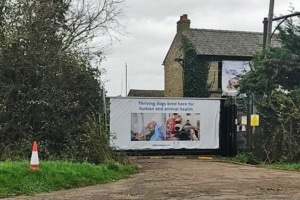
So, you know, you had mentioned and we’ve got a panel here that’s going to weigh in, including an anti-vivisection expert, Hurek Tela and our Unchained TV host. But you had mentioned that they’re also trying to pass new legislation that is going to make it even harder. We know there’s something called Camp Beagle outside the testing facility where all this happened.
I can show a little video of Camp Beagle, but supposedly it’s going to make it even harder. Tell us about this legislation.
[Speaker 2]
Yes. So here in the UK, a couple of years ago, this thing called the Public Order Act came in essentially to tackle, you know, basically protests escalating here in the UK. And so far, there have been certain things in there that have been branded as key infrastructure, a lot of it regarding airports and motorways where protests have happened in the past.
And now they are looking to bring in and reclassify animal testing facilities as part of that. And what this would mean is it would give police additional powers to tackle any protests outside these facilities or in these facilities, and that it would give essentially harsher sentences. So just causing significant disruption, delay in any of the processes that happen in those places could land you 12 months in prison.
So they’re trying to make it much harder. And it’s not a coincidence. It is because there is higher pressure on the animal testing industry with organisations like Camp Beagle.
There have been other targeted protests that have been really affected and things like these Beagle rescues, they’re feeling the pressure and so the reaction from the government is to try and protect these industries rather than looking at why there is so much upset over what’s happening.
[Speaker 1]
If you are just joining us, the verdict is in. The jury of nine men and three women came back very quickly. And yes, people are saying unbelievable.
And it is very shocking. Guilty on all counts. So these are folks who turn themselves in.
You can see there they are waiting for police. They did not try to hide their actions. They videotaped themselves and then turned themselves into police.
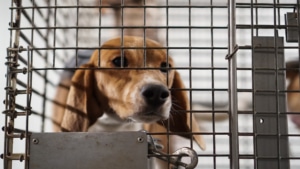
Basically, the entire operation was a desire to wake people up to what’s happening to these Beagles, where they’re subjected to toxicology tests and bled often every last ounce of blood in their bodies, bled out. And we’re going to talk to an anti-vivisection activist, an expert right now about how unreliable those tests are. So these dogs who are bred specifically for that live in this facility.
The facility says it follows all government regulations. But people are saying they’re living in their own feces. They’re shipped off at a very young age to be experimented on.
And so these activists went in there and took them out. And now they have been found guilty. Just moments ago, we got the news.
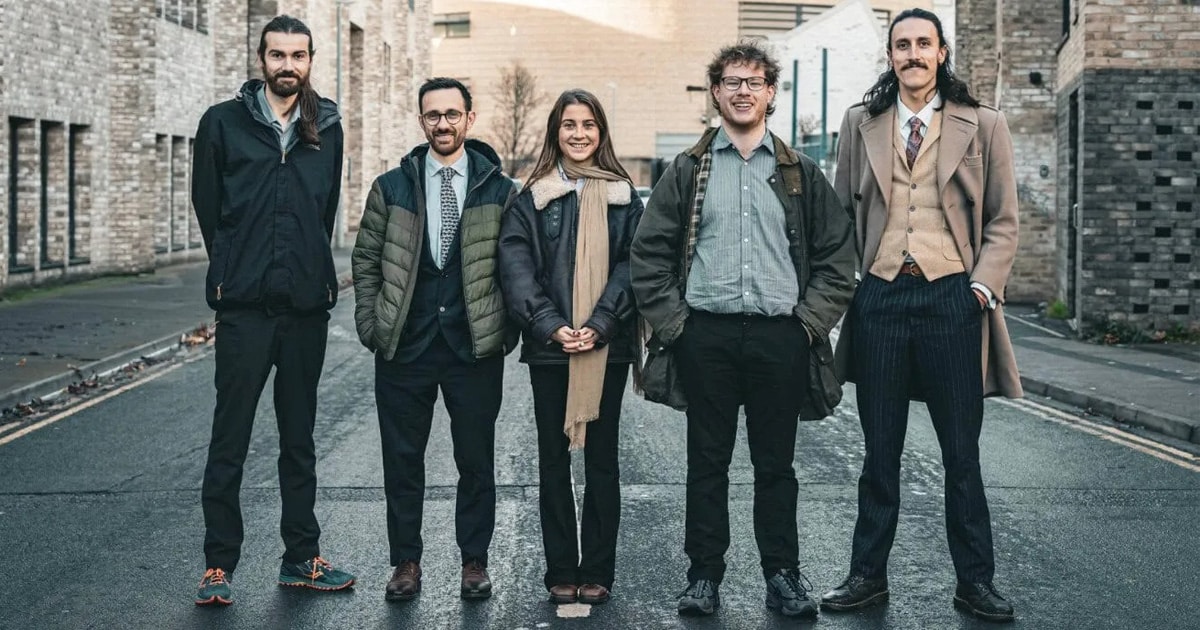
Guilty on all counts. OK, five defendants found guilty. The people you’re looking at right now, they now face up to 10 years in prison.
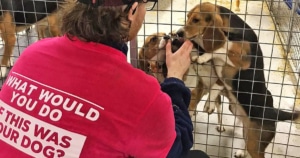
And there’s a dozen more rescuers because there were something like 18, depending on how you counted, 18, 20 people who went in or had cars, getaway cars with the dogs. 18 dogs are living their best life at sanctuaries right now. But these folks are now facing 10 years possibly in prison.
Claudia, when is the sentencing?
[Speaker 2]
So the sentencing is not fully set. It’s likely to move, but it’s set for the 19th and 20th of February for most people. Ben, who also has another charge because he has actually done two rescues, will not be sentenced until the end of his final trial in March.
And the reasoning for this is that the judge essentially wants to see what happens with the remaining trials before making any kind of decision. So we still have a waiting game to see what happens. He did state that custodial sentences weren’t off the table, that there would be careful consideration about that.
So it really is a waiting game to see what happens. So when you say custodial, what you’re talking about is at home? No, it’s prison.
Prison. So for you, a custodial is prison. There is a chance, I think, for suspended sentences.
And it’s not necessarily set that that is what will happen. But I think it’s just worth acknowledging that it isn’t out of the realm of possibility that that could be the outcome.
[Speaker 1]
So people are very upset. The jury have no compassion or soul. How can anyone say they’re guilty?
They rescued puppies being poisoned. MBR acres are the criminals and all the laboratories who are doing horrific experiments on animals. So let’s just get some reaction here.
Lindsay Baker, you’ve been covering this from the beginning. Your your your reaction as a human being and a and a dog parent. Well, as a dog parent, I’m horrified, disappointed, and I see how animals are regarded.
I mean, this is significant because it shows us how the judicial system in England, how they regard conscious driven civil rights in the 21st century. I mean, it’s insane. You can’t do something for because it’s morally wrong.
That’s what this is saying, that that’s no legal defense. They’re not taking the right to rescue or the fact into consideration of what the animals are going through. They indeed said, don’t bring the animals into it at all.
Just go by the fact that this is breaking the law. I mean, I’m simplifying it, but basically that’s what they said. And I’m just hoping that the defense attorney may be just for the next trial.
Oh, one other thing I want to say, I know I’m jumping around a bit, but suddenly the judge is allowing for us to report on this. If it wasn’t not guilty, would they have done the same thing? I think not.
I think it’s very skewed into for the for these or these animal testing organizations, which I’m speechless. I’m really speechless. You know what you’re referring to is that the judge at one point said, because there’s so many trials, because there’s so many defendants are going to have to one trial after the next and maybe we can’t report the verdict.
And well, I was happy to know that we could report the verdict, although the verdict is extremely disturbing. But that’s a conspiracy theory that he’s only allowing the verdict to be reported because it’s guilty. I believe that decision was made before the verdict came down.
So we want to be fair. We want to be fair. But Hurek, Hurek Tele, you are an anti vivisection expert.
You’ve done a lot of research into this. Your reaction. I, I want to say that I would like to think and I strongly believe that the jurors, overwhelming majority of these jurors do have compassion about for animals.
They were able to put themselves in the shoes of these animals, these beagles, like the defense attorney asked them to do. And yet they found these brave souls, these defendants guilty because they simply followed the law. And that’s the unfortunate part.
The law says that vivisection is legal. The law says that torturing animals is called science. The law says that you don’t have to give them even pain killers if it interferes with the results of your test.
And all these jurors did was they followed the law. And that’s the tragedy. And until such time that we do put the science on trial, that we do put the pharmaceutical pesticide, petroleum, military, commercial, industrial complexes on trial for using unscientific methodologies, which happen to torture animals, until we put the science on trial, these people are going to come back and say they’re following the laws.
They’re trying to save human lives. And that’s the sadness I feel and the anger I feel today. And let’s put this in the context of what just happened here in the United States with Zoe Rosenberg in jail right now.
This weekend, we covered a protest here in Los Angeles. There were protests in San Francisco as well because Zoe Rosenberg, who rescued four chickens from a slaughterhouse truck, is in jail right now, even though she suffers from a life-threatening illness that could make even a short time behind bars a matter of life or death. She has been convicted and sentenced.
And so what we’re seeing and, you know, I’d like to go back to Claudia Penarojas, our reporter in England. Are we seeing? Oh, you know what?
I’m going to give my opinion for a second. I think what we’re seeing is a global crackdown, the system cracking down on activists globally because we are getting somewhere as a movement and it’s very threatening to the status quo. The status quo wants to see and and I will show for a second police response to an open rescue.
See, the trial that’s just ended in England is the first open rescue trial in England. You’re looking at footage from California of an open rescue in California a couple of years ago. Look at the police response to that.
And as I often say, when I’m walking my dogs at 1130 at night, I’d like to see some police presence. But they’re too busy cracking down on animal rights activists who are holding peace signs and singing and holding flowers. This is a direct action everywhere, open rescue.
So what I’m seeing here. Is the system, as Horrocks mentioned, it’s you could call it the military industrial, I call it the big meat, big ag, big pharma, big corporate, big government, industrial complex saying we’re making a ton of money off of all of this and don’t stand in our way. And by the way, I invite MBR Acres on any time to respond.
They have said that they follow all the rules and regulations and that they are operating within the law and they are proud of what they do. They are invited on any time. But going back out live to England.
What does this portend for the other defendants who are going on trial? This I mean, this is what, 18 to 20 people. OK, that’s a huge percentage of the animal rights movement in London, like some of the leadership.
We’re talking about Rose Patterson, Ben Newman, you know, all these other folks that are the head of Animal Rising, which is like the direct action everywhere of England. What does this portend?
[Speaker 2]
Yeah, I guess to touch on that, I also want to go back on kind of what you put forwards in terms of the reactions that we’re seeing from the courts in terms of these sorts of cases. And I think one of the biggest challenges that this case faced was actually the limitations in terms of the evidence they were allowed to put forwards and what they could talk about, because essentially they were allowed to say they had genuinely strongly held beliefs, but they weren’t really allowed to talk about what those beliefs were. They weren’t really allowed to talk about or show what happens in animal testing in general.
They weren’t allowed to talk about what they saw at MBR in great detail. And so it’s much harder to get a jury to sympathise with you and really understand where you’re coming from when you’re only given the surface level of information. And I think that had a big role to play in the jury’s decision making process.
And this is not something new. This is something that we’re seeing more and more in the UK criminal justice system, is that any case that is seen as protest related or political is far more censored than any other cases on average would be. And this is a challenge that we’re seeing all across the board and that we seem to be seeing on a global scale increasingly.
And yes, so that’s not new, but definitely made this case difficult, especially when you are essentially meant to be considering whether the actions that were carried out were honest. And how could you possibly reach that conclusion when you’re barely allowed to know the context of what the defendants believed at the time and the knowledge that they were bringing with them? How can you expect to fully understand people’s reasoning?
So that was a big challenge and honestly felt like an overreach. And there are potential points to look at an appeal. It’s very early days and obviously today has just been a lot of processing the outcome, but it’s something that we will be looking at in terms of what this means for the other case.
It’s it’s impossible to know exactly. Obviously, it’s not the best and we will be having the same judge for the second trial. However, there are chances to fight on some of the points that he made, some of the rulings that he made for this trial.
It’s a completely new legal team, so they can kind of start from scratch and maybe push back on some things a bit more. And I do think the judge is worried about appearing to essentially completely gag people. So maybe there is some room to play there.
And the other thing is, and I think very importantly, that you get a whole new jury. And I think it was difficult with this case. This jury did not seem particularly sympathetic from the start.
And so there is the hope that with another set of jury members, the outcome could be very different. But it will be a case of going forwards and seeing what happens. It could be another guilty verdict.
It could be not guilty. And I think the second case will say a lot about how the following cases will go forwards. But I think as disappointing and disheartening as this outcome has been, again, I know that speaking to the defendants, they all fully stand by their actions.
And I know that speaking to other defendants who are yet to go, they are still as determined as ever to bring this forwards and will do their very best to speak out for animals in that courtroom.
[Speaker 1]
Yeah, and you’re looking at the individuals now who face a possibility of up to 10 years behind bars. There’s Ben Heumann. He is the co-director of Animal Rising, one of the leaders in the animal rights movement globally and especially in the United Kingdom.
And people are asking, what about a change of venue? Because you’ve made a big point. Claudia Pena Rojas doing great reporting from the scene.
She’s not allowed to be right outside the court. So she has to run a couple of blocks away because another limitation, which also makes it harder to get mainstream coverage. So when you look at where this is happening, it’s happening in Cambridger.
You see there’s Cambridge, one of the most famous universities, like the Harvard of England, and they do a lot of animal testing. So that’s not a great place to pick a jury pool. So what about a possible change of venue?
[Speaker 2]
Could that be something that the attorneys could argue for? I think that’d be very difficult. It’s essentially not up to us.
I think the biggest thing we could push back on actually would be the jury questionnaire, which is the questionnaire that’s given to potential jury members to try and eliminate anyone who is obviously biased one way or another. So I think potentially that has more grounds for challenging. But it is very difficult, like you said, when you are in a city that is so interlinked with animal testing.
And even if people aren’t working in the industry themselves, a lot of people have friends who do, family members who do. And so, yeah, it’s not an ideal location. It’s not necessarily, I think, representative of how the majority of the country feels.
But we are going to be starting a new trial. It is going back to the drawing board with a new legal team. And I think there’s just a chance to throw everything at it again.
When does that new trial start? It starts in January. So let me remember.
Is it OK? Yeah. Next month, new trial.
Yes. Just after Christmas.
[Speaker 1]
We’re back at it. Oh, my gosh. And there’s going to be five of these trials going all the way to the springtime.
All the way to March. Yeah. All of the people who were involved in this rescue.
Byrne says the Western judicial system has become a dangerous farce. That was kind of your point, Horik. You were saying that you felt that the judicial system was a farce at this point when it comes to animal rights activism.
Yes. And as I said a couple of panels ago, the vivisectionist machinery, which, again, is led by the big pharma, agricultural, food, tobacco, alcohol, military, cosmetics, personal care, pesticides, all of these industries. They engage in vivisection because they need to have some kind of an alibi.
They need to have a scapegoat, which are the laboratory animals, in order to cause people to believe that they have done safety tests for the products that they manufacture or for the drugs that they manufacture. And it’s this safety testing their alibi, that false promise of a cure, which is what they keep on talking about. And that perpetuates vivisection.
And we as activists, we need to be able to tell people that these drugs, these chemicals, nobody can know which ones are going to save human lives, which ones are going to be harmful for human beings, which ones are going to be meaningless and cause no effect on human beings until such time that humans have actually been subjected to these chemicals or these drugs. And only then, only then the scientists, we know, we often have activists, we say 90 percent of animal tests don’t work. Right.
OK, so let’s see from the perspective of one of your viewers who thinks that vivisection should go on. The implication when we say 90 percent don’t work could be and a lot of people perceive it as 10 percent works. But that is absolutely not true.
Because again, when there’s 10 drugs and they don’t know which one is going to shrink a tumor in a lab mouse, but give brain cancer to a lab rat or birth defects to a lab dog, there’s no way that they know which one of these 10 percentile, which are supposedly the good ones, are going to be beneficial to human beings. So these percentiles are numbers that we come up with, we calculate after we see how humans react to exposure to a drug or chemical. But most people here, 90 percent doesn’t work, meaning 10 percent work.
And every scientist claims that, well, my drug, my procedure is going to be one of these 10 percent that’s going to save human lives. And these poor animals. Suffer, they suffer a lot, and I just want to play just what it’s like to be.
All right.
[Speaker 3]
I’m heading this way. I’m going to be. It’s all right.
I’m completely nonviolent. I’m not going to hurt you.
[Speaker 4]
God, I’m in the building. Hello.
[Speaker 1]
Hello. So there you see it, that was just a clip that was given to us and to the mainstream media by Animal Rising. The defendants are, for the most part or entirely, members of the organization called Animal Rising.
I know you’ve got to go in a couple of seconds. What is going to happen, Claudia, to the organization Animal Rising? We know that, for example, the conviction of Wayne Shung, you know, did Direct Action Everywhere is still going strong, but it did have an impact because once he was convicted and he was the co-founder of Direct Action Everywhere and he’s sort of can he sort of considered the the founder of the Open Rescue Movement.
This is a constitutional law professor. You know, it made Direct Action Everywhere, the group he co-founded, have to change because part of the sentence was he couldn’t have any contact with any of the other alleged co-conspirators who were the other people who run Direct Action Everywhere. So how is it going to impact this incredible organization, Animal Rising, as so many people who are members of this group go on trial?
[Speaker 2]
Yeah, it is something I have thought about, and I think it’s so tricky when so many of the people who are willing to to take these steps and make these sacrifices are people who in many ways carry so much responsibility, but in no way downplaying the contributions that Ben and Rose have made, because they truly are such wonderful people who have given and consistently give so much. But Animal Rising is made up of so many people who do carry so much and do so much work and have achieved so many wonderful things outside of just Ben and Rose. And I do believe that that work will continue going.
And if anything, hopefully making them proud if the worst came to happen and they were in prison. And the other thing is they are they will be sentenced likely a bit of time apart. And there is the hope that also that they don’t both go to prison, that there are suspended sentences on the table.
So I guess still trying to feel hopeful about that, but I think important to acknowledge the potential impact. But I think I do find comfort in the fact that this is a movement made up of lots of people who are incredibly hardworking, who really know what they’re doing and that whatever happens, that work will continue because people are dedicated to this. And while there continues to be injustice, there will continue to be people who will be doing the work that’s necessary to achieve animal liberation.
[Speaker 1]
And I just want to before you go, people are saying there’s a protest at LabCorp on the 18th of December. There’s also a gathering at Camp Beagle, which is outside MBR Acres on December 21st. So just like there have been protests regarding Zoe Rosenberg’s imprisonment here in California.
I attended one on Sunday and Lindsey Baker was there as well. A March speeches, Moby came. We’re working on a video actually today editing that story here at Unchained TV.
But what I’m hearing from these posts is that there’s also going to be public demonstrations in England to denounce this verdict.
[Speaker 2]
It sounds like it. I think the protest on the 21st as well is essentially remembering the day of the rescue as well when it took place and honoring that and honoring those dogs who were rescued, but also the ones who were left behind. And an important to acknowledge that also this is a move.
Well, a pushback by many, many organizations across the movement and that people are not going to be deterred by this verdict, that people still support those rescuers and are still going to continue fighting this industry that we know is so evil and that is causing so much harm. Well, thank you so much.
[Speaker 1]
Extraordinary work. You deserve a round of applause. Being there at the courthouse, running several blocks because the judge says you can’t report from outside.
I have one last question. I know you’re running out, but what about mainstream coverage? What about mainstream coverage?
Because when when I spoke to Ben Newman, who was one of the defendants, the leader of one of the co-director of Animal Rising, he said, we’re going to put animal testing on trial. But the way this court was structured, you know, with the thumb on the scale, it’s been very hard for mainstream media to cover it, because, for example, you can’t be live outside the court. There’s no cameras in the court.
We were actually wondering if we could even report the verdict, because at one point he said you might not be able to report the verdict, which I said, that’s cuckoo for Cocoa Puffs. This is not North Korea. And so what’s happening with the mainstream media coverage due to all these restrictions?
[Speaker 2]
Well, I guess there is hope now that obviously it would have been great to have far more coverage from the start for this trial. For following trials, at least we know that. Well, we don’t know for sure, but it seems far more likely that we will be able to cover things more openly from the start without the fear of then not being able to report on the verdict.
So I suspect that our press team is going to be working very hard to get more media out there. Of course, also wanting to talk about this verdict, while it’s not what we hope for, I think still very important to talk about. And yeah, just continuing to try and use this platform to expose the reality of what’s happening, which is ultimately such a huge part of what this action was about for those dogs that weren’t able to be rescued on that day.
[Speaker 1]
Thank you so much, Claudia Pena Rojas, for your incredible reporting there. Lindsay Baker, and thank you. I know you have to go, but we are going to play some key elements from the trial right now.
Lindsay Baker, do you feel that this is a global crackdown on a movement that is rising? And you know what Dr. Silas Rao says, the famed systems engineer who is fighting for a nonviolent plant based world, he says, the more you try to suppress, it’s like a volcano, it’s going to explode. Yeah, I mean, it absolutely is a global crackdown.
I mean, if you look at all of the things that are going on with these cases, it’s definitely information. The bottom line is they were not able to express fully why they took the action they took. So without giving all the information to the jury, how could it not be, you know, skewed in the direction of you know, for these testing labs?
I just think that the most important thing, in my opinion, is that everyone, like you just said, continues to talk about it. Because even with the Zoe Rosenberg chicken rescue trial, we one of the last things Zoe said before she went to jail was, please don’t get discouraged. Please keep going.
Because if we don’t keep going, what these brave people are doing is not going to have the same effect. And could you imagine how you would feel if you were they? Or what about these dogs?
I mean, you look at the ones that don’t get chosen and they’re like, they don’t really know what’s going on, but anything to get out of those cages and just going into that situation, how could anyone not speak out about it? That’s the question. I mean, it’s it’s virtually impossible if you have any kind of a heart.
Wow. Well, I’m just trying to get the big picture here. And what I’d like to do is play a clip of the two co-directors of Animal Rising, who are two of the defendants, one who was just found guilty.
Let’s listen to what they said before the trial started. And this was their goal, their mission, their motive. And I don’t even know how much of their motive they were allowed to express in court because the motive is seeing and knowing what’s going to happen to these dogs.
And the jury was limited in what they could see about what really happens to these dogs. If they were able to watch a vivisection experiment where these animals are cut open or forced to inhale deadly fumes, masses of them or bled to death. The jury might have said, I get it, but they weren’t allowed to see all that.
[Speaker 3]
This is the first open rescue trial ever in the UK. So it’s a historic event and just a huge moment for the animal movement to draw more attention to animal testing and hopefully see the closure of NBR Acres very soon as the first step in ending all animal testing.
[Speaker 4]
And we’re calling for the facility to be closed. Long story short, and put animal testing, originally the concept of animal testing on trial because we actually I did it once in June 2022 with three of us who did it accountably. And then the Crown Prosecution dropped the charges.
They said due to lack of evidence. So then we went back again in December 2022. And so what we’re hoping is that will be found by obviously it’s not guaranteed, but hoping will be found not guilty by a jury.
And then, yeah, and that will significantly hopefully undermine the animal testing industry in the UK.
[Speaker 3]
And so there’s 20 of us going on trial over a period of about three or four months. So, yeah, Ben’s in the first trial that starts on the 1st of December. And we’ve been split into groups of four or five.
And mine’s the fourth trial. So my trial is in February.
[Speaker 4]
I’m not too worried about it at the moment, to be honest. I’m quite hopeful. It seems so common sense.
[Speaker 3]
Yeah, in 2022, there was the opportunity to to go into NBR Acres and do this. And, yeah, of course, to save those individuals that we did, those 23 puppies. I think that in and of itself is a really, really good thing.
But also we did this openly and accountably, and we wanted it to go to trial to raise awareness about what’s happening to eagles in animal testing labs. Still in the UK, it’s just like completely barbaric that this is still happening when there are alternatives. The government’s actually trying to phase out animal testing now.
And yeah, I just cannot stand the thought of animals being tested on. And it’s a day and age. And so, yeah, I felt I’m totally happy to put my freedom at risk for saving some lives.
[Speaker 1]
And that was then before the verdict that just came down. We just heard about it this morning here in California. It is nighttime in England.
Guilty on all counts. And they face up to 10 years in prison. Young people.
And, you know, there’s been some really interesting comments. One of them here is. Let me put this up.
Residents of England, residents of England, today only, they are trying to take your right to protest. You must email your MP today. They are voting on it tomorrow.
Well, I don’t know if that’s connected to animal rights, but, you know, the big picture here, Hurek Tele, anti vivisection expert, is that how do you put animal agriculture on trial? How do you put animal testing on trial? When in both cases, the case here in L.A., in California, where Zoe Rosenberg was just convicted and is in jail right now as we speak. The case in England where they were just convicted of rescuing beagles. The jury is not allowed to see the real why. They’re not allowed to see what, for example, the rescuers are trying to save the beagles from the toxicology tests, the bleeding tests, the LD 50 tests where you see what kind of.
Tortured it takes for 50 percent of whoever, whatever animal population you’re testing to die, Hurek. Yeah, I believe that the public education is the key, and that education needs to begin not when the jurors are in the jury room, because by then, if they already don’t know, it’s. Bad on us, right, and that’s why it’s so critical what you’re doing, Jane, that you are trying to reach out to the media, right?
You are the one of the medias that covers it. So I think that our upbringing, our education, our culture basically is such that it tells us animals are there for our benefit. My mother, she was a 39 year old woman who one time saw a footage in a slaughterhouse on TV in Los Angeles, and she became a vegetarian from that day on.
Back then, veganism wasn’t even there. I’m talking about 50, 60 years ago. And I remember I was a 20 year old young woman.
And I asked my mom, by the way, my brother, he became a vegan when he was 19 years old because he was so compassionate that that was enough for him. Seeing one footage, my mother and my brother, they became vegetarian vegans. But I wasn’t.
I was in my 20s. And I remember I would ask my mother, Mom, why are you not eating meat? Because I didn’t know about the footage even.
I hadn’t seen it. And my mother thought that because I’m a young woman, because I have to grow up and bear children, that I need to stay healthy. And she thought that I need to eat meat and I need to drink milk and eat eggs in order to stay healthy, to be able to bear healthy children.
My poor mother did not have the information. So she went from her point of compassion. And that’s the education that we need to be able to tell people.
We need all the doctors and the scientists to speak up how animal food is the reason why we get sick. And that perpetuates the need for medication and surgeries, which perpetuates vivisection. So that education is something that needs to happen.
And when public opinion shifts and they realize that these chemicals are bad for the environment, they’re bad for our health, they’re bad for the animals, then they will be on trial. Well, behind me is Unchained TV. We just put out a new documentary, How Not to Die, based on the bestselling book.
You must watch it. It is it first of all, it moves like a thriller. It’s packed with information, but it’s not boring to watch.
It has dozens of doctors explaining exactly what you said, Hurrick, that most of what is killing us in Western society, heart attacks, the leading killer in the United States, it’s preventable in most cases, in almost all cases with dietary change. Instead of letting people get sick and then doing experiments on animals to figure out how to mediate their disease, we could literally be preventing the diseases in the first place. So we’ve got a very upside down, mixed up society, but there’s money to be made.
You don’t see commercials, TV commercials about broccoli, about carrots, about apples. You see TV commercials about fast food and pharmaceuticals. Actually, I will just say on a personal note, I try to watch the news around six o’clock in the evening here in Los Angeles, and I literally cannot have dinner or have any snacks while the news is playing because the commercials are so disgusting about all the problems, all the digestive problems and all the problems people are experiencing that they need drugs to cure.
I literally have to mute and turn the channel. This is the society that we’ve created because we’re eating the wrong foods and we’re then torturing animals in laboratories to figure out, oh, how to medicate ourselves from eating the wrong foods. Eat the right foods in the first place.
Fruits, vegetables, nuts, grains and legumes. OK, so this is part of an entire societal change that needs to occur. And right now I’m working on a documentary about a convergence that I attended in Toronto, Canada, where we worked on creating a planet B, a planet B, which is basically a redesign of the planet so that it’s functional, so that we are, we produce 60 percent more food than we need on this planet.
And yet millions of people go hungry every year. OK, because the food system is designed to make sure that the richest people can have whatever exotic food they want at whatever time instead of what could feed the most amount of people. The overwhelming majority of soy that’s being produced is fed to cattle, which produces a very small percentage of food in return.
So it’s a mixed up system. But the problem is, follow the money. And what you’re saying, Horik, is that all of these systems of oppression are connected.
So the system of oppression that has these folks going in there to rescue beagles, getting back to why we’re alive today, because they were all found guilty. OK, and now they face the possibility of 10 years each behind bars. Their sentencing isn’t going to happen until February.
But these are activists who knew they were putting their freedom at risk. They went in there, they videotaped themselves doing this. They waited for the authorities to come to arrest, arrest them.
They publicized the video. So in other words, it’s an upside down world. Normally, people commit a quote unquote crime.
They try to hide the evidence. They try to flee from police. In this case, they provided the evidence to the police.
They waited to be arrested and they rescued 20 beagles. The police recaptured two of the beagles, which created a huge uproar. Even celebrities in England were saying, I’ll take those beagles.
But no, they were returned to the company. God only knows what happened to them. And now these people just convicted face up to 10 years in prison.
And the whole idea was to put animal testing on trial. Look at that face. But how can they put animal testing on trial when the jury was not allowed to see what happens to these animals?
You can’t. A picture is worth a thousand words. And it’s the same thing with what happened to Zoe Rosenberg here in California.
She was convicted. Now, the only thing the jurors were allowed to see in that case was the video of her actually doing the rescue of the four chickens. This is the video that they were allowed to see.
They were not allowed to see other video. And by the way, as far as I’m concerned, this is enough. I mean, these animals, the way they’re packed in there, that’s enough for me, but not for the jurors.
So she rescued four of these chickens. And imagine how hard it was for her to put the to close the door on the other chickens that are in there. All of these chickens are dead, except the four that she rescued.
The four that she rescued are living their best lives in undisclosed sanctuaries here in California. But the jury wasn’t allowed to see any other footage. I could show you a little bit of that footage.
There she is rescuing the chickens. Now, the defense in this case, and she’s convicted and she is in jail right now. The woman you’re looking at right there is in jail.
She’s a 23 year old University of Berkeley graduate student. Highly intelligent woman. This is the footage that the the defense wanted to show the jury, but was not allowed to.
And this is footage released by Direct Action Everywhere, which is sort of the US version, although it’s an international group of Animal Rising, which is a UK organization. These are organizations that engage in open rescue. This footage might have if they had seen this, the jury might have responded differently, but they were not allowed to see this.
OK, by the way, we invite this company, Purdue, one of the largest chicken producers that owns Petaluma Poultry on any time they deny all allegations of animal cruelty. And they called the they called Zoe Rosenberg, the defendant who was convicted and is in jail right now, an extremist. And say Direct Action Everywhere has a goal of eliminating animal agriculture, which is true.
Direct Action Everywhere does have a goal of eliminating animal agriculture and the production, mass breeding, production of animals to supply the food system. We invite Purdue on. We invite MBR Acres on.
We invite all the companies that we’re discussing today on any time. We would love to dialogue with them. But the point, the reason I’m showing this is that.
The jury, if they saw this, might have had a different decision. Lindsay Baker. Absolutely.
First of all, the one thing that comes to my mind right away is what? Even if you’re even if you eat animal flesh, would you want to eat chickens in that condition? Of course not.
So the first thing that would happen is they wouldn’t only they would lose all of their customers, even the ones that aren’t compassionate. If people actually got to see that footage. And that’s the key point here.
If and the other key point is people say, well, if this food supply is no good, what do we eat as an alternative? And on the other side there of the coin, they are constantly attacking these alternative food sources like plant based meats and things like that. And it just goes to show that it’s such a threat to the system.
And the only way for it to change is education awareness for people like what it was saying. Her mother didn’t know that she would be healthy unless she, you know, ate meat and eggs and dairy, et cetera. Let me break education.
And I might be covering your face, Herrick. I apologize. But this was something that our reporter in England referred to.
Urgent. Your right to protest is under threat. On Wednesday, the policing minister, Sarah Jones, is pushing through a statutory instrument that would reclassify facilities like MBR Acres, the UK’s only facility breeding dogs for animal testing as key national infrastructure.
By adding the life sciences sector, which is code for animal experimentation to this category, the government would treat animal testing labs like airports and power stations. The consequences are severe. Anyone who even peacefully blocks, you get the idea.
She’s she’s explaining and she ran out of words to explain that. But that would mean that even the people running, for example, this Camp Beagle outside the laboratory breeding Beagle facility in England, this would all be illegal. This would all be ripped up and and pushed aside.
So that is also very scary. Herrick, as an anti vivisection activist. This is basically a crackdown.
It’s not just the conviction of the Beagle rescuers in England, but it’s then, oh, let’s double down and also make these Beagle breeding facilities or this Beagle breeding facility, you know, national security, as it were. Right. And this goes back to the deception that they tell people, animal research, we’re doing something noble to save human lives, which is the exact opposite.
And the secrecy, which they are trying, they are operating in secrecy and which goes more, which is more upon us to be able to find alternative media channels. If we can protest outside of the facility, there’s the Internet where we can reach out millions and millions of human beings. I have a very good vegan anti vivisectionist friend in Ireland, and I have another very good family member who is in London.
And I reached out to both of them and I told them about what’s going on. I said, if you want to watch, neither of them, Jane, knew that the trial even existed. Well, and that’s a.
That’s why Unchained TV exists. Exactly. We exist.
I was in mainstream media for 37 years. I worked at all the biggest, you know, some of the biggest companies in media. And I’ll tell you, nobody needs to knock on your door or go into your office and say, hey, don’t cover this.
All you have to do is look at the TV commercials. And if you have half a brain, you realize who’s keeping the lights on the advertisers. So mainstream media, advertiser based mainstream media is beholden to the advertisers.
Who are the advertisers? Fast food, pharmaceutical corporations. And so it’s all like this.
The industries have co-opted government. The industries have co-opted the media. And that’s why Unchained TV, our nonprofit streaming network for the plant based, cruelty free lifestyle, is doing what we’re doing because we are doing an end run around the mainstream media blackout.
You can download Unchained TV for free as an app on any phone. I urge everybody watching. Just go on your phone and put in Unchained TV.
Unchained TV. Or you can also watch it Unchained.tv.com online. But the reason I urge you to download it is that you can then text this.
You said your friend, who is an activist, had no idea this trial was happening. Well, you could text them the trial. It’s live right now on Unchained TV.
So you could watch it right now as here. Watch live. You could watch it right now.
We’re talking. It’s live. You could text it to them.
So this is why I’m telling people, please download this app. There’s 57 people watching on one platform alone and others on other platforms. If everybody downloaded the app right now, then they could have the ability to text this story as well as everything else that we’re covering and as well as all of our documentaries.
Like, as I mentioned, we just put on how not to die based on an international bestseller. It is a brilliantly constructed movie. You can see it right there behind me.
It’s featured and it’s featuring a dozen doctors who are saying, hey, people, most people die of heart attacks or strokes. And they’re also making the connection to meat consumption and dementia, because when the vessels in the body get clogged with plaque, it’s not just the vessels to the heart. It’s the vessels in the brain, too.
And I hate to say it, it’s it’s systemic. That’s why erectile dysfunction is a precursor of heart disease, because your vessels in your whole body, guys out there get clogged with plaque. Plaque comes from cholesterol.
Cholesterol only exists in animal products. Go up and down the supermarket aisle. I defy you to find one vegan product that has cholesterol because animals don’t animals produce cholesterol.
Cholesterol plants don’t produce cholesterol. So you will never find cholesterol in any vegan product. Even the even the quote unquote junk food vegan products don’t have cholesterol.
OK, so our entire system is upside down. And these brave individuals who go in there to they go in there to rescue. And these people who have been outside can’t beagle for four years.
Now they’re going to be possibly going to prison. It’s just and then we hear about Zoe Rosenberg, who was convicted here and is in jail right now. We’re protesting.
There were protests this Sunday. After her verdict, the Farm Transparency Project, Open Rescue in Australia, they were also arrested. So what you’re seeing here is a global movement rising up to say no more, no more animals being tortured in labs, no more animals being tortured in factory farms.
And the powers that be are cracking down. But it’s not a fair fight, Lindsay Baker. It absolutely isn’t a fair fight, but we can make it a fair fight if we can get the public to really see what’s going on.
Because once everyone or just many people, the majority of people see what’s happening. And I’m so happy that there are some things changing in America here. For example, they’re they’re trying to transition from animal testing.
Some of the politicians want to transition into other methods. And we have the scientists speaking out as well and saying, we don’t want this. We don’t want it’s not good science.
We need to test on humans. The more the word gets out again, it’s the same thing over and over. Suppression and then pushback, suppression, pushback.
We have to really lead the fight. So everyone that’s on here, please share this out. Download the app.
It’s free. There’s nothing to do but five minutes or less of your time, two minutes of your time to download it and just look what you can do from your phone. I remember you said that to me, Jane, and that’s how I got into all of this.
Every person becomes a citizen journalist now that we have the ability to go live and do all of the social media. So it’s a two edged sword that we finally do have a voice. We do have a voice.
Let’s use it. Yes, what I liken it to is, you know, back in maybe the 19th century, people who were churning out little leaflets and they were in the back alleys at night handing them out. We’re that we’re that in a 21st century digital world.
We’re and we need other people to leaflet. And so we are a 501C3 nonprofit streaming network and fast channel network. We do not have the budget that a major network would have to do publicity and to do ads.
We rely on the public to spread the word. So share it out, share it out. If you’re watching on Facebook, share it out.
If you’re watching on the streaming network, you can if you especially if you’re watching the phone, you can just share it out. You can also share it out online. Listen, we’re at the end of our hour.
I want to thank you both for being here and covering this and lending your voice. It’s I have to say. I wasn’t shocked, I was extremely disappointed, but I wasn’t shocked, given what we have discussed about the juries not being able to see the real reason why these people go in and do what they do, they’re not able to see the experiments.
That are the basis, as awful as it is to see these poor dogs in cages, that is nothing. That is a walk in the park compared to what they are facing when they get out. And I want to go back to my girl and always bring her in.
I want to bring in my beagle mix Wednesday, because the reason that they use beagles is because these animals, this particular breed of dog is so docile and friendly. Even after being tortured, when they are rescued, it is known that they are just incredibly affectionate and docile. So the people who were just convicted, they are not expressing remorse.
And that’s another thing when they are convicted. And this is Wednesday. She’s my beagle mix.
And here she is just sitting very gently. My other dog, who’s a Jack Russell, would last five seconds. I can have her here all day long.
And I’ll tell you another thing that is weighing against these poor defendants who have just been convicted. Is that the judge bases the sentence on whether they show remorse. In the case of Zoe Rosenberg, one of the reasons she was sent to jail is that according to the prosecutors, she showed a, quote, staggering lack of remorse.
And these defendants as well are not showing remorse because they’re not remorseful. The defendants in England are not remorseful. They and that could impact the sentence.
It’s another way that they are doubly penalized for having feelings and caring. If you don’t show remorse when you go in to be sentenced or prior to sentencing, the judge can use that against you to give you a harsher sentence. And none of these people, to my knowledge, feel any remorse because they did this for moral reasons.
They did not do this because they were stealing something. These are not something. They’re someone.
And they were rescuing them. So they could be penalized even more for not showing, quote, unquote, remorse. I would like to end by saying that people who go to jail and who are arrested for reasons of conscience often become heroes down the road.
Am I boring you? Susan B. Anthony, who voted illegally in the 1872 U.S. presidential election, she was arrested, she was prosecuted, and convicted. Today, she graces U.S. currency as a hero. And she was the first non-mythical woman ever to have a coin bearing her image in the United States of America. So let’s hope that down the road, these heroic individuals are showing up on currency.
Thank you for joining us. And we will keep you apprised as the other trials ensue. Thank you for the coverage, Jane.
Thanks for.
[Speaker 3]
All right, everyone, stick to the plan. All right, end, end, end, end, end. Evan, this one.
[Speaker 2]
Oh, oh.