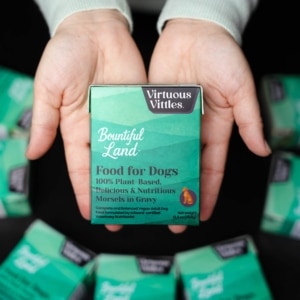
This is so easy, I love how you can just cut this open, lickety-split, boom, there you have it. This is their base. You see, that’s 100% plant-based.
There’s my sundae. The virtuous vittles, she just loves them. Check that out.
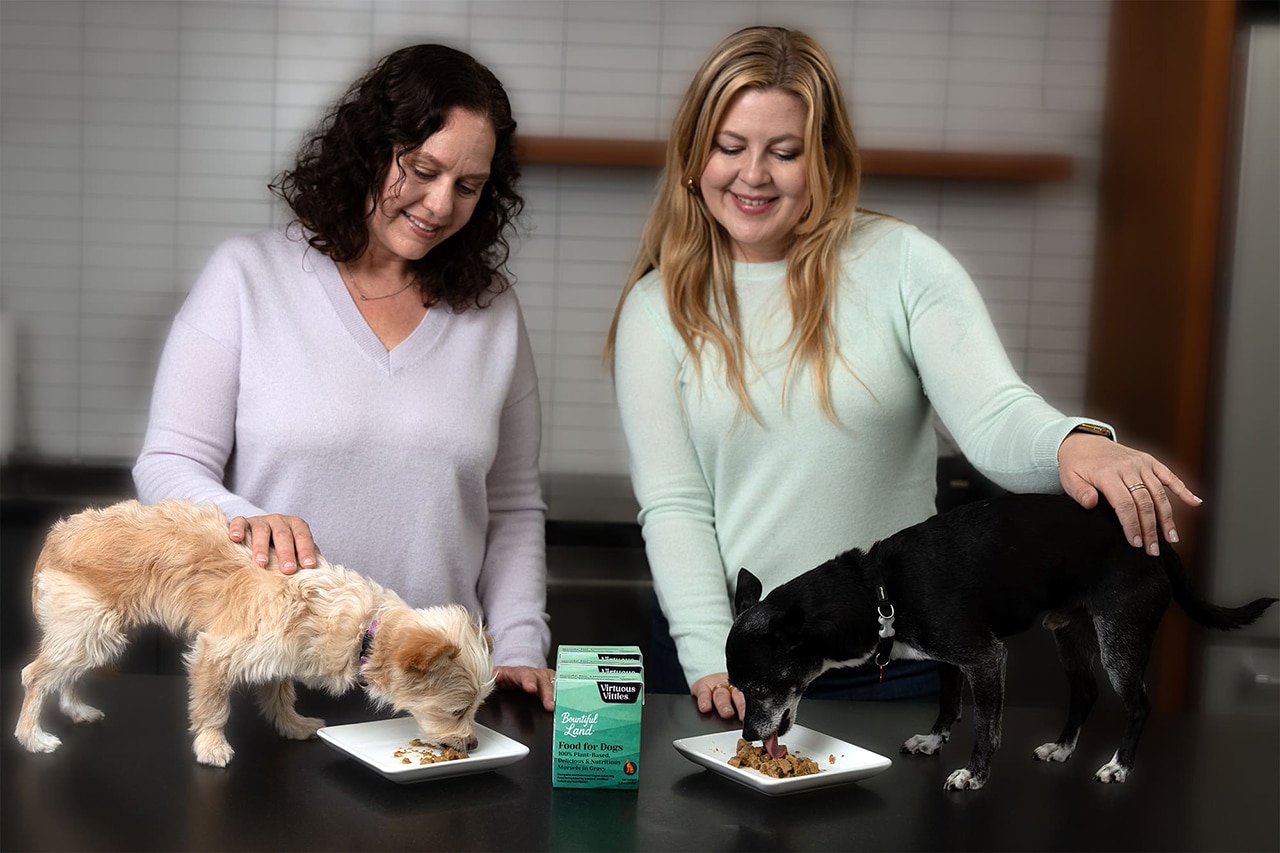
Here’s sundae on the right, and Wednesday on the left, jowling down on her virtuous vittles, they just love it. You can see, they are just, mmm, just look at them eating away. There’s my sundae.
She just loves it. There she is, jowling down her virtuous vittles. And here is one of your biggest fans, Wednesday Velez Mitchell, who loves virtuous vittles.
And I have to tell you, my other dog, as you saw, does as well. So we’re going to be talking virtuous vittles today. I stumbled upon this product at an event where somebody, one of these fabulous co-founders handed me a box, and I went home without much of any expectation, put it in a bowl, and oh my God, my dogs went crazy.
I believe they think it’s meat, but it’s not. It’s 100% plant-based. So we’ve got the co-founders here today.
We’re so excited. Let’s start with Brianna Schweitzer. Wow.
What makes this product so meaty and makes the dogs dive in thinking that they’re actually consuming meat when it’s 100% vegan? Yeah, well, so we do actually, we’re the first and only on the market with a meaty morsels and gravy. So we make a plant-based meat and we chop it up and we put it in a delicious, hearty gravy with also a bunch of fresh vegetables. And it was developed over the course of collaborating with Ziggy, my little one.
We really looked at what Ziggy loved to eat. I watched him carefully with all sorts of different ingredients. We also built it foundationally from whole foods, looking at the nutrients in each ingredient and how they would contribute to what he really needed.
And so I think all of those things together just really make it irresistible to them. Dogs can taste quality. Yes.
And over the course of this show, we are going to actually open a case and show you the little nuggets inside. I believe they are made from seitan, which is also known as wheat meat, Brianna, but correct me if I’m wrong. Yes, it’s a version of.
So vital wheat gluten, which is 90% protein and has a really great amino acid profile, very similar to meat. We mix that with some pea protein and with yeast proteins in order to get a balanced blend. So it’s like seitan, it’s very close, but a little bit different.
Wow. This is so exciting. Now, how did you two powerhouse women come together? I know you’re longtime friends and you have somebody who’s really good in the kitchen, Brianna, and then you’re an attorney and a startup expert.
Wow. My head’s exploding. Tell me all about it, Lisbeth.
So Brianna and I have known each other for over 20 years, like almost 25 years. And we talk to each other constantly on the phone. And she had been working on this for some time.
And it was so exciting. She, you know, she just had come up with a formulation and we just started getting together and said, you know, we need to get this out. So this was like several years ago.
So we, she actually went and got a canning because we figured out what is the most sustainable way we can market this and put into a packaging. We didn’t want to do fresh frozen because, you know, all of the environmental aspects of having to keep it cold and frozen and all of that, we wanted something that was shelf stable, that was, you know, that was whole foods that can seal in all of the delicious nutrients without having to do a lot of processing. And so she actually went and got a canning machine and tried it at home.
And then we sent it out to friends to make sure that that wouldn’t affect the taste of what she’d already come up with. And then we were like, let’s do this. And it took us so long to find a co-manufacturer that could do it human grade, that could do it with a whole foods that could handle the texture of the meat and then still also be able to scale up as we grew.
So it was a hard work, it’s a passion project. We’re so excited we’ve gotten here and we just launched. All right, well, I got to tell you, you’ve got some fans in this audience.
There it is. You can see that it looks meaty. And I’m going to also show you one of the number one fans.
This is my dog, Sunday, my incredible rescue. She’s very smart, but she’s also quite finicky. Wednesday, she’s just, you know, put it in front of me.
But this one is a discerning connoisseur and she loves virtuous fiddles, don’t you, my dear? OK, I’m going to let you run along. Now, what I really like about it also is look at this packaging. You have sustainability in mind and tell us a little bit about the connection between climate change and the consumption of meat by dogs.
I have heard wild statistics like if dogs were their own country, they’d be the fifth largest meat eating country in the world. I don’t have any confirmation, but I know Lisbeth and Brianna, Brianna, you have some hard stats on that. I think it’s very important because people when if you’re vegan and you’re feeding your dog a human’s worth amount of meat, you’re kind of undercutting yourself and self sabotaging.
That’s right. Yeah. So a stat that I didn’t even know when we first started is that twenty five percent of the meat proteins in this country are consumed by our cats and dogs, which is just a mind blowing number.
And you’re totally right. The stat is that a 50 pound dog eats about the same amount of meat per year as the average American. And we all know that Americans are extremely heavy meat eaters on average.
So it’s really a striking amount of savings that you can get just from switching. I mean, going vegan is aside from having not having children, which is actually the number one thing you can do to affect climate change, but which is obviously changes one’s lives quite a lot. The second largest thing you can do is changing from a meat based diet to a plant based diet.
And that goes same for humans as for dogs. So it’s really, really impactful. And just a huge, huge savings.
I calculated that switching my 10 pound Chihuahua Ziggy, who’s also quite picky and was inspiration for this, to a plant based diet from a conventional canned meat based diet saves basically an equivalent of like flying around the world per year in CO2 emissions. So it’s really, really striking. Yeah.
And I want to say that I’ve been looking into this. It’s a fascinating story. You can learn all about it by going to VirtuousVittles.com. Their story, which we’re going to dive into more, is on there.
And also they’ve got this bountiful land for dogs sampler pack for twenty dollars. Now, this is a perfect way to introduce yourself and your dog to this because you’re investing 20 bucks. I got to tell you, I was handed these two packets at a party and I went home, like I said, and I didn’t have any expectation.
And my dogs gobbled it up and I was like, whoa. And it really is the chunks that are in there. Plus the sauce, it has a meaty flavor.
I’m joking sort of when I say don’t tell your dogs it’s not meat. They don’t know it’s not meat. So tell us about I want to go way back to when you first started this.
You’re a vegan. You love animals. You’re cooking in the kitchen, but you’re struggling to get your dog Ziggy to eat the vegan dog food.
Pick up the story from there. Yes. So so I’ve been I’ve been plant based since I was 12 and I one day decided I didn’t want to eat animals, kill them anymore.
Within a year, I read Animal Liberation and became vegan. So I’ve even had had vegan cats for three years, quite a long time ago. It’s a very intensive process to do that.
And you very, you know, you have to really pay attention to what you’re feeding them when you home cook their meals. So so anyway, life got busy. You know, we’ve gone back to conventional food in the house.
Then I got my first dog about 10 years ago and I would buy conventional food when I was too busy to cook for him. And so, you know, about four or five years ago, I just said, OK, this is enough. Let’s go with a purely plant based diet, you know, never use the conventional food.
And we tried everything on the market. And he is admittedly a picky chihuahua, very opinionated. And I just struggled with the canned foods that were on the market.
So but, you know, I would cook an impossible or a beyond burger and he would be all over me or I’d make a delicious homemade meal for him and he’d be all over it. So it wasn’t about plant based. It was really that we just thought that it wasn’t for his taste buds, at least.
So that was the genesis. And that’s how we started our collaboration with him. I don’t know if you got the actual package open.
I’d like to show people I want to show people like what’s in there, because what happened to me was when I saw it, if can you open it? Yeah. Yeah. Open it.
Because when I saw it and I was like, what what makes this different? And then I really started looking and there were these little chunks. They want that those little chunks. Now, there is incredible nutrition.
I’m going to play a clip from a doctor while you get that ready. I’m going to play a clip from a doctor, Dr. Sarah Dodd, who is an expert in plant based nutrition for dogs. She’s written numerous published papers on this subject.
Let’s hear what she has to say. We actually see there’s a number of therapeutic diets that are plant based that are intended to manage a number of conditions. So a lot of people recognize skin allergies and some dietary sensitivities that can be resolved with switching to a plant based product or a therapeutic product.
And we also see, for example, conditions like liver disease and in some cases kidney disease that can benefit as well from particularly the kind of plant based proteins and the different kind of fatty acid profiles that are available in plant based diets. And one of the mantras is nutrients matter, not meat. Explain.
Exactly. So it’s very different when we talk about feeding companion animals. So in the USA, there is an organization called the Association of American Feed Control Officials, and they set the standard for the industry on what sort of nutrient profile we want to look for.
And so when we’re feeding a plant based diet to dogs, it’s really no different from the essential nutrient perspective than it is feeding an animal based diet. In fact, if you go and look at the ingredient list on a number of products out there, you’ll see a lot of the nutrients are already coming from plant based ingredients or non animal ingredients. And so feeding a plant based diet that meets that same essential nutrient profile really doesn’t have much of a difference.
The ingredients are different, but the nutrients aren’t different. And so it’s really focusing on providing that essential nutrition regardless of where the ingredients are coming from. Wow, that was a great explanation.
So we really don’t have to be afraid of this because some people, you know, it’s just like the general public. We’re not getting the information about the value of plant based foods, human or animal, because mainstream media is controlled by its advertisers. And who are the advertisers? Big meat, big dairy, big pharma.
So all the positive advantages of plant based are simply ignored. That’s why we started Unchained TV. I was in the mainstream media for 35 years.
I’ve been behind the curtain. I know what it’s like. So that’s why we we really try to show people that plant based nutrition is a completely valid thing.
Don’t listen to all the hysteria because there’s a lot of false information out there. What I call alternative facts. Take it away.
Show us, Brianna, the actual chunks that make this so salivating for dogs. There we go. So I put some out on a plate and there are there’s chunks of veggies in here, too.
But I’ll pull out a little meaty chunk. Stick it right in the camera so people can see. Let’s see if I can.
Yeah, that’s OK. You realize it’s a little sloppy, but this is what it is. There it is.
That’s the little chunk. Yeah, that is the chunk that the dogs, right. And you know what you were saying.
And it’s human grade. I see you. Yeah, it’s pretty good.
I mean, you know, it’s made for a dog’s taste buds and flavor profile. It’s not very salty. It’s not very spicy, but it really has a rich umami flavor and it’s totally safe for you to eat.
It’s human grade, made in a human grade facility with human grade ingredients. So, yeah. And so I’m just wondering how you hit on this jackpot, because I know so many people have been trying it.
And, you know, listen, I love all the vegan dog food products. Like I’m friends with V-Dog and their kibble and their treats. My dogs gobble them up.
And ditto for Wild Earth is incredible, incredible kibble. But this is a unique product. It’s not an either or.
It’s an and. OK, and that’s how I approach it, because I feed my dogs V-Dog and I feed them Wild Earth and I feed them a Halo and all sorts of other plant based treats. I mean, yes, they’re spoiled.
OK, I’m a helicopter dog parent. But this is a unique product that is different than every other product on the market, because it’s like taking your dogs to the Four Seasons, cuisine wise. Thank you.
We’ve heard that. We’ve heard that it’s elevated dog food. So yeah, that’s a direct quote from one of our from one of our customers.
And yeah, we are like we are all about variety. We’re so glad that there is a good number of people in the market already. It’s, you know, dogs just like us, they want variety and to be able to have different textures and flavors in their lives.
So we love, you know, we’re just we’re joining a community and we’re happy to be here. Yeah, and I want to go to some of the comments now. Nilo Farr Asgarian says, I have 400 pounds of rescued dogs distributed in four rescue dogs.
So she’s got four rescues. I use Natural Balance vegan formula. Is your product affordable? So let’s talk about affordability for a second.
Yeah. Who wants to hit that? We could probably add on to it a little bit. I can start.
So we worked hard to try and make this as affordable as possible. But I mean, we are going up against 20 subsidized, 25 cents a pound chicken that’s on the market. And so, you know, we and we wanted to have a human grade.
We wanted to have healthy. I mean, and the more I mean, we’ve gotten as many organic ingredients as we could from a price perspective, as many GMO ingredients that we could. So we you know, one box is seven dollars.
If you get a subscription, you can get that down. And then we also have 20 percent off of the first shipment and all the shipping is free. So you’ve got to keep that in mind.
We don’t add that to your order. And then you can also use it for a topper. You know, if you don’t want to use just all virtual spittles and or just all wet foods, you can use as a topper on kibble.
And we think it’s a really healthy alternative. And anything that you can do to reduce your meat consumption, anything you can do to give your dog more wet food and whole food ingredients is going to be a plus. I want to jump in.
We got a comment from Melissa Cromwell. And we welcome all comments. This is not a judgment against your comment, but this is what I would call misinformation.
She says, I thought dogs and cats were meat eaters. This diet couldn’t be healthy for them. It’s a not natural way of thing.
Now, we had we just had the vet on a veterinarian talking about how it’s the nutrients. It’s not the meat. It’s the nutrients.
And here’s what we’re talking about. They’re more than 90 percent of food allergies in dogs, Melissa. And we appreciate you coming on and and asking questions and challenging us.
But more than 90 percent of food allergies in dogs are caused by animal based proteins like beef, dairy and chicken, not plant ingredients. Brianna, do you want to expand? Yeah, I’d love to. Yeah, I mean, it’s such a common misconception.
So dogs are, in fact, nutritional omnivores. Wolves are also nutritional omnivores, although their diet consists of more meat than the average than dogs certainly need or is good for them. So dogs have co-evolved.
Our domesticated dogs have co-evolved with us for 40,000 years. And we definitely know that plant based diets are more healthy for humans. The because they’ve co-evolved with us, they their genetics have actually evolved alongside ours.
So where wolves have two points on the genetic on their two alleles is what they’re called on their in their genetics that are used to to direct starch digestion. Humans have 22 and domesticated dogs have I forget the exact numbers, but it’s it’s like 14 to 22. So they’re really much more like us.
They can digest digest starches and plant based materials quite easily. But moreover, it’s really that it is about the nutrients, not the not the not where the specific ingredients are coming from, whether they’re animal based or plant based. Plant based nutrients are just as bioavailable.
And they are they also come with a lot of benefits that meat based ingredients don’t have. For instance, a lot of the antibiotics and stuff that goes into our meat production is not found in a in a clean plant based protein. All right, and we’re going to go back to the doctor, Dr. Sarah Dodd, again, a very well known, renowned veterinarian who’s written numerous papers on dog food in general and plant based dog food specifically.
Here she is talking about nutrients. Now, I also wanted to ask you about the ingredients and the nutrients in Virtuous Vittles. Let’s take a look and give us a breakdown on this.
Sure. So Virtuous Vittles contains plant based protein exclusively, so there is no animal protein in it. And yet we’re still meeting the same essential amino acid requirements and the total protein requirements, not only meeting, but greatly exceeding those that are required by dogs.
And yet it is entirely plant based and we can see that there’s other kind of beneficial aspects. So the fatty acid profile, for example, we have our balanced omega six and omega three fatty acids. We have naturally sourced vitamins that are coming from our plant based ingredients.
So they’re highly bioavailable and readily absorbed and useful for the system. Same with the minerals. We have like a seaweed derived calcium as opposed to synthetic calciums being added.
And so we can see that there’s great benefits from providing these natural plant based nutrients for our pets. And the proof is in the pudding. This is Sunday and she’s been on a plant based diet for more than two years.
And let me tell you something. This is one bundle of energy. We run and walk a mile and a half every day.
You chase balls, you fetch. And she’s as healthy as they come. And she goes to the vet regularly and they confirm that.
So here she is living proof, just like with humans. And, you know, one of the things that I want to mention is that there is this whole myth about the caveman. You mentioned that domestication of dogs is one of the hallmarks of human civilization and that the dog packs would follow the human nomadic tribes and eat the scraps.
And contrary to popular myth, the early humans who were nomadic were not eating steak and burgers, cheeseburgers and ribs. It was there’s no factory farming. It wasn’t that easy to find animals.
And now the later research, the new research of literally what’s between their teeth in the fossils has uncovered that they were primarily almost exclusively plant based. Occasionally they might grab a bison or something, but basically they were eating a lot of plants. Any thoughts on that, Lisbeth? Yeah, so, I mean, we mentioned earlier the alleles, but I mean, actually, even wolves were, if you look back at the history, they were omnivores, they weren’t meat eaters exclusively.
And, you know, and when you have a complete and balanced diet that meets all the nutrients, then there’s no reason that you can do you shouldn’t have a plant based diet. And one of Dr. Sarah Dodd’s studies actually looked at over 2000 individuals who were feeding their dogs plant based and it showed she just determined that it was statistically significant that there were, if you feed a dog a plant based diet for at least three years, that you can have an average life expectancy increasing by as much as a year and a half on your dogs, which is a lot for a dog. Yeah, because that’s seven years in human terms, right? So you’re adding 10 years to your dog’s life in human terms.
And we know, us dog lovers, that every second with our dogs counts. I mean, I’ve had dogs my whole life and they bring me so much joy, but when they do get to that end of life, it is the most crushing experience that I can personally tell you. About in my life, I think it’s interesting because people say we grieve more for our dogs because we have no conflicted feelings with any human being.
There’s a little up and down, a little conflict. So the grief is tempered by remember when they did that, but with dogs and cats and other companion animals and animals in general, there’s none of that because there’s unconditional love. And that’s it.
So we have some great stories on that really quick, Jane. So we we’ve been doing taste tests that are one bowl taste tests for our our dog food. And I have these two great stories with senior dogs that were not eating.
They were conventional diets, meat diets, were not eating their kibble. One of the dogs was deaf and blind, 14 years old. And I could see the ribs on the dog.
I opened up this our virtuous vittles soon as our package was open, this dog came flopping over. I filled up her bowl and she just gobbled a package, went, did these little wigglies on the couch and on her chair and her bed. I put some more in there.
She came back, she went through two packages. And then when we would mix the virtuous vittles with the kibble, she was eating. And so my friend was just so gracious.
She’s like, oh, my gosh, my dog is so old and and it hasn’t been eating. And now we can just have this extra joyful time with our dog because of your food. It was really touching.
Yeah. So that shows you that these dogs crave this food. And let me ask you about the transition, because first of all, we always say this is educational only.
Consult your veterinarian. But when you’re transitioning a dog from a meat diet, primarily meat to a plant based diet, what are some of the instructions that you would give somebody who’s making that transition? Yeah, that’s such a great question. And it really depends a lot on your dog.
So if your dog. So we we designed virtuous vittles really to be like delicious from first sniff, you know, from sniff to snarf right away. So there’s no need from that perspective, you know, from a taste perspective to give them any transitionary period.
But it depends. If your dog has a really sensitive stomach or is used to eating one type of food consistently, we find it’s better to do a gentle introduction. So, you know, start start with a quarter virtuous vittles, three quarters the food and kind of do transition over a week to 10 days just to make sure that their gut biome has a chance to catch up.
But other than that, there’s really no need. There’s the difference, as as Dr. Saradon was saying, the difference there isn’t really a difference in the amino acid profile and in all the essential nutrients between traditional dog foods and virtuous vittles. So there’s no you know, there’s no biological need for a transitionary time.
It’s kind of a tummy need, perhaps just a biome need if your dog is not used to eating a variety of foods. But if your dog’s used to eating a variety of foods, just you can just feed them a meal of virtuous vittles and they’ll probably snarf it up right away. Now, we always talk about here at Unchained TV, you know, environmentalism and plant based.
The New York Times reported on an Oxford University study that showed that heavy meat eaters, which is most many, if not most Americans, can reduce their greenhouse gas emissions footprint by 75 percent by switching to a plant based diet. So let’s dive in a little bit, because I think there is a disconnect. I think a lot of people think, well, these dogs have to eat meat.
Therefore, even if I’m a quote unquote environmentalist, even if I’m plant forward, which a lot of people say, and I applaud that we accept people wherever they are in the journey, my dogs have to eat meat. A, you’ve talked about why that’s just not true. But B, let’s talk about the environmental impact a little bit.
Yeah, as you just put up on the screen, it’s really shocking. Twenty five to 30 percent of the meat consumed in the U.S. goes to feed our companion animals. And that’s just, I mean, when I heard that number, I thought it was astounding.
But it’s, you know, it’s verified. And as I said, with Ziggy at 10 pounds saving enough CO2 that, you know, you could fly around the world the whole time. I’d rather take a vacation around the world than feed my dog meat, meat, food.
If the environmental or the CO2 savings are the same. So it’s really an impactful way that if you’re looking to just reduce or mitigate or be plant forward and reduce the overall impact of your whole family with regards to CO2 emissions is a big one. But it’s also, you know, land use, water use, species, the species of the world.
So, yeah, extinction. Yeah. Thank you.
Yeah. I mean, it’s 80 percent of the Amazon. One of the thing that we see going on.
Oh, sorry. Go ahead. Go.
OK, sorry, I thought it was a little bad, so I thought you were finished. One thing that’s been happening and we were talking to Dr. Serdot about this is as as guardians are starting to try and get healthier foods for their companions, they’re turning away from what was originally in the meat industry. Just I mean, the meat industry for pet food started out as being just the worst of the worst.
And just the extras that were not being used for human consumption. But as as guardians are turning to healthier alternatives for their companions, then that’s exasperating the the impact on the climate. Because now we have our dogs and our cats eating human grade food and competing with that.
And so instead of using the the extras of the meat industry. And so that even has a bigger impact on the climate. So turning to plant based is really a really great alternative to address that issue as well.
And we know you guys are saying I got five dogs in my immediate family and they all eat a plant based diet. Yeah. I mean, look, there are thousands, hundreds of thousands of examples, because as vegans grow as a percentage of the population and they become hip to this possibility that you don’t have to listen.
I’ve been vegan 30 years. I didn’t know this. When I started, I didn’t know that dogs could survive on a plant based diet.
So I’ve had dogs that weren’t plant based. But I’m so thrilled personally as a person who is a plant based to not have I’ve got a sign. It says, welcome to my plant based kitchen.
I don’t want to have meat in my house. Exactly. Bringing meat into my house.
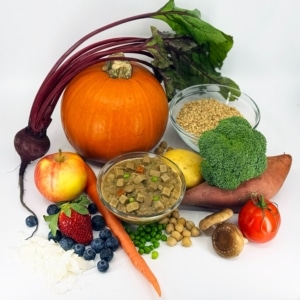
I don’t like to go to dinner with people who are eating animals. So why would I want to serve it to my dogs? I want to read or you can the ingredients here, because I think that people are interested. And so I’m going to just quickly run through it.
It’s long, but I think it’s worth it. We’re talking vegetable broth, potato, sweet potato, apple, coconut oil, wheat gluten, coconut aminos, carrots, pumpkin, spinach, olive oil, pea protein, green peas, yeast, beet power, chickpea flour, calcium from red algae, amino acids, taurine, agar, apple cider vinegar, choline chloride, dried kelp, fruit and vegetable blend, carrot, apple, tomato, shiitake, broccoli, orange, cranberry, pumpkin, beet, tart, cherry, strawberry, blueberry, green algae, minerals, phosphate, selenium, yeast. So, oh, my God, that’s a lot of work.
When you said that this was the home recipe, wow, and everybody’s saying this is exciting. Yes, I think it’s a breakthrough. How did you come up with this combination? Yeah, so, well, we started with a very, very complex spreadsheet, to be honest.
I took all of the ingredients I was working with and went to the FDA website, got all of the micronutrients into a spreadsheet and literally just like worked it and worked it and worked it because it was really critical for us that we didn’t just have a base and then throw a bunch of synthetic vitamins and minerals on top of it in order to kind of make it a complete meal, which is really common in the pet food industry at large. So what we did instead is really build foundationally from the nutrients found in every one of these ingredients and put them together so that they formed a complete and balanced meal. And of course, we brought in Dr. Sarah Dodd, who massaged and helped and brought it to fruition with her much more sophisticated knowledge and software.
But yeah, I want to ask you about the taurine, because people are always talking about taurine, taurine, taurine, and they equate it with animal products. And I’ve even had people say, well, you know, dogs need taurine. Well, you’ve got taurine here.
How did you get the plant based taurine? Yeah, so taurine is actually one of only two synthetic ingredients. It is available from plants. It is extremely expensive from plants.
So that was one area where, you know, in conversation with Dr. Dodd, this was a decision that was a perfectly healthy and strong decision to be made. We add it in our dog food. It is actually not it’s a it’s a it’s a nutrient that dogs do synthesize on their own, like humans do.
Like humans don’t actually have a taurine requirement. Cats do. Cats don’t synthesize it on their own.
But dogs and humans do. Even so, we added some because it’s just basically a good, you know, a healthy we we designed this food to for long term health. We also designed it for urinary health, which is another thing that is makes it completely different than anything else on the market.
Currently in the plant based space, we found that, you know, so dog urinary issues are very common. They’re not actually commonly diet related. But once your dog does have a urinary issue, it can be assisted with diet.
And that’s a diet that has a balanced mineral content and and a high moisture content. So we designed we we formulated with Dr. Dodd for urinary health. And yeah, just kind of every choice that we put into this food was to was for health.
OK, so Ruta is saying, I can’t wait for Virtuous Vittles cat food to come out. But guess what, Ruta, we have a surprise for you. Tell us about that.
We focused on the dog food, but tell us about and there it is. There’s the chunky beefy. They don’t know it’s not meat.
Tell us about the cat food. It’s coming. It’s coming.
Cats are like so much pickier. So so we we have some formulas. We’re in the final stages of kind of of getting them just perfected.
I mean, so like with our with our dog food, that this is a little known fact that in order to call in order to use the word delicious when marketing a dog food or a pet food, one has to for dogs achieve 80 out of 100 dogs snarfing up the food within 15 minutes. And there’s a bunch of like little requirements. It’s a it’s a it’s a real test that the FCC requires.
So for cats, that’s a little bit lower of a number for dogs. So we actually have a ninety five percent delicious rate with our dog food. And for cats, we are like we’re just we’re striving for this for the same.
So so we’re doing final micro tweaks each time. We’re making a test batch, sending it out to a bunch of cats we know, getting feedback and tweaking the recipe a little bit more. We’re very, very close.
And we are thinking that we’ll have one come out hopefully in just about four or five months from now. Wow, well, this is so exciting, everybody. I just want to say bravo to creating this.
These are the co-founders. Go to Virtuous Vittles. And there is a great little what would you call it? Special offer.
You can get the packet for twenty dollars. You can test it out. Get tails wagging with a generous trial pack that includes two full size twelve point five ounce cartons of this incredible Virtuous Vittles product.
I just think you guys are fantastic. Congratulations. My dogs are loving it, as you saw at the top of the show.
And I just want everybody to share this out so that we can be part of the solution and live in a world where our animals are happy. We are happy. And look what Tina Walker says.
Can’t wait for that because my Lucky is getting off his food. OK, there you go. Cat food as well.
Yay. Everybody’s moving on that. See you next time.
Share this out, people. Let’s let’s solve this climate problem with delicious, delicious Virtuous Vittles dog food. So it’s a vegan Netflix.
OK, that’s the craziest thing I’ve ever heard. I love Unchained TV. Unchained.
Unchained TV. Your life will change. It’s just that easy.
Unchained TV has all sorts of content for everybody. Unchained TV changed my life. Unchained TV is crushing it.
I love Unchained TV. Unchained TV is my go to. Unchained TV.
Who knew? Unchained, baby. Yeah.