[Speaker 1]
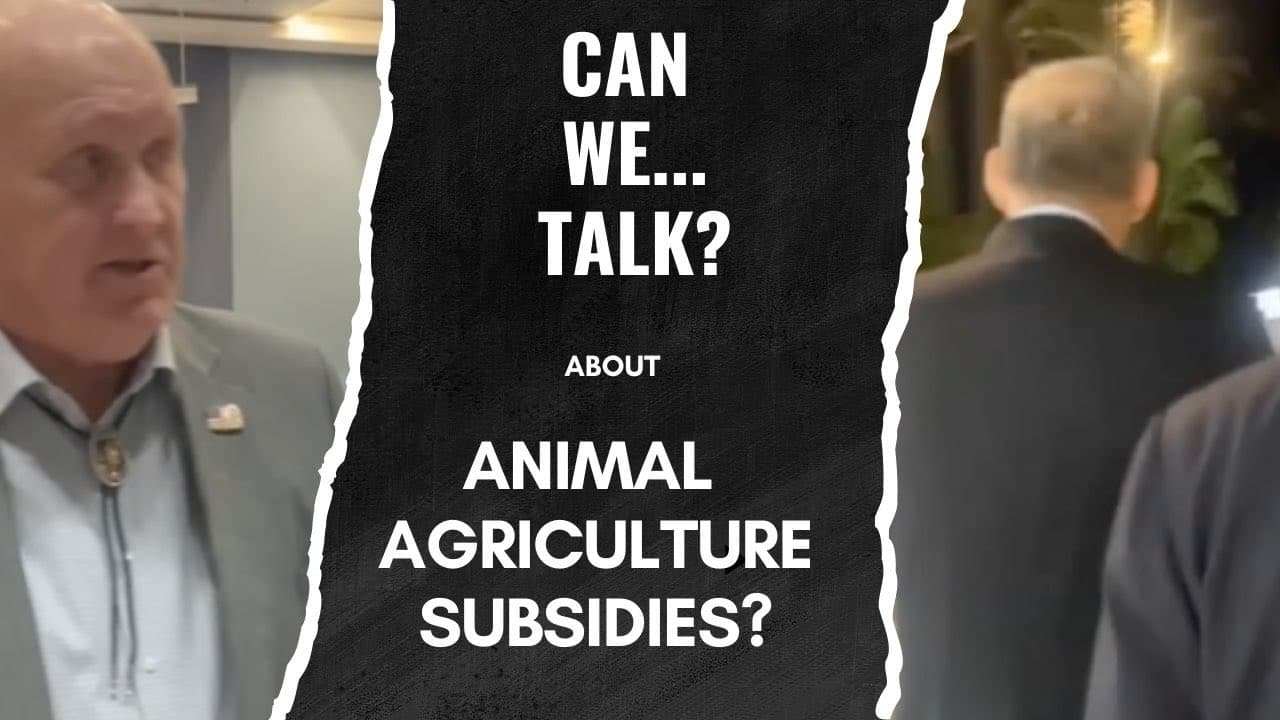
Can we talk? Apparently, either not at all or not very much when it comes to talking with our representatives, members of Congress, Senators, who are at a major convention regarding animal agriculture. There is the guy from Free From Harm who tried to have interactions along with his associate Ariana, the two of them really trying to reach Congress and talk about animal agriculture.
So you had this opportunity at this convention. And let’s talk about how it went, because these people work for us, hypothetically. And you were asking some very specific questions about, hey, why not promote plant-based foods for human health?
What was the general response you got, Robert?
[Speaker 2]
Well, you know, from what I could see in the videos, the general response was either, hey, we’re not partial to animal ag. We support all forms of agriculture. But the reality is, is that, you know, animal ag receives, what Cory Booker once said, about 93 percent of the subsidies support that industry, and only 7 percent go to all the other crops that are grown for human consumption.
So you tell me, is that equitable? I don’t think so. I don’t think anyone in their right mind would think that that was equitable.
The reason why animal ag is such a subsidy hoard is that it costs a lot of money and resources to raise huge animals and millions of them. And they have a lot of disease, and they have a lot of external costs that they can’t afford. So they, you know, Congress is essentially helping them by using our tax dollars to cover a lot of the costs that they want to externalize.
[Speaker 1]
So you, your team, Free From Harm, went to the American Farm Bureau Convention to essentially try to talk to members of Congress. And we’ve got the clips, we’re going to play them for you right now, of you really attempting to talk to these members of Congress about animal agriculture. Let’s see how it goes.
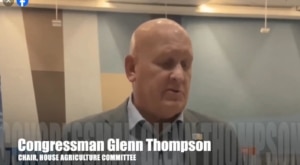
We’re going to start with the person who is the chairman of the House Agriculture Committee. I just want to ask, do you believe more support is needed for producers of healthy, plant-based food?
[Speaker 3]
Yeah, I mean, whether it’s, I don’t discriminate as, personally, as chairman of the House Agriculture Committee on the size of farms, or quite frankly, the commodities. And so whether it’s plants or livestock, it’s all important and all has a place on the American dinner plate.
[Speaker 2]
Right. Okay. So why are you advocating for billions of our tax dollars to bail out animal ag and the commodity crops?
We’re not bailing anybody outward. Quite frankly, those folks who grow plants, soybeans, corn, specialty crops, and there’s over a thousand different specialty crops, which are all plants and not near as many livestock.
[Speaker 3]
They’re all hurting right now. Thank you. Right.
[Speaker 1]
Thank you.
[Speaker 2]
All right.
[Speaker 1]
Well, first of all, we invite the American Farm Bureau Federation, any members of Congress, and any members of the agriculture industry on to comment at any time. We would love to dialogue with you. But Robert, I got to go back to you.
He says here, we don’t discriminate. We are for any kind of agriculture commodity. But that flies in the face of the fact that when you talk about soybeans, the overwhelming majority of soybeans produced are fed to farmed animals.
A lot of the commodity crops that are technically plants, yes, you’re producing plants, but they’re fed to farmed animals.
[Speaker 2]
That’s right.
[Speaker 1]
So he, as the head of the Agriculture Committee, he has to know that, right?
[Speaker 2]
Oh, sure. Yeah. He knows full well what we’re getting at.
And we’ve approached him several other times on the same issue. And this is the first time we actually got some kind of a response out of him, which was kind of shocking to us to begin with. But I mean, the bottom line is that, yeah, the commodity crops that he’s talking about, they’re used to feed livestock, corn and soybean, namely.
Alfalfa is another one. But yeah, and only 7% of the overall support from the government for plants, plant crops raised for human consumption. It’s around 7%.
And the numbers just don’t lie. He knows that. He’s legislated that in the past.
And that’s what’s continuing here in this current Farm Bill that they’re proposing. So there should be no confusion over this, right? And I think he’s obfuscating.
And he’s trying to say, oh, we support everyone equally. And of course, that’s not true. Not only is that not true by agriculture sector, it’s also not true in terms of scale.
The larger farms get most of the subsidies. The smaller farms get much less.
[Speaker 1]
But I have to say, and Arianna, I believe you were the person asking the questions. And I think you did a great job. Because with all of the interactions you had with members of Congress, you stayed cool.
You stayed polite. Nobody can accuse you of being abrasive. Um, he actually was the best response in terms of numbers of words uttered.
So we’re going to get to the ones that did not say a word and just walked away from you. But what was your response? What was your gut reaction to this, this idea that he’s saying, oh, you know, we don’t discriminate.
We love plants. We love animal agriculture. We love it all.
What was your gut reaction to that? Yeah.
[Speaker 2]
Um, I did appreciate that he actually answered the question. Um, but it’s known that we can live healthfully on a plant-based diet. And like Robert was saying, majority of these crops being grown are being fed to animals.
And you just imagine like how much land we could save, how much water usage we could prevent a ton of animal, um, suffering if we started supporting plant-based farmers. Um, so in my head, I was like, I don’t agree with that, but I wanted him to keep talking. So I was, um, I was like, yeah, but I a hundred percent, I don’t agree.
[Speaker 1]
So if you’re just joining us, the folks from Free From Harm went to the American Farm Bureau convention here in Southern California, I believe. And, uh, basically they tried to confront members of Congress politely and ask them tough questions. We know that, you know, the number of animals being killed for food continues to skyrocket.
It is in the many, many billions. Uh, in 2022, it was 75 billion. It’s now jumped to something like 85 billion.
We have a health crisis in this country with two-thirds of Americans overweight or obese, heart disease, a leading killer, skyrocketing colorectal cancer, skyrocketing cases of early onset dementia. A lot of that can be traced to diet. We’ve got a great film on Unchained TV called How Not to Die that dives into the connection between eating meat, which is packed with cholesterol, which clogs up the arteries and the connection to, uh, meat because plants do not produce cholesterol.
There’s only cholesterol in animal products. So you’ve got the health issue. You’ve got the environmental issue.
New York Times reported that heavy meat eaters can reduce their greenhouse gas emissions by 75% by switching to a plant-based diet. You’ve got the compassion to animals issue, 75, 80, 85. This is just land animals being raised in industrialized conditions and killed every year.
So the thing that gets me is that this is the most important issue we could discuss. It concerns health. It concerns the environment.
It concerns ethical issues. And yet it’s almost as if you’re being rude to want to talk about it. So let’s go to another member of Congress.
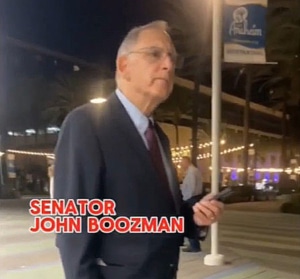
Um, this one is, uh, Senator Boozman. We’re going to hear this interaction that you had, Arianna, with him. And you can see somebody running interference, literally blocking the camera and we invite all of them on, but let’s watch this and dissect.
I shouldn’t use the word dissect. Analyze on the other side.
[Speaker 2]
Do you believe more support is needed for producers of healthy plant-based foods? So do you believe more support is needed for producers of healthy plant-based foods? Right on.
Okay. Um, so why are you, uh, just one more, I’m so sorry. Why are you advocating for billions of our tax dollars to bail out animal ag and the commodity crops that before animal agriculture?
[Speaker 3]
No comment. You said, why is that?
[Speaker 2]
If your position is to make Americans healthier, why aren’t you supporting healthy and sustainable plant-based options and food production? Why should taxpayers carry the burden for animal ag industries problems like bird flu, my friend? Don’t you think that these outbreaks like bird flu and screw worm are an inevitable outcome of the extreme conditions under which the industry raises and slaughters billions of animals?
[Speaker 1]
Wow. So that was another interesting interaction. Um, I want to go to Ariana.
What was your gut take on that? At least, uh, representative Thompson did talk to you and answer your questions. Um, albeit briefly, but he did give you the respect of answering your question.
This was just basically the cold shoulder, right?
[Speaker 2]
Um, I was kind of, I mean, I was expecting it, but I was also kind of shocked because these are people who are supposed to be representing us. And as humans were like trying to evolve or hopefully want to evolve. And if, um, I’m just like an everyday person.
Yes. I’m an animal rights activist, but I’m just a person. Like I, I am asking very valid questions to the people who represent us and use our taxpayer dollars to fund this industry.
So I feel like they’re very reasonable questions. And it’s kind of sad that we can’t even have a conversation with these people who represent us.
[Speaker 1]
Yeah. And let’s go to some of the comments that are coming in about this. First of all, love this as Tiffany.
Um, and it takes gumption and guts to do this, to basically speak truth or question truth to power. Uh, not an easy thing to do. Um, raping children, slaughter factory, farm warehousing.
This is one and the same for them. These are comments that are coming up. I am not, uh, filtering them or censoring them.
So this is what people have to say. Nilo Farr says, isn’t it interesting how they think they can ignore taxpayers when polite activists approach them? Uh, Ari so well-spoken Karen LaCava says this administration obviously does not care about the health of the American population.
They only care about money and power. And basically taxpayers are paying for the animal ag lobbies and this reelection campaign on top of money in their own pockets. All right.
Well, let’s see if there’s one more. Here we go. Sloan.
Thank you. These people are morally bankrupt, hence ag gag laws. Hopefully they will die off some.
Well, we don’t wish that on anybody. I’ll how important it is and how basically the deals are made, not in front of the cameras, not when the cameras are rolling or when the legislature state or federal is in function, but at these, these kind of get togethers. Tell us about this.
[Speaker 2]
Right? Yeah. So, um, this is the big annual convention of the American Farm Bureau Federation, which is arguably the most important animal ag lobbying front in the country.
And perhaps even the world, um, it shapes food policy. It shapes, it has a very heavy hand behind the scenes, um, in shaping the farm bill. And, um, the influence of the CEO Zippy Duvall can not be underestimated.
He’s one of the most influential people in our food system that no one’s ever heard of. Um, and the fact that they can bring in the top brass in Congress, working on farm and food policy that they fly in from DC to just to come in and do their, their speeches and make their promises that just tells you the power and influence that, that we’re dealing with. So there were thousands of people at this conference.
Um, and it was a great opportunity for us at free from harm, um, to, uh, to, to get in front of them because, you know, our, our simple belief is this. We believe that in a democracy, um, or any kind of representative government, that the average working person should be able to access the most powerful people making decisions on their behalf. And when we do this, we’re showing our supporters, we’re showing the public that it is possible to access them.
And not only is it possible, but it’s absolutely imperative because if we want to protect our rights, if we want to protect a democracy, um, we have to do this work. It’s not even an option. We should, we have to be out there.
We have to be in front of them, holding them accountable.
[Speaker 1]
All right. We have yet another interaction with Ariana and this one. Well, let’s just play it.
This is, uh, representative Angie Craig, who I looked up, she used to be a journalist. So she knows that whole system of, you know, walk and talk, asking questions while you’re walking. Let’s listen to what happened here.
[Speaker 3]
Sorry, we’re on our way to another thing. Sorry about that. I apologize.
[Speaker 2]
It’s okay. It’s just a quick one. Um, do you believe more support is needed for producers of healthy plant-based foods?
Why are we advocating for billions of our tax dollars to bail out animal ads and the commodity crops that support animal ads? Nothing, my friend. I just want to have a conversation.
I know you’re on your way somewhere. We’ve got to get to another event really quickly. We can walk and talk, right?
[Speaker 3]
Yeah, we can walk and talk.
[Speaker 2]
We have time. If our position is to make Americans healthier, why aren’t we supporting healthy and sustainable plant-based food production? You guys want to give me your email so we can, do you work for an outlet or like a media outlet?
[Speaker 3]
Independent. Can we have our business card?
[Speaker 2]
Yeah, I’m happy to give you my business card if you guys want to. Um, we do work with like, you know, influencers and citizen media. Is this something like that because we’re wanting to speak with her?
Yes, so if you wanted to like set up a phone interview or even something on Zoom, you can reach out. It’s just we’ve had a very busy day and she’s got places to go. But yeah, so if you let me know just kind of like the who, what, when, where, that’s, you know, how much time you need, what topics you want to cover, what the outlet is or, you know, I use outlet.
[Speaker 1]
So please, if you ever have that meeting, I will, I promise you right now do another podcast with you and find out exactly what happened at that meeting. But what is what you would call the strategy here? You see three members of Congress.
One’s talking, but not saying a whole heck of a lot, but you got to give him credit for talking. The other one basically says one thing and then rushes off. And then the third one won’t talk to you at all.
[Speaker 2]
Well, look, as I said, you know, we in a, in a democratic system, we need to hold the most powerful people accountable. I don’t think anyone would argue with that. And, uh, it’s a, it’s a job.
It’s not a happy, you know, fun job. And it’s sometimes it’s a thankless job, but if you look at other movements, you’ll see the same kind of strategy where climate activists, uh, uh, pharma activists, uh, healthcare for all, where do they go? They go to the CEOs and the top leadership in Congress to demand the changes that, that society needs.
And we’re, we’re basically taking that cue from a very tried and tested and accepted strategy that the most powerful people need to be in the limelight. We need to, we need to make them front and center because consumers, yeah, it’s important to re to have consumer outreach, but guess what? Um, these big decisions and deals that are being made behind closed doors, um, are made long before consumers have any choices, um, when they go into the store.
Right.
[Speaker 1]
Of course. I mean, look, uh, they say, well, it’s the capitalist system at work. I personally call it corporate socialism.
The average hamburger would cost $30 or more if it wasn’t subsidized by animal agriculture, by government, by big government, um, everything from rounding up wild horses so that the cattle can have public lands to graze, um, to subsidizing the commodity crops that go into the feed for the animals. I mean, there’s a gazillion tax breaks and the farm bill is where a lot of it happens. And interestingly, they’ve been sort of dilly dallying on the farm bill now and extending it and extending it.
So there is this opportunity to have meaningful change in the next farm bill, but it’s a fait accompli when all these deals are done, uh, again, behind closed doors or at conventions or in social settings. Uh, I will say that many years ago, uh, I went with, and I believe it was the humane society at the time to talk to a member of Congress that had been elected with the support of environmentalists and animal activists. And it was at a time when there was this horrific scandal involving a slaughterhouse, one of the early, uh, undercover investigations that resulted in the closure of the slaughterhouse.
And we went there and we played this footage for him. And the reason we were able to get in is that we knew the person who threw a big party for him in Beverly Hills. And this was a member of Congress who was on our side, hypothetically.
And he looked at this shocking video of animal abuse in a factory farm setting, a slaughterhouse setting, said not a word and just wanted us out of his office.
[Speaker 2]
Right.
[Speaker 1]
Once you get in there, you apparently get the message that you start pushing it back against this industry and you’re done. I mean, uh, you’re nodding your head, Ariana. Yeah, no, this is a big moneymaker.
[Speaker 2]
And I think as humans, we get very stuck in our ways. And from my experience, the people who are on the side of animal ag, um, they’re very, um, against any change or movement towards a plant-based system, even though they might portray that they are like for little changes, but they’re not really for the big change that would really help people, animals, the environment, et cetera. Um, so that’s really sad that, that, that was the case that you even showed them the physical footage and then you’re met with get out, get out the door.
Yeah.
[Speaker 1]
Yeah. Well, it wasn’t said verbally to me, but we definitely got the impression. This person did not want to interact with me.
Um, even though I had met him at the party, right? So it was, it was just like a different person. And that’s what I think what happens is, you know, as soon as you get elected, you’re running for reelection.
And so, you know, it’s almost like a mathematical calculation that’s made. Uh, somebody said something about a where’s core. We know Cory Booker is vegan, but I don’t know that, uh, AOC is vegan.
I I’ve never heard that. I’ll check it out, but, uh, yeah. Um, this is a bipartisan problem by the way, of the people that we, the members of Congress that we showed, there was a Democrat, there were Republicans.
This has been going on administration after administration. Uh, I mean, correct me if I’m wrong. I see it as, as a bipartisan problem.
[Speaker 2]
Yes. Uh, it, it’s a bipartisan issue. And surprisingly, there’s some Republicans that are actually making bolder, uh, efforts to, to move in a plant-based direction than some Democrats.
So, um, you know, there are some promising developments happening and that we’re tracking, like for example, representative DeLauro, um, sent a letter with 33 signatories, other 33 other members of Congress that essentially said, Hey, we need more support for vegetables and, and fruit and nuts and, you know, specialty crap, what they call specialty crafts, right. Which is everything we eat. That’s not animal based.
Um, and 33 members of Congress signed on the last time I checked. Um, she wants, she is basically advocating that subsidies from animal ag shift to plant-based agriculture. It’s one of the first, uh, and probably clearest and boldest, uh, uh, messages to send to the industry and to Congress that, um, we need change.
And so we are rallying behind efforts like representative DeLauro’s, um, because, um, they’re starting to gain momentum. We have the plant powered meals coalition that is working on, uh, an act to introduce plant-based meals, which is spearheaded by a Senator Schiff and representative Velasquez. So there are some things that are really happening in the right direction.
And we just don’t want to, we don’t want to spoil people’s thinking that there’s it’s totally static because it’s not, there are good things happening, but we need to be there to show our support, to rally support from the public. We cannot take a back seat and just think that we can email our way through this. We got to be there.
[Speaker 1]
Yeah. And also I’ll point out, we just had switch for good on the Olympian Dotsie Bausch, uh, who was one of the leaders in getting the right for children in public schools to have plant-based milks. And now you don’t need a doctor’s note anymore.
You just need to know from your parent and they will provide plant-based milk. That’s a huge breakthrough because really my belief is that the dairy industry supports the meat industry. Most of the burgers, the cheap burgers are spent dairy cows.
So if we, and notably the dairy industry is propped up by the government, by trying to get institutions and schools and all sorts of, uh, institutions to get public dollars to push dairy, even though a huge percentage of it is thrown out the window. So imagine all these animals living torturous lives, having their breast milk stolen only to be discarded. It’s beyond morally bankrupt.
It’s also just stupid and self-destructive. Okay. Speaking of food, we’re saving the best for last.
Now, I just want to clarify, was this Robert F. Kennedy Jr. interaction at this convention?
[Speaker 2]
No, this was at the gym in DC where we found him.
[Speaker 1]
Of course, when it comes to R.F. Kennedy Jr., it’s got to be at a gym. God forbid. Of course.
He, you know, sit down at a desk and, all right, let’s, let’s check out this very short interaction with Robert F. Kennedy Jr. What do you think of factory farming, Secretary? Aren’t you worried about factory farming?
It’s making Americans sick. All right. Well, of course, priority number one, get into that gym and do some reps.
[Speaker 2]
Right.
[Speaker 1]
Apparently, he was just, last night on the news, they were talking about how he was jumping into some kind of a cold water tub with his jeans on. And it’s all very strange. Yes, you have a nice physique.
You know what? I live in LA near the beach. 90% of people around here have a good physique.
All right. It’s nothing that you have discovered the secret to a good physique. Certainly not with the upside down pyramid that he just pushed out, which tragically puts, as you can see here, steak, cheese, and milk at the very top.
So, you know, you talk about there are some positive developments, but this is a, an upside down pyramid. It’s the exact opposite of what it should be. What are your thoughts on that, Ariana?
Yeah, I, like many people was, we were shocked.
[Speaker 2]
Considering, like you said, that animal products contain cholesterol and also that they’ve been linked to heart disease, stroke, diabetes, type 2 diabetes. It’s concerning to know that this is like something that kids will see and think, oh yeah, that’s healthy. And I grew up eating so much fast food, so much, so many animal products and animals, and I would always have headaches.
I was overweight. And just what you would do to help suppress it is like take Advil or, you know, just pray it goes away, drink water, but you’re not getting to the root of the issue. And it’s scary that this is being pushed as something that is healthy when it’s the complete opposite.
It’s like devolving instead of evolving, like I was saying.
[Speaker 1]
Well, you, again, were very polite as the person who was going over there and asking these very powerful people to comment. And your question was, why don’t you support plant-based foods that people eat? See, they were doing kind of like a sleight of hand by saying, we support all kinds of vegetables.
There’s soybeans, there’s corn. Well, those are the products that are primarily fed to animals. That’s the same thing as saying you’re supporting animal agriculture.
What you’re talking about, Robert, is fruits, vegetables, nuts, grains, and legumes that people eat, like cauliflower, red cabbage, carrot, you know, those kinds of foods. They get almost no subsidies from the United States government. Just spell it out for people who don’t understand or don’t know this issue.
[Speaker 2]
Right. Well, you know, and RFK, if I can just say, you know, there’s such a level of disingenuousness here because, you know, for years he criticized factory farming. And now he’s asking the beef industry, he does a press release yesterday with the CEO of the National Cattlemen’s Beef Association, and they’re doing some stupid stuff.
And they’re basically saying we need to increase the beef industry. We need to increase the number of cows. So how does he think, he knows that factory farming is an unavoidable consequence of feeding millions of people and billions.
And yet he says he’s against it. He says he’s an animal lover. He talks about a humane nation, doesn’t treat animals the way we treat animals.
Well, then your guidelines are in direct contradiction to those values. And it’s pretty disingenuous. It’s really transparent.
And I see a lot of negative backlash to this already. I’ve seen, I don’t know if you guys have seen it, but I’ve seen a lot of negative backlash to his doublespeak. And I don’t think it’s, I don’t think he’s going to have much of an influence on this.
[Speaker 1]
Well, yeah. I mean, it’s very interesting to note that it could actually boomerang because of his unpopularity and the controversy surrounding him. I mean, we don’t even need to get into it.
There’s a gazillion controversies surrounding various things that Robert F. Kennedy Jr. is suggesting Americans do that is not backed by science. But you’re absolutely right.
He used to be a major opponent of factory farming. I believe he even filed suit as an environmental attorney against factory farming. So it’s extraordinary how he has changed his tune.
Now, let me say this. This is one thing that really bothers me and it applies to all of our lives as vegans and animal activists. If you say something politely and are ignored, then you might say something, especially when there’s lives at stake, human and animals, more urgently.
Then you’re accused of being inappropriate or too loud. But here’s an interaction with representatives, and I believe Free From Harm may have been involved in this somewhat tangentially, that a very concerned citizen was having over bird flu. I’m worried about that bird flu very much.
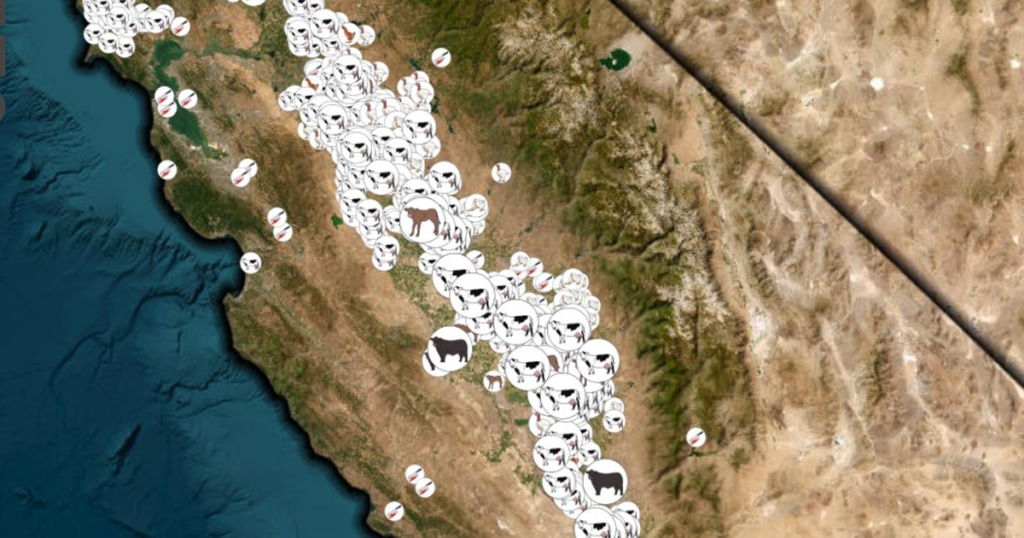
And I know that there are dead dairy cows infected with bird flu that lay along the roadside near dairy farms. The scavengers go after them. There’s no biosecurity or warning.
And that scavenger hut there actually spreads the disease, the bird flu, to wildlife, other birds and humans. How can the CDFA allow this? And are you putting industry profits over public health and animal welfare?
That’s my question. All right. So I know that you, Robert, have gone into the halls of Congress and been dragged out kicking and streaming.
Well, no, you weren’t kicking and screaming, excuse me. You were dragged out. I stand corrected.
But you were making your case. What I see that infuriates me the most is that it’s a no-win situation. If you go up the way Ariana did and ask politely, you get the cold shoulder or some kind of interference from some lower-level person.
You don’t get to talk to the people in power. And if you do it in a more forceful way, you’re accused of being extremist. There’s an inherent unfairness there.
[Speaker 2]
Right. And that speaks to the fragility of our system, of a democratic system that shuts out everybody except those that pay to play. And in the food system, it’s particularly ugly and apparent that when you go to these events or you go to these hearings, you look into the hearing room and all of the seats that are supposed to be for the public have a reserve sign on them.
Most of those people turn out to be industry insiders or lobbyists or people that have influence. So it is technically open to the public, but it isn’t really because there’s no seats and you can’t stand. So we decided at one point we were going to test the system and expose it for how bankrupt it was.
And we decided a couple of years ago to go into one of these highly televised Farm Bill hearings that Representative Thompson was overseeing and just walk in. They told us to leave because we couldn’t sit. We refused to leave.
And then we did disrupt the hearing because that was the only way to get the message out. I think that regardless of whether they speak to us or not, every time our message gets out, every time we make this effort to reach them, we are showing democracy in action. I know that sounds kind of cliche, but every time we do this, we’re showing that not only is this not needed, but this is a necessary thing in a democratic society.
And our food system, there’s so much at stake. There’s so much money at stake. And there’s so many animals and public health and all the other issues at stake.
We can’t afford to be missing in action.
[Speaker 1]
What just kills me is that we are in a situation right now where climate change is getting more pronounced. I’m actually working on a documentary right now with Dr. Silas Rao of Climate Healers, and he says we are barreling toward a really serious climate apocalypse-style situation, and that environmentalists and people who really study this in depth are just sounding the alarm. Well, you’ve got the United Nations COP conferences that are, I’m sorry, I’m going to do a little editorial here, a joke.
Somebody said, if you wanted to accelerate climate change, you couldn’t do a better job than what they’re doing. And you’ve got basically the powers that be, not just ignoring the environmental issues, but specifically completely downplaying or ignoring entirely the impact of animal agriculture on climate change, on habitat destruction, wildlife extinction, human world hunger. And so they’re playing with fire, literally.
I had asked Dr. Rao, the head of Climate Healers, well, what would it manifest like? Give us a sense of how could we visualize the climate apocalypse that you’re saying is coming towards us if we don’t get a handle on rising greenhouse gas temperatures, the temperatures from greenhouse gas. And he said, well, you saw the Pacific Palisades fire.
Imagine if thousands of those fires were going on simultaneously. And that’s like a wake-up call. The Pacific Palisades and Altadena fires should have been a wake-up call.
It doesn’t matter how much destruction happens, the mainstream media that is also completely co-opted by big meat and big pharma, because half the drugs that they’re selling, or even more than half, would not be necessary if people ate a plant-based diet, especially a whole food plant-based diet. So you have big meat, big pharma, big dairy, controlling, co-opting not just Congress, but the news media. Look at the commercials.
I literally cannot watch the news at night when I’m trying to catch up because these commercials are all about indigestion and this sickness and that sickness, literally almost entirely. You wonder, is everybody in America sick? Apparently.
And if people got healthy, well, you don’t see, let’s put it this way, you don’t see any commercials for apples or bananas or cauliflower or cabbage or microgreens. You don’t see that. So the point is, at a certain point, will these folks realize that they’re also spelling their own doom?
The other thing Dr. Rao says is that the economy lives within the ecology, not the other way around. And that if there’s an ecological collapse, that will also mean an economic collapse. Final thoughts, Robert.
[Speaker 2]
Well, you know, since you mentioned the dairy industry a little bit back, I wanted to point out, just to put things into perspective, a Canadian dairy industry did a study that found that the U.S. dairy industry relies on 73% of its revenue on taxpayer government funded programs, 73%. And they have an interest in getting those numbers right because they’re competing and trading with the U.S. dairy industry. So no other industry that I can think of enjoys that level of corporate welfare, 73% of its revenue.
And so there is a lot of potential here. Think about if we could just get 10% of those subsidies cut, that could wipe out their profit margin or a completely ban subsidies to have a huge impact. Even if we got them cut to 10 to 15%, we could have an enormous impact as a movement.
And I think we’re on the cusp of that happening.
[Speaker 1]
A follow-up question. The Farm Bill, it keeps getting kicked down the road. And we know it’s in the Farm Bill that a lot of these subsidies are packed in.
What’s happening with that? Is there any hope that we might see some kind of break in the Farm Bill? Or is it just going to be continued on and on?
It’s supposed to be renewed, I believe, every five years, but it’s just been constantly just being extended without a new Farm Bill.
[Speaker 2]
There have been some promising pieces of that Farm Bill to support specialty crops, the plant-based food crops for humans. However, sadly, there’s not a big shift yet in funding. And money is power, right?
It’s very simple for us. Money is power, and the subsidies represent the money. That’s where we need to see the fundamental change happen.
So you know what? The longer this Farm Bill gets delayed, the better it is for us. Because if they can’t agree on a funding package that continues business as usual, that supports animal ag to such a ridiculous level, hey, let them keep working on it.
And the longer it delays, actually, I consider it almost a good thing.
[Speaker 1]
All right. Well, this has been fascinating. I want to give Ariana, who was the woman with microphone, trying to talk to these members of Congress.
First of all, kudos for keeping your cool. You’ve got to jump in at that exact moment, or they pass you and you never see them again. So I know how difficult, as a reporter, I know how difficult it is to catch them.
And you did catch them. So what are your final thoughts on the experience of going to this powerful agricultural convention and trying to talk to some of the most powerful politicians on the planet about animal agriculture?
[Speaker 2]
Yeah, thank you. It is tough, and it’s not necessarily like a comfortable situation. But I want to encourage people to do it themselves.
It was just me and another activist. And it just took two of us and a camera to ask these questions. And the more that we are in these spaces asking them questions, putting the pressure on, that makes it less likely that they will run away from it, that they will actually start to address it.
It’s almost like we as humans, we need things repeated to us over and over. And I feel like the more, and Robert has said this before, it’s better that we’re here in these situations rather than not. The more that we’re in these spaces, the more we’re going to change.
So I just encourage people, if you’re scared, to do it anyways and to just try.
[Speaker 1]
Well, we have one more question that I think is important. So I’ll add, Paige asks, what can we as consumers do? Robert, you want to hit that one?
[Speaker 2]
Sure. I mean, consumers and supporters can do our digital actions which support our efforts on the ground to try to get in front of these powerful decision makers. So we do all forms of supporting that through the phone call blitzes and email calls to action.
If you’re not on our mailing list, that’s where you’re going to find these calls to action. You can join it at freefromharm.org.
[Speaker 1]
Fantastic. And I want to invite any of the members of Congress, the actual convention and the organization behind it, or anybody from animal agriculture industry, can we talk? I would love to dialogue with you.
And I’m sure our guests, Robert Grillo and Ariana would love to as well. Thank you for watching. Please download Unchained TV.
We are the world’s only plant-based streaming television network, a 501c3 nonprofit. We can’t do it without you. See you next time.
Unchained TV is my go-to. Unchained TV.
[Speaker 2]
Who knew?
[Speaker 3]
Unchained, baby!

 Los Angeles, February 20, 2026 — When activists from Free From Harm confronted members of Congress about plant-based food policy and federal subsidies for animal agriculture, they expected disagreement. What they encountered instead was evasion. At the American Farm Bureau Federation’s annual convention — where food and agricultural priorities are shaped—activists attempted to question top lawmakers about why billions in taxpayer dollars support animal agriculture while crops grown directly for human consumption receive only a fraction of that backing. The exchanges, captured on video and later discussed on UnchainedTV, reveal a widening gulf between public accountability and agricultural power. Host Jane Velez-Mitchell talked to Free From Harm’s President Robert Grillo and activist on the ground Ariana Azoulai about these awkward and revealing interactions with elected officials which were caught on video.