
LA Climate Week Epitomizes Bold, Plant-Based Climate Action in Motion
Share This
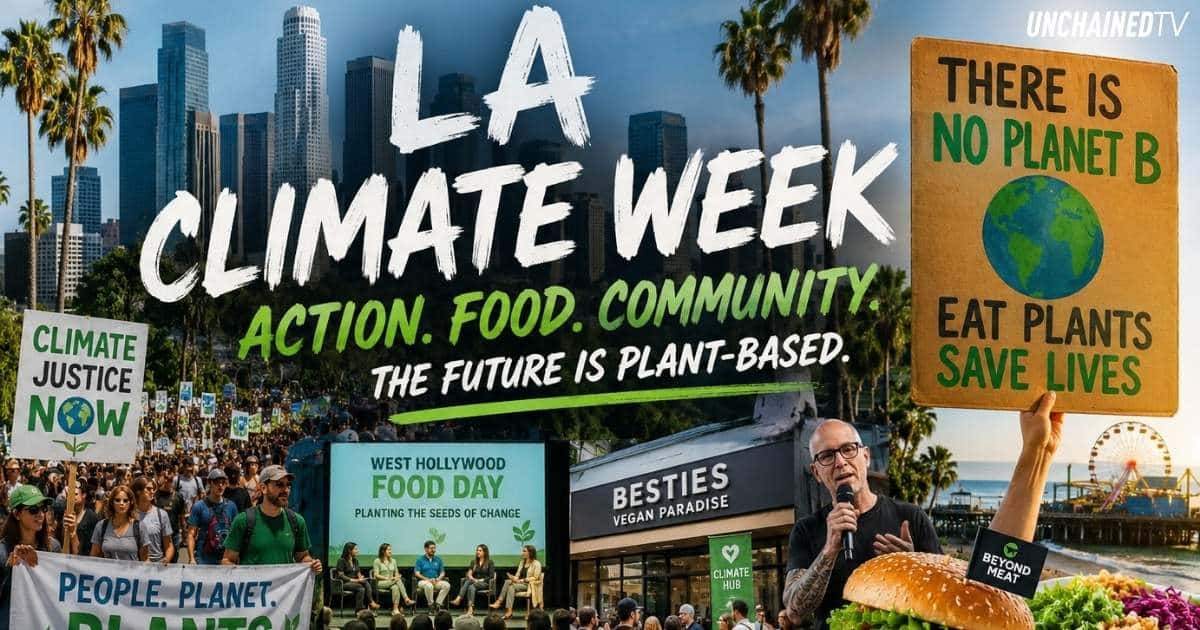
LA Climate Week epitomizes the rise of plant-based climate action, from its first historic event in 2024 to the many 2026 events including West Hollywood Food Day, the BESTIES Vegan Paradise Hub and Moby’s inspiring speech
Los Angeles, Ca – May 31st, 2026 – Los Angeles Climate Week has quickly become a major gathering point for climate action, and UnchainedTV’s video coverage shows why plant-based solutions belong at the center of the conversation.
UnchainedTV has followed LA Climate Week’s growth from its historic kickoff in 2024 to the slew of packed 2026 events. It’s been three years of head-spinning climate action including food policy panels, vegan fashion shows, marches, art exhibits, celebrity appearances and climate hubs like BESTIES Vegan Paradise. The result is a front-row look at a climate movement that is finally saying the “food” part out loud.
Let’s be honest: a climate event that refuses to talk about food is leaving one of the biggest drivers of the crisis conveniently off the menu — while still pretending the conversation is complete. LA Climate Week deserves kudos for consistently making its opening and closing ceremonies 100% plant based, supporting local vegan food vendors and encouraging vegan events throughout the week.
First-Ever LA Climate Week Puts Plant-Based Action in the Spotlight
UnchainedTV’s “1st EVER LA Climate Week” video – shot during the 2024 LACW experience – gives viewers a fast, energetic look at how Los Angeles turned its first citywide Climate Week into a showcase for real-world climate action. From downtown LA to Santa Monica Beach, from West Hollywood to East Hollywood, organizers bellowed a powerful message that too many climate events still dodge: food matters.
Right from the start, the opening and closing ceremonies were fully plant-based, and many events in between followed the same lead. LA Climate Week did not just talk sustainability while ignoring the menu. It walked the walk.
A recent Oxford University study reported by The New York Times found that heavy meat-eaters can reduce their individual greenhouse gas emissions footprint by 75% by switching to a plant-based diet. That is not a cute lifestyle tip. That is a climate solution hiding in plain sight.
And this is where LA Climate Week offers a real lesson to “environmental” organizations across the U.S. and the world. A climate event serving animal products is like a charity, seeking to cure cancer, serving cigarettes. The menu should not contradict the mission.
LA Climate Week Begins With a Plant-Based Push
For viewers who want the deeper backstory, UnchainedTV’s “LA Climate Week!” video goes inside the launch of the first Los Angeles Climate Week, held September 8 through 15, 2024. The event kicked off with more than 100 organizations, more than 100 events and 20 venues across Los Angeles, with more than 5,000 people taking part.
Plant Based Treaty raised the issue of food system change as a theme. Events included art shows, a vegan fashion show, a march on the beach and screenings of “Eating Our Way to Extinction” and “Eating for Tomorrow.” Many events also featured vegan food trucks.
That mattered then, and it matters even more now. Climate events love to talk about fossil fuels, and they should. But, if the conversation stops there, it is incomplete. Food systems are not a decorative side dish in the climate crisis. They are part of the main course.
It was not just another calendar of eco-friendly events. It was the start of a bigger question for Los Angeles and every other major city: if we are serious about climate action, why are so many municipal, state and federal food policies still stuck in the past?
Can Plant-Based Food Policies Save the Planet?
Every city official in the United States should watch the following panel. If local governments are serious about the climate crisis, plant based food policy should not be treated as a fringe idea. It is one of the most powerful tools available to fight climate change.
The central question was not whether plant-based food belongs in climate conversations. It was whether cities and counties are finally willing to stop treating food like a mere personal preference and start treating it like climate infrastructure. Menus are not neutral. They reflect values, budgets, public priorities and, too often, the political cowardice of leaders who want climate credibility without touching the dinner plate.
Panelists discussed how Los Angeles County is incorporating more plant-based foods into its massive food procurement and distribution system. West Hollywood’s declaration that it’s gone “plant-based by default” for city-sponsored events and meetings showed, by example, how cities can make that climate-conscious choice the starting point towards a truly sustainable food system.
Food policy impacts schools, hospitals, prisons, government agencies and other institutions that feed people every day. When local governments move toward plant-based procurement, the impact is not symbolic. It is structural.
LA Climate Week 2026: BESTIES, West Hollywood Food Day and Vegan Climate Action
By 2026, LA Climate Week’s plant-based message had grown louder, bolder and much harder to ignore. Plant Based Treaty’s West Hollywood Food Day drew thousands to sample vegan food, hear speakers and see plant-based solutions served up as real climate action — not as a side salad to the “serious” conversation.
That matters because the climate conversation has spent far too long treating food like the awkward topic no one wants to bring up at dinner. Leaders will talk about electric cars, solar panels and reusable straws all day long, but the massive deforestation, habitat destruction, wildlife extinction and pollution caused by industrialized animal agriculture remains one of the movement’s most uncomfortable truths. LA Climate Week helped drag that truth into the daylight.
BESTIES Vegan Paradise, a vegan restaurant and grocery store, became a bustling climate hub where food, activism and culture collided. Musician and longtime vegan advocate Moby spoke about the urgent need to confront industrialized animal agriculture’s role in climate change, putting the issue exactly where it belongs: in the center of the room, not hidden behind the recycling bins.
The week also brought a vegan cooking competition, a climate march with live music and plant-based food donated by Beyond Meat. It was the opposite of the tired myth that climate responsibility means joyless self-denial. Here, climate action had flavor, rhythm, community and a clear refusal to act like the future has to be boring.
The excitement spilled into the streets, where the climate march became part protest, part street theater and part community gathering. That is how movements grow: not through policy papers alone, but through moments people can taste, hear, join and remember.
With hundreds of events across the city, UnchainedTV’s coverage shows what happens when plant-based climate action stops waiting for permission and takes the main stage.
Climate Healers Documentary Debuts at LA Climate Week
A Climate Movement That Finally Talks About Food
The strongest takeaway from UnchainedTV’s LA Climate Week video series is that plant-based climate action is becoming harder to ignore.
For years, vegan advocates have pushed climate leaders to confront the role of animal agriculture and food systems. Too often, that conversation has been softened, delayed or pushed aside to avoid political discomfort. But, the events captured in these videos suggest that silence is breaking.
UnchainedTV’s LA Climate Week coverage shows vegan food being served, plant-based policies being debated, public officials engaging with the issue, celebrities using their platforms and activists bringing the message directly into the streets.
That is what climate action looks like when it becomes tangible. Not just pledges. Not just timid suggestions. Not just abstract goals for some distant deadline.
Food on tables. Policy on the agenda. People in the streets. Cameras rolling.
These videos offer a front-row view of a movement that is no longer asking whether vegan solutions belong in climate conversations. It is showing that they should be the main course.
Share This
About the Author: Brandy Walt-Rose


Latest News



Stay Tuned In
Be the first to know when new shows drop! Plus, get the hottest headlines, inspiring stories, and behind-the-scenes extras. Sign up and keep streaming!
you might also like

The provocative animal rights documentary Viral for the Animals is reaching viewers worldwide on UNCHAINEDTV with new subtitles, helping its message travel even further. Hollywood, Ca. - October 13th, 2026 - It’s called Viral for [...]

A federal strategy would gun down 450,000 barred owls. As shooting begins in Oregon, animal and environmental advocates are expressing outrage and charging the real reason is to help the timber industry. Los Angeles, CA [...]

PCRM celebrates $88 million in NIH grants for human-based research as FDA and EPA policy shifts mark a turning point against animal testing in 2026.