A Vegan City? Food as a Basic Human Right?
[Speaker 1]
An exciting experiment is happening right now in Port Townsend, Washington State, and it could take the world by storm. Here’s where it’s happening. Just about a two and a half hour drive northwest of Seattle, and it’s called Together Around Food, and the basic concept is that, well, vegan food, healthy plant-based fruits, vegetables, nuts, and grains, should they be a basic human right?
This entire concept is the brainchild of one of my heroes, Dr. Silas Rao of Climate Healers. Dr. Rao, how is it going?
[Speaker 3]
It’s going great. We started out slow for the first three days, and then yesterday we overflowed pretty much the room that we were in, and so we had to get tables from the other room and, you know, safety overflow people. So, exactly what we wanted, you know, things picking up like that.
And so now we are looking at new spaces that we need to go find to accommodate the people who are coming.
[Speaker 1]
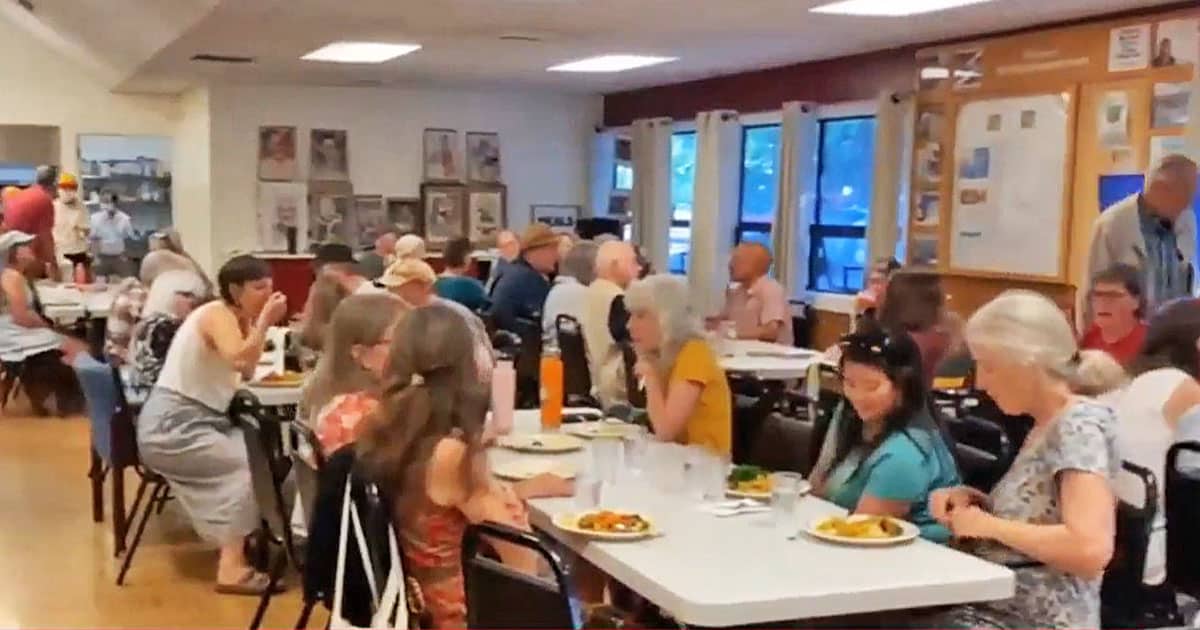
You are looking at a live cam on the kitchen where food is being prepared for a lot of people, and one reason that this can happen, because it is free food for anybody in the town who wants to take advantage of it. And when I say food, it’s not, you know, a meat burger and fries, it’s healthy plant-based food. Fruits, vegetables, nuts, grains, and legumes brought to us by Loving Hut.
So we want to go to the representative of Loving Hut, who is Mike Zanabria. Mike, tell us, wow, this is extraordinary. What’s happening?
What’s the who, what, when, where, why, how? Awesome.
[Speaker 2]
So we are here in Washington on the Olympic Peninsula at the Tri-Area Community Center, which is in a city called Chimicum, just outside of Port Townsend. And the goal with Together Around Food is, as you said, Jane, to showcase that whole food, plant-based meals that are gourmet, that are delicious. They should be served to the community, by the community, in a community center like this, free of charge, as a community project where anyone, breakfast, lunch, and dinner can come to their local community center and get a free, delicious meal that’s awesome for their health, great for the environment, great for the animals.
So this is really what could propel our world into world peace and the vegan world that we’re hoping that we are moving towards very quickly, especially since we are in the current climate crisis that we are all feeling the pressure of.
[Speaker 1]
Now, I want to make a very important point. Port Washington, Port Townsend in Washington State is not an impoverished community. We have a lovely resident who has agreed to join us.
There’s no major food insecurity, malnutrition, starvation. These are people who are taking part in this experiment as a test example of something that could expand to the rest of the world and some areas where there is food insecurity. So I just want to give a shout out to everybody in Port Townsend for taking a leap of faith.
And we’re going to go to Patty Schmucker, who is one of the local residents. Patty, what inspired you to get involved?
[Speaker 4]
Well, we had the opportunity here in Port Townsend. We have a community that is very environmentally aware. Port Townsend is a pristine environment, a rural environment.
And like every other community, we do have some food insecurity and we do have issues with homelessness and those kinds of issues. But we also have 55 percent of our population is over the age of 50. And we have a lot of people who have made their fortunes in other parts of the United States and have retired here.
So we have a very diverse population. I’m one of those. I’ve spent the last 45 years in Los Angeles and made Port Townsend my full time home just two years ago.
And my motivation to be involved is I know that we have a crisis. We have a crisis at many different levels with regards to what’s going on in our society and what’s going on with regards to our planet. And now is the time to act.
And this was for me where I’m feeling sometimes very hopeless about some of the things that are going on. This was an opportunity to lean in and be able to do something that I thought was impossible three weeks ago when we started this whole discussion. And yet the community has just embraced it.
The food has been amazing. The lectures and the programs that we’ve done has just really enrolled the community and has started a very important conversation of real substance.
[Speaker 1]
Well, for those who are just joining us, the concept is should food be a basic human right? And we’re not talking about fast food, junk food, cookies and meat burgers and french fries. We’re talking about healthy, whole food, plant based.
Should it be a right like air or water? This is the fundamental question being posed because after all, you can’t live very long without food. Now, we know that air is a right.
We certainly hope that water is a right. But since you can’t live without air, water and food, maybe food should be a basic human right. This is a radical concept and the test is happening now in Port Townsend, Washington.
You are looking at a live camera of this extraordinary experiment in progress live. So the question is, could this end up being exported to other towns? But even before we get to that, I want to talk about some of the really ambitious goals this project has.
And as I was looking at the website, which is, we’ll put it up in a second, I was blown away. I know Dr. Rao is an overachiever, but gee, there’s a lot of goals here. Eliminate hunger and malnutrition worldwide.
Improve human health. Support local food systems. Strengthen community.
Accelerate the plant-based transition and restore planetary health. Wow. Dr. Rao, tell us, how are you going to achieve all this, sir?
[Speaker 3]
This is the food system transformation. To me, any system is based on an objective function. So I sort of analyzed it, as an engineer would, and I said the current food system is not designed to nourish people.
So this is why even people who are wealthy, who don’t have food insecurity, are not eating the right food. And they’re getting sick. So it’s evidenced in the amount of sickness that’s going on in society.
So if people are not getting the right food, they’re being misinformed. They’re being deceived into eating the wrong food. So let’s create healthy food as a basic human right.
And so then everyone knows, okay, if you eat like this, that’s my baseline. That should be free. So if healthy food is free, then it’s impossible for you to be unhealthy.
It’s almost impossible. You have to choose to be unhealthy. So that’s the goal.
And you can make it very delicious. This is why we enrolled Marlene Matsanchara and Jill Chara of the Human Ecology Project, because I had Marlene’s food for the first time, maybe three years ago. I went and had lunch with them.
And I told Marlene, if people could eat your food, the world will be vegan tomorrow, because it’s that delicious. And she addresses how the food looks, how the food smells, how the food tastes, the texture. She addresses all aspects of the food experience and shows how you can create meals like that.
She’s there in the background, walking around. She’s very busy.
[Speaker 1]
She’s working like crazy, serving up lunch. I want to go back to Mike Sanabria of Loving Hut Restaurants. I’m sure a lot of people are wondering, well, how the heck are you affording all this?
Either you’re one of the tech billionaires, and we just don’t know about it, or you’ve got some secret formula that’s allowing you to serve all this food for free to everybody. Take it away. What do you have to say about that, Mike?
[Speaker 2]
Sure. So Loving Hut is, we’re all part of a spiritual community. So we’re all students of Supreme Master Ching Hai, and we have members around the world.
So they are helping to fund this project, because projects like this are really how you can make an impact in the local community. And then we’re producing a short-form documentary on what happens here in Port Townsend. And our goal is to bring this to the United Nations and showcase this as a project that can be done around the world, where communities are funding this project locally, providing the food for free to the community members, like a subsidy.
So currently, so much money, unfathomable amounts of money are going from our government tax dollars, are fueling animal agriculture. And it’s killing our health, it’s killing our planet, it’s killing billions and billions and billions of animals each year. So instead, the same money could just be allocated towards beautiful, peaceful, delicious, healthy food that would literally completely revolutionize the world, and bring peace, bring love, and showcase what humans truly are.
Humans are love, animals are love. So a project like this, Dr. Rao brought this to our team coordinator and said, hey, can you guys please, please come to Jefferson County and let’s do this project. And that was just a month ago.
And we assembled the team quickly, we came quickly. And because it’s so urgent, I mean, we needed to come as fast as possible. So we’re really thankful to Dr. Silas Rao from Climate Healers. We’re grateful to Bill and Marlene Watson-Terra from the Human Ecology Project. And of course, you, Jane, for having us on, because it’s a team effort. And when you get a community to support this project, then you have hundreds and hundreds more people that are going to start advocating for this message.
So the transition can happen very quickly. And we’re very excited to be part of this mission.
[Speaker 1]
I want to ask a follow up question, because I’m going to be honest here. When Dr. Rao, who is, everything he says goes over my head the first five times, and then I finally get it, right? It takes me a while.
But in a lot of ways, I’m kind of like the average consumer, although I’m vegan, plant based animal lover. But my reactions to things can be like the average consumer. So he did this in a very small way in Santa Monica on the beach.
And he said, Jane, I want you to come over and have some free food. And my first reaction was, I’m offended. I was like, why is he asking me this?
Then I went kind of like with my eyes rolling. And when I got there, I had a totally different experience than what I envisioned it was going to be. And I’ll be honest, I envisioned it was going to be unhoused people lining up for free food.
And it turned out that it was a wide swath of people from some unhoused people, but people at most expensive hotels in Santa Monica coming out, people from France, people from living Santa Monica. It was just an entire group of people who were trying this out, and it was a big party. So I want to go back to Patty.
How are the folks in Port Townsend reacting to this revolutionary idea? I would imagine it might take some people a little bit of time to get used to it.
[Speaker 4]
Yeah, it’s been amazing. As Dr. Ross said earlier, it’s built in momentum, but by day four, we had people just from overflowing our capacity. And the amazing thing is it’s not only, it’s about this food and this amazing tasting and looking food, but it also is about community.
And I know for myself, I do economic development here in the Jefferson County area. And the conversations that are going on around the table, our friendships are being formed. Things about our community and how the community is working is part of the conversations that are going on.
Opportunities in terms of the ways that we can sustain this and the relationships that are, that we knew each other, but as a result of being able to break bread with one another, it’s also given us an opportunity to really look each other in the eye and have conversations that would never normally be taking place. So it is not only just about, and it’s the education. Each night we’ve done a different program that’s allowed us to be in a situation where we’re all being, our knowledge is being expanded, our paradigms are being shifted, and we’re being introduced to various different things.
And the urgency is so compelling that people are walking away and really thinking about it. Tonight, as a result of the conversations we’ve had the last few nights, we’re actually going to have a round table where we can have Dr. Rao and Mike and Marlene and Bill dive a little bit further into some of the topics they’ve talked about the last four nights and our community can engage in the conversation and talk further about how do we sustain this. We’re fortunate here in Jefferson County that we do have a lot of programs where people are being fed and now this elevates the conversation of can we choose to feed people in a more healthy manner.
[Speaker 1]
We’ve got a question here from one of our viewers, Nilofar Ashgarian, how can we get the attention of the upper echelon to propel out of tax dollars to plant-based foods instead of animal foods? This is a very important question because what’s really important to keep in mind is this food is free but it is all 100% plant-based. So there’s a reason for that and I want to play a clip from a documentary that we just did here in Unchained TV featuring the work of Dr. Rao called The Climate Healers where he talks about the causes of climate change.
[Speaker 3]
It’s preventable by just shutting down the killing machine. What we are doing to animals on the animal kingdom we are dropping a hundred thousand Hiroshima bombs a week, one every six seconds. That’s how you get to kill a trillion animals a year.
That’s what we are doing and that killing machine is the leading cause of all of these planetary boundary transgressions. So all the problems that earth has you could immediately reverse it if you shut down the killing machine.
[Speaker 5]
So this is urgent, this is pressing. Our future generations, the ones who didn’t even cause this are going to be dealing with the repercussions. So go vegan.
[Speaker 1]
Cue The Climate Healers. And that is our documentary about another one of Dr. Rao’s projects, A Convergence that was held in Toronto. So I urge everybody to go to Unchained TV and watch that, packed with information.
But that helps Dr. Rao sort of explain why this isn’t just offering free food. And it raises the question of a lot of these groups that want to end world hunger offering meat, which is the most inefficient food source that’s actually creating the world hunger problem. So address those issues if you would, Dr. Rao.
[Speaker 3]
Yeah, it’s just analyzing these things as a system and you realize that feeding people meat and animal products, you’re using way more resources, 39 kgs of food for every one kg of animal food that you’re consuming. That’s the average reduction that happens. And this is why there is world hunger in the first place.
So how can you address hunger by using the same food that caused that hunger? So when you analyze it as a system, when you analyze why our human engineer systems are in conflict with the life support systems of our planet, the system solution that pops up is healthy food. Healthy vegan food should be available for free, subsidize that.
So that makes the economic case, everything turns around as soon as you do that. You have to turn around so everyone starts, health becomes normalized as opposed to diseases and killing being normalized. So once we understand that we have to heal ourselves, heal human beings, and then automatically we will start healing the animals and healing the planet.
And we have to go and intervene sometimes when the animals are, it’s too hard for them to come back because they don’t have enough water. Then we have to go and figure out how to get them water. So there’s a lot of ecological repair work that needs to happen.
And that follows once we become healthy ourselves. So I say the current system is all based on extracting from the planet and holding the wealth. And we need to create a system in which it’s all about repairing the planet and healing.
So it’s healing ourselves and healing the planet. So that’s the motivation, that should be the objective function of the system. So I’m just applying my knowledge as a systems engineer to show how you can solve the systems problem that we are facing today.
Because everything is a system, right? A system is an organized way of accomplishing an objective. And we have built systems, we live in systems, and yet a lot of us don’t understand that that’s what’s causing us to do these things.
Now, when you think in systems, you stop blaming people. Okay, that’s the good news. You don’t have to blame anybody.
It’s really about transforming systems. And once we transform the system, we’ll all be doing the right thing.
[Speaker 1]
Excellent points, as always, Dr. Rao, way ahead of me on everything. And I love to learn the new concepts. This is revolutionary.
If you’re just joining us, we’re live from Washington State, where they are doing this. I call it radical because it’s new, the idea that you’re going to offer free, healthy plant-based food to the entire community. And it’s testing the concept, could food be a right, like air and water?
So I will say there are unnamed, quote, unquote, environmental groups that I’ve worked with, that even when you try to offer them vegan food for free, they are resistant. So my question, and Patty could address this as a local resident, Mike could also address it, is was there any resistance? Were there any people who were like, you know, I’m blown away by your ability to get hundreds of people to participate in this.
And kudos to you. But I’m just curious, like, how you did that? Because sometimes, even when we try to offer food for free to people, if it’s vegan, they’re resistant.
So maybe, Patty, you want to hit it first, and then we’ll go to Mike.
[Speaker 4]
Yeah, I think, again, this community is very much, we live in a pristine environment. Jefferson County is a population of 32,000 people. Port Townsend has less than 10,000 people.
But our school district already has reimagined the food systems by the fact that we have actually gardens on two of the school campuses, where the food that’s grown by the students, that’s part of their education and their learning process. And then it’s actually used in the kitchen where they’re cooking from scratch. So there is already a very large community here.
We also have a local community called the Port Townsend Vegan. So it is a community that very much is in concert with nature, and the environment, and wanting to do everything possible. We have a very, very well-educated community.
And people are very open to thinking about new approaches. Has there been a little bit of resistance? And any time you’re doing something new, there’s an element of that.
But the way that Dr. Rao, and Mike, and Marlene, and Bill have approached this project has been simply to welcome everyone, to create a welcoming environment where people can just develop relationships and talk to one another. And if they’re interested in learning more about the reason behind it and the motivation for it, they’re welcome to stay. But there’s not this huge pressure.
And those who have been curious have been quite delighted by what they’re learning, because it’s such a compelling place that we’re at in society. And the urgency is clearly articulated in such a way that it makes people really stop and think and consider that this is something that is of substance that we really need to take into consideration.
[Speaker 1]
And also, it’s helping people get healthier. So Mike, can you address that aspect, that there’s a lot of coordination and scientific basis for what’s being done here?
[Speaker 2]
Yeah, and it’s interesting because it’s twofold. So first, it’s through the food. And the whole food, plant-based meals, free of oil, free of sugar, free of salt, are by far scientifically proven, nutritionally proven, the healthiest diet on the planet.
And really, it’s unquestionable when you meet Bill and Marlene Tara from the Human Ecology Project, which I invite anyone to check out their works online. They are so healthy, so happy, so excited to share this message. But really, you’re healing the community through food.
But then also, there’s this other social aspect of it, of bringing community together. And it’s very fascinating because we’ve had community members that have just kind of stayed around throughout the day and just hung out with us, and read books, and just hung out at the community center, or came and met many community members for the first time. So it’s very fascinating, just from my own education, honestly, to see how people are just so happy with the food, so welcoming of us personally.
This was a wonderful place to do this because I took public transportation once I got off the plane to get here. And from the moment I got on the bus and off the bus in Jefferson County, everyone has been so welcoming, so friendly, really open-minded, and honestly just curious with an open mind about what we’re doing. So this to me is, it showed me actually as well, that this truly is the way forward.
By serving food in the communities, offering it free of charge, bringing everyone together around these healthy, delicious meals, having these conversations and discussions beyond the meals, I mean it’s been so awesome. I’m so grateful to be a part of it.
[Speaker 1]
It’s so exciting, and I know what you’re talking about when it, the community aspect, it’s the first thing that I thought of. I remember when I went to Vienna, and because I’m vegan, I used the Happy Cow app to get out of the tourist traps. And I found myself in a communal garden where they were serving a meal, and you just paid, you did pay, but you paid something.
It was no menu. I was like, where’s the menu? They’re like, sit down lady, there’s no menu.
And they served vegan food, and all of a sudden I’m with all these people from Vienna having these conversations with people who live there. And it was, it brings tears to my eyes because I’ll always remember it. It was such special experience that I would never have had if I hadn’t gone off the beaten path, being a vegan, taking the road less traveled to this fascinating thing.
But where does community happen? It happens over meals. So I really feel that this could be an opportunity for people.
You know, obviously Port Townsend seems to be a pretty tight-knit community, and people, a lot of people know each other, but you know, in general, in society, we have seen statistically with this high-tech world we’re in, that there is feelings of isolation, that people feel lonely, that they don’t know their neighbors as well as they might, that there’s a lack of community. I was just reading an article about this. Hi, there you are.
These are the incredible chefs alive in Washington State with this extraordinary experiment. So I want to ask Patty, like, how do you think it’s impacted people who live there in terms of forming relationships? I’m kind of jealous.
Like, I would like to do this where I live and have all my neighbors come out, and can you make this the next stop, Dr. Rao, okay? And we’re getting people commenting. They’re all saying, bring it here, bring it here.
But what has the reaction been in terms of creating connections that people may not have had, even if they’re in the same relatively small town, Patty?
[Speaker 4]
I’ll give you my own personal experience. I’m a Rotarian. I mentioned it in my Rotary Club.
We had several of the Rotarians that attended. I’m a member of various different types of other groups, and we’ve all of those people who I interact with on a regular basis, but never had that kind of opportunity to sit across the table with these folks and have these kinds of conversations. So it’s deepened relationships.
There’s also been, because we are a bit of a small community, a lot of people that they know me through Facebook or one of the social apps or various different places, but we’ve never had a chance to actually meet each other in person, and we’re doing that. I know we have, as Mike said, people who are just hanging out with us. Today I will have a community meeting where there’s five people that are coming in from all parts of the county.
We’re having a meeting, rather than having it in my office, we’re having it there at the community center, and part of our meeting we’re going to be having food so that afterwards they can stay and be involved in the program. So we’re finding that having this experience is allowing the community to deepen the webs that allow for us to make true impact and be able to make a difference in the way that we’re taking care of ourselves. And really, at this particular point into day five, we’re experiencing and being able to share stories about how are you feeling, how are you sleeping, is this making a difference, and everyone that has been doing it on a consistent basis is sharing firsthand experiences about the impact that already it’s making in our bodies, but also having these social connections.
[Speaker 1]
Oh, guess what? You may have to head across the pond, as they say, because one viewer says, please bring this to the United Kingdom. Dr. Rao, what do you have to say about that?
[Speaker 3]
Yeah, we want to create like a turnkey recipe for how to do this in any community. It doesn’t cost that much, you know, when you start cooking together in large volumes, and you’re not making like, you don’t have menus, and you don’t have like a whole list of things that you have to keep ready just in case someone orders it, right? It’s just one menu per day, you know, one menu for lunch, one for breakfast, one for dinner, you choose.
And then you decide to make it such that you have a variety of foods for the whole week. So people know that if you just come eat at this community center, you will get adequate nutrition. So take that doubt off their mind.
And so this is why it becomes inexpensive to do this. And so the community should be able to use their resources to create this in their community, in any community. So this is what we want to do, create a system transformation that happens with the resources of the community, with the local farmers involved, and the local food system being involved.
So that’s what we want to create. And bringing to the UN, we want to go to the UN in Mongolia for the UN desertification conference. That’s in August.
And then there’s a climate change conference in Turkey in November. And so we want to take what we have learned here, we want to create this turnkey project that you can go implement in any community, and offer it to all the UN members and say, look, you can implement this in your country, in your community as well, and spread this worldwide. This is how we can get all humanity participating in something like this, so that we can restore the planet and start healing the planet.
And it’s about time we do that. It’s such, there is so much urgency. This is why even though we first got this idea to do this in Port Townsend in May.
And I said, we have to start doing this in June. And everyone said, what? We cannot get this all done in one month.
And so, but when you have a fire, you figure out how to use the bucket you have. You don’t say I need to pack up that bucket and get a new one, and then I can put out the fire. Even if the bucket has holes in it, you’re going to fill it with water and put it on the fire.
That’s what we have to do. And so you want to also make sure that this is extendable, right? That anyone can implement this in their community.
[Speaker 1]
Well, it’s so extraordinary. And people are saying, let me tell you, we’re getting more. You might have to take this show on the road a lot.
We’ve got Elmhurst, Illinois. They want you to come there. I love the idea that this could be turnkey and it could be established anywhere.
And I will say this as well. We just put a series up on Unchained TV, starring Gabrielle Ray as one great vegan, feast for under $10 a day. And she made a feast for a large group of people, five or six different recipes, all under $10.
In this time of economic concern where you have inflation, rising prices, et cetera, there are people who are very worried about budgets. And this mantra, this false mantra, has been indoctrinating people. It’s like, oh, you can’t eat vegan.
It’s an elitist thing that has to cost so much money when rice and beans and lentils and potatoes are some of the cheapest things. In fact, I was at Smart and Final and I saw a thing of rice that was this big. I couldn’t even pick it up.
It was so heavy, $13. And it struck in my head. It’s like, wait a second.
We’re brainwashing people that they can’t eat healthy because they can’t afford to when the opposite is true. And Mike, I want you to address that because as the representative of Loving Hut, this is a canard that we really have to dispel.
[Speaker 2]
Yeah. Thank you. Thank you, Jane.
And I mean, you’ve spent so many decades doing that. We’re so grateful for your work. But what you said is exactly right.
I mean, there are systems in place, as Dr. Rao highlights so beautifully, that are truly pushing this false narrative on us each and every day through social media, through false health studies, obviously television. It goes across the board. So what we want to show through this really is, A, how great people feel by eating this food, B, how it brings the community together, but also C, that once people who have lived that way and been part of really, unfortunately, been brainwashed into thinking that, you know, we need meat and meat has protein, you know, and milk has calcium and all that.
Once they just take a few days and eat this way and be part of this community endeavor, that honestly, they don’t want to go back because they feel how much better that this food, this food makes them feel. As Patty said, even on the third day, we had a lady who walks her dogs each morning, and she came in for breakfast after she walked her dogs. And she said, you know what, I feel less pain today.
Like this is the first time in a long time that I haven’t felt so painful after walking my dogs. And then we had another gentleman say, really just just sitting and hanging out with this. Wow, this is this is the best I’ve maybe ever felt.
So it’s incredible that just after a few days of getting this project in motion, that so quickly, people’s minds are open, people’s eyes are open. And they become truly aware that that, as you said, Jane, we have been brainwashed. And this is the solution.
This is where we’ve got to move. And we’ve got to do it quick.
[Speaker 1]
If you’re just joining us, the whole question is, should food be a basic human right, like air and water. And we’re not just talking about any kind of food, we’re talking about healthy, vegan food, fruits, vegetables, nuts, grains, and legumes. And there’s this extraordinary experiment going on right now in Fort Townsend, in Washington State, where everybody in the community can come and sit down in a community space and have free vegan food.
The community is embracing it. They’re coming together around food. And people are just loving it.
This is happening now. You are watching history in the making. And it’s happening in Port Townsend, which is just a two and a half hour drive northwest of Seattle, Washington.
So, so many people. I want to just show some of the comments. People are wanting this to come to their town.
Come to West Virginia, Morgantown. Please come to DFW, Dallas-Fort Worth. Please come to the UK.
We got another one. Please come to the UK. Anyway, you get the idea.
I think this could spread like wildfire. So, a couple of questions. Looking at your very, very, very ambitious goals.
This is a 15-day whole food plant-based jumpstart program. You’re working with medical doctors via the Rochester Lifestyle Medicine Institute, a community-wide experiment in healthy living. How are you going to determine whether people have improved their health?
What exactly, Dr. Rao, is the marker, the metric whereby you can tell the folks who have participated in this glorious experiment, yes, statistically, you are doing better. How will they know?
[Speaker 3]
Yeah, so we offered people to, for the first day, we had Dr. Michael Clapper here, and he took blood pressure readings, he took blood sugar readings, and then we offered people that they could go get their cholesterol checked as well. And, and then after the 15-day program, we will do the same thing again on July 4th. We will measure people’s blood sugar and their blood pressure and, and get their cholesterol checked again and see how it has changed.
So, this is standard that the Rochester Lifestyle Medicine Institute does in their 15-day jumpstart program. And Dr. Ted Barnett will be speaking to the people around July 4th, maybe July 3rd, he will speak, so that they know how they can carry this forward with the help of RLMI. If they want to maintain their health going forward, I say the best way for them to maintain their health going forward is to maintain this program.
Once we leave, we don’t want to leave and have no more free food available in community centers. We want this to continue in Fort Townsend beyond our 15-day program. So, that’s one way, you know, and, and you will see based on the markers how you have improved.
[Speaker 1]
Wow. Again, if you’re just joining us, this is a radically exciting experiment to eliminate hunger and malnutrition worldwide, improve human health, support local food systems, restore planetary health, accelerate the plant-based transition, and strengthen community. Now, how are you supporting local food systems, Mike?
Is this something where you’re using the local growers and farmers who are providing the vegetables and the fruits?
[Speaker 2]
Correct, yeah. So, there’s a local co-op in Fort Townsend and Chimicum, which we have gotten most of our produce from and some of the specialty ingredients that Marlene uses, which can be found really in most grocery stores. So, we’ve gotten a lot of our produce locally, but what’s so amazing about this community, and I’m sure Patty could share more about this, is this is really a farming community.
Chimicum has lots of farms. We had actually someone come in to eat yesterday that has a farm that’s a five-minute walk from here and asked us if we wanted some of their produce for free. So, it’s really incredible how the community just kind of comes around this and how perfect of a location that this was to launch the program.
So, we’re still building, because this is day five, so we’re still building our relationships with the local farmers. And actually, as we continue this throughout the next 10 days, we’ll be sourcing our ingredients more and more directly from the farms that are in Chimicum and Jefferson County. So, very exciting and an awesome place really to start this program.
[Speaker 1]
Okay, well here’s a question from Judy. Selector, who would pay for this? You could take it, Mike.
[Speaker 2]
Sure, so the idea honestly is that this is why we have to go to the United Nations. So, we have to go to these governing bodies to show them that this is the way forward, because to me, they’re looking for solutions. And we went to COP29 in Brazil, and we saw that governments are becoming more open to plant-based foods, even the local population.
Thousands of people come into our booth for presentations, and we got invited to Bangladesh and spoke with other non-profits and diplomats that are encouraged by what we’re doing and want to see more plant-based foods. So, as Dr. Sailesh Rao said, our goal with the documentary is to have a short-form video content, eight to ten minutes, where we can showcase a turnkey operation, how any community can do this. And our goal is we’re going to Mongolia in August for the COP conference there, and we’re going to Turkey in November, and we’re going to go all out to try get this to as many delegates as possible, because if the governments really get involved with a project like this, it could expand very, very fast.
And we know it has to happen. So, it’s just a question of how much environmental destruction is there going to be in these countries? How much malnourishment and world hunger is there going to be before they actually do something?
So, we think the time is absolutely now.
[Speaker 1]
Well, I hate to be the person who throws a wrench in the plans, but unfortunately, in the United States, there’s a new food pyramid that has meat at the top and dairy. And so, how do you deal with that, Dr. Rao?
[Speaker 3]
Well, we have analyzed it. We tell people, look, there are seven myths that are drilled into our head in schools, in educational institutions, that make us behave like zombies going in the wrong direction, you know, eating the wrong foods. And these seven myths are absolutely false.
So, you have to ask them, you know, how long do you think you can continue to fool us? As I think Abraham Lincoln said, you can fool some of the people all of the time, all of the people some of the time, but you can never fool all of the people all of the time. And that’s where we are.
You know, we now know that we’re being fooled and saying, no, we don’t want to be fooled anymore. We want to build something that actually works. So, when you start, when you have to solve problems, you have to put everything on the table.
And you have to become clean about these things. And I think that’s the kind of conversation that needs to happen, which is again facilitated by these programs. You know, I’m having a lot of conversations with community members here about this, and they’re beginning to get it.
They understand now, you know, what is happening. And as this spreads, the commons cannot continue hiding behind those myths.
[Speaker 1]
Wow. Well, I have to say I’m blown away by this. And these are the goals, people.
This is a test in this lovely community of poor towns in Washington. Restore planetary health, accelerate the plant-based transition, strengthen community, eliminate hunger and malnutrition, improve human health, support local food systems. If we accomplish all of that, we could really save the world.
And, you know, there’s that 80-20 rule, 80% of the problems are caused by 20% of the inputs. I’d like to get some final thoughts from everybody. Let’s start with Patty.
Patty, you’re a local resident who has embraced this. First of all, what would you say is the overall reaction of your community to this radical experiment?
[Speaker 4]
It’s been one, it’s been welcoming that the opportunity to truly understand what the issues are that we’re facing. But we are a very rich agricultural community where we have beautiful fruits and vegetables that we’re exposed to. Our farmers market twice a week is just an abundance of good, healthy food.
So the community is already embracing this lifestyle of being able to live active lives. We are in the middle of the Olympic rainforest or Olympic National Forest is here. We’re in Olympic Peninsula.
So people who come here, come here because they want to live a long and vibrant life. And as a result of that, recognizing and understanding the real issues of the nutritional value of living a plant-based life combined with the destruction that’s being occurred as a result of the demand for meat-based products. The community is very much leaning in from our county commissioners to our port administrators.
They’re doing everything that they can with less than three weeks notice to make this happen, to lean in and say, how can we help? We’re inundated with volunteers to say, how can we help? Every time we say, this is what we need, the community is stepping forward and saying, here it is.
So it’s just very exciting.
[Speaker 1]
Wow. And I want to ask Mike, because you brought up the idea of the county commissioners, and I know that you had gone to the commissioners. So the first thing I think of the normal reaction is, well, this is going to hurt the local restaurants.
Have you gotten any of that kind of pushback and how have you countered that?
[Speaker 2]
Honestly, I was quite nervous because that was the first time I addressed any county commissioners at three minutes and I had nothing prepared. So I just spoke from the heart about how much love that we felt within this community. And what was incredible is that when the topic of Together Around Food came up, Patty spoke first, and then I spoke, Silash spoke, and then a couple of the community members spoke as well.
They came with us to support us as we talked to the county commissioners. And the county commissioners all clapped at the program. They were so happy that we had come here to do the program.
They were all so supportive. And we’re still hoping that we can get a county-run facility, which is the fairgrounds, which can seat 500 people per meal, because we want to really expand this. For us, our vision that we’re putting out in the universe is that we hope that in early July, that we are in a huge facility where 500 plus people are coming together and eating this delicious whole food, plant-based meals, enjoying their time together, bringing the community closer together, supporting the local ecosystem with the organic farms.
So honestly, I mean, for me, it’s been a tremendous learning experience. I’m so grateful to be a part of it. And honestly, the support has been tremendous.
And really, it’s interesting that when you go into speaking with government officials with compassion and love, and you demonstrate that you’re actually going to do what you said you’re going to do, which is come and do this project, serve people for free, that they can be really, really receptive and really helpful as well. So we’re just so grateful for the local community.
[Speaker 1]
Okay, I have one more question. As a media person, are you getting positive media coverage, either locally or nationally, Mike?
[Speaker 2]
We’ve gotten, thanks to Patty and some other people within the community, there’s two local papers. Patty’s been putting a newsletter out with her local organization, which Patty, maybe you could share more about. But honestly, the community has just been coming together to support it.
One of the newspaper writers who initially wrote an article about the project, he’s actually taking part in the 15 days of food. So he was here this morning. And he’s been coming almost every day to get the meals.
He’s brought his wife. Each and every day he asks questions. And it seems like he’s going to do a follow up article on how the program ends up going over the 15 days.
So we’re looking for more national media coverage. So if anyone’s watching, we have a press release that Dr. Sailesh Rao has put out through climatehealers.org, which you can talk more about. But honestly, it’d be great if we got more national media coverage.
So we can spread this word, because we want to do more. I mean, this is the pilot. But we want this to spread around the world.
And we’re willing to go into communities that are open to this project and doing it in countries across the world. So thank you so much.
[Speaker 1]
All right, final word from the man himself, Dr. Sailesh Rao. This is your concept, and it’s genius. Where does this go from here?
[Speaker 3]
No, it’s a concept, but it requires so many moving parts, so many people coming together to make it happen. And I’m incredibly grateful for the team, the Together Around Food team, and the local people who have been so helpful. And without their support, nothing would have happened.
So it will just be a concept in my mind, but nothing gets done on the ground. But the fact that it’s getting done on the ground is testimonial to all the hard work that everyone has been doing. And I’m incredibly grateful for that.
So we’re just here at the right time in the right place and the right idea.
[Speaker 1]
I hope this spreads around the world. It is truly genius. And the thing that I want to say is that it looks like a lot of fun.
It looks like a big party. So there’s this other false mantra that is, oh, you know, if you eat vegan food, we’re like all either meditating or praying or hanging upside down from a tree. And you know, it’s a big party.
I always say this. If you’re feeling isolated in your community, which I just read an article, people want to work at home, but a lot of people are feeling isolated. They’re spending entire days without actually having human connection because everything can be done on the computer right now.
And I tell all those people, go vegan. You could go to a party every night. Yesterday, I was too tired to go to a party.
I didn’t go. But there are parties all the time here in Los Angeles and everywhere. Every community has a vegan group on Facebook, just like Port Townsend.
There’s a very fun, you know, energy of people coming together around food, whether it’s Thanksgiving, when we have vegan potlucks, where everybody brings their alternative to killing a turkey. It’s a party. And I tell people, and this is Exhibit A.
So I think the thing that obviously, environmentally, it’s huge. Health wise, it’s huge. Ending world hunger globally, it’s huge.
Stopping animal suffering, unnecessary animal suffering and industrialized animal agriculture, it’s huge. But I think one of the keys that is really another big point on this is the community, the sense of community in our modern day world. We have lost that connection and this could bring it back.
So I want to thank everybody. Genius idea. Just excited.
Thank you to our videographer, Eric Crown, who brought us the live images. Thank you, Eric. Great job, as always.
He’s also the one doing the documentary. He did the previous documentary, The Climate Healers on Unchained TV. I hope you see it, as well as other great documentaries like Harambee.
All right, everybody. We’re going to follow this. It’s exciting.
Let’s save the planet. See you next time on Unchained TV.
[Speaker 4]
So it’s a vegan Netflix. Okay, that’s the craziest thing I’ve ever heard. I love Unchained TV.
[Speaker 2]
Unchained. Unchained TV. Your life will change.
It’s just that easy.
[Speaker 5]
Unchained TV has all sorts of content for everybody. Unchained TV changed my life. Unchained TV is crushing it.
I love Unchained TV. Unchained TV is my go-to. Unchained TV.
Who knew?
[Speaker 6]
Unchained, baby.