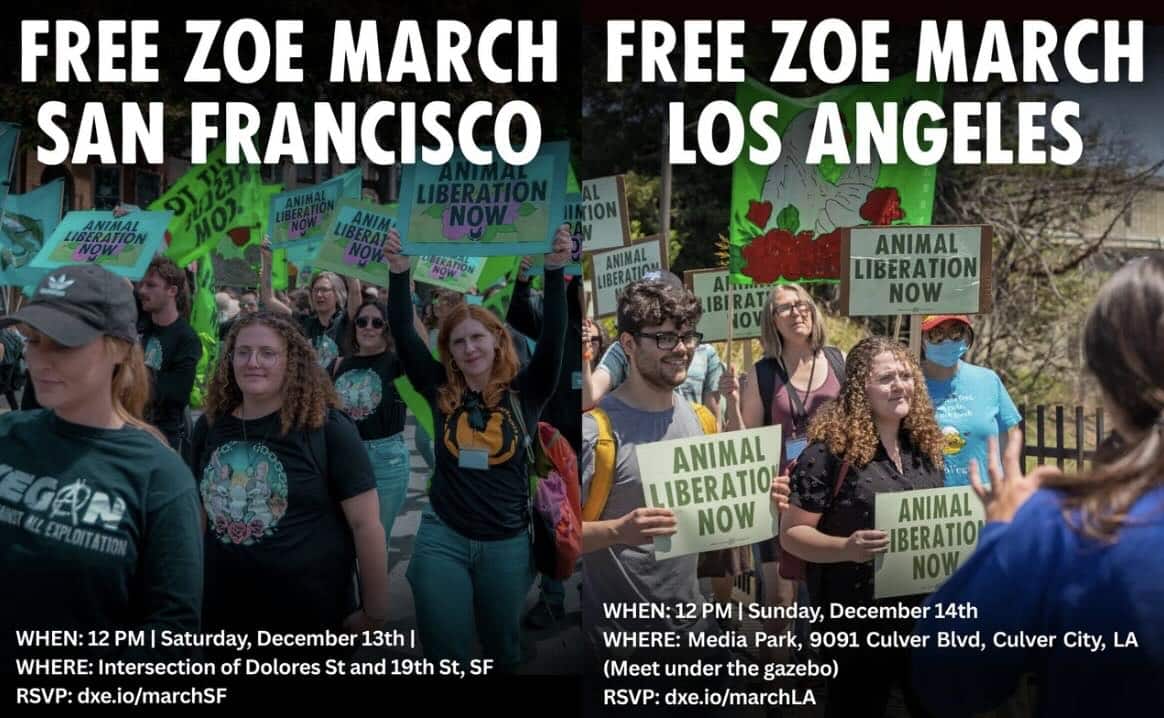
Free Zoe Rosenberg marches happened on Sunday, December 14th in Los Angeles, San Francisco and elsewhere to demand the release of animal rescuer Zoe Rosenberg, who has begun her jail sentence, but who suffers from serious, lifelong illnesses that she says could make even a month in jail a life or death matter.
Los Angeles, California, December 14th, 2025 – Supporters of animal rights advocate Zoe Rosenberg are demanding that California Governor Gavin Newsom intervene to secure her release, warning that her incarceration poses a grave and immediate danger to her life. Rosenberg has lived her entire life with Type 1 diabetes and other serious health conditions that require constant, carefully managed medical care. Advocates say that even a single month behind bars could become a life-or-death matter if her health needs are not adequately met.
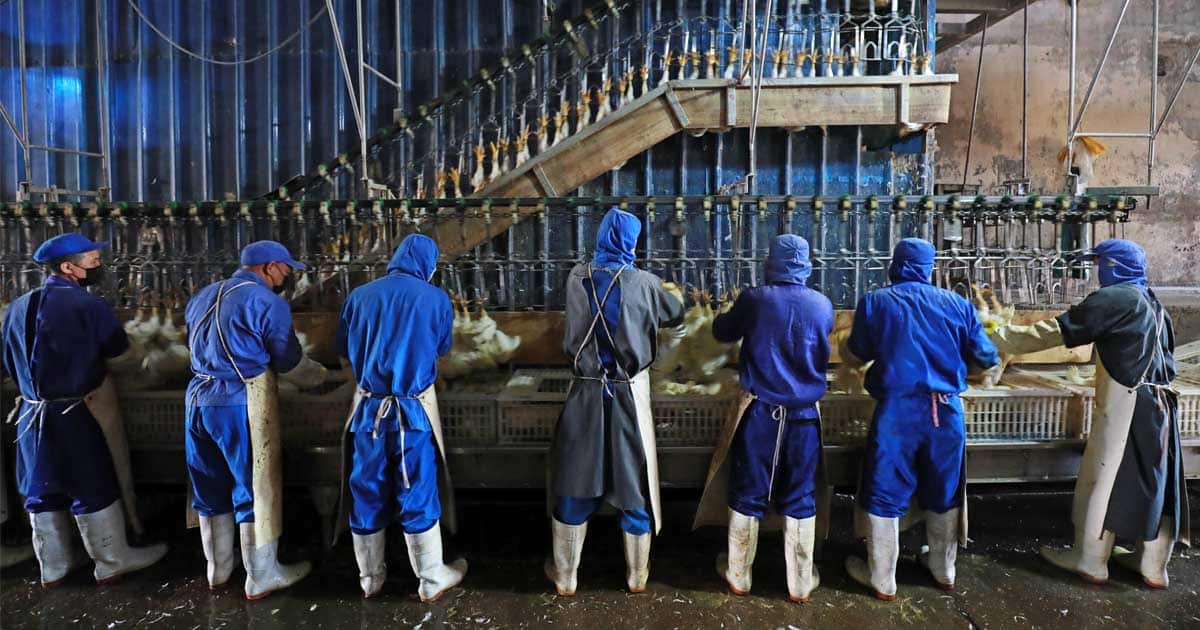
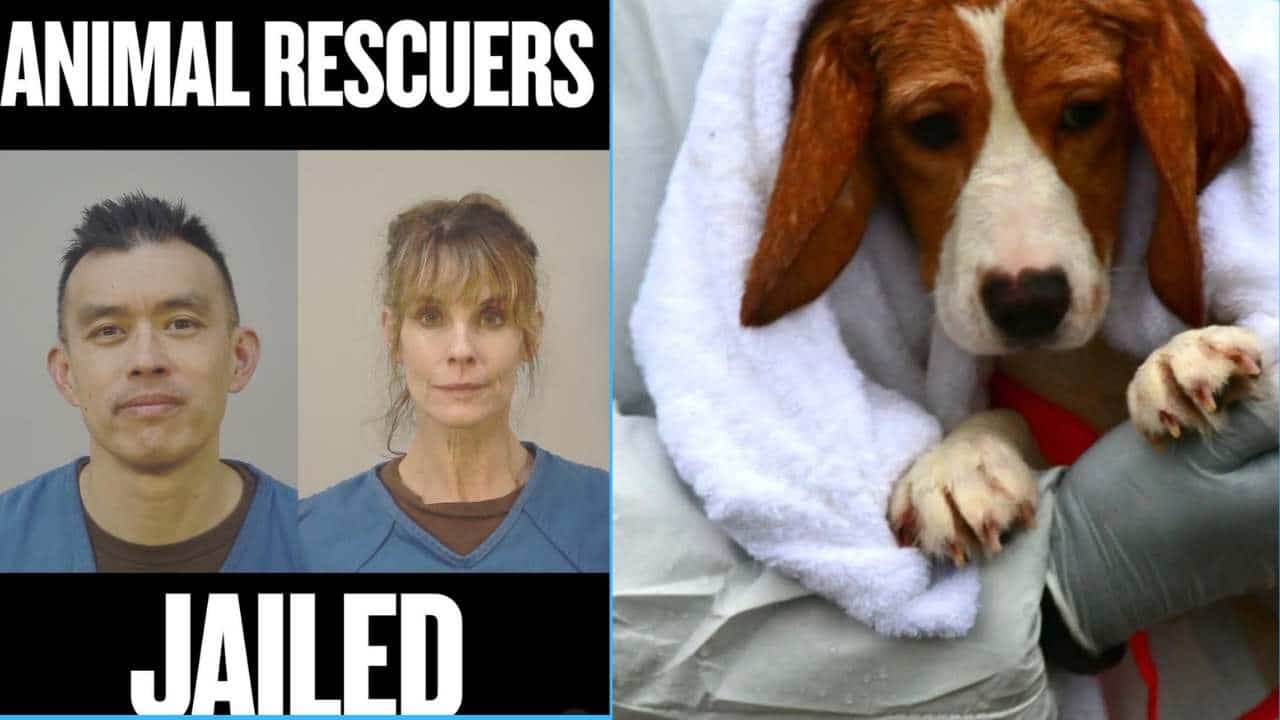
Despite these concerns, Rosenberg is now serving a 90-day jail sentence at Sonoma County’s Main Detention Facility. She was found guilty in October of conspiracy, trespassing, and vehicle tampering stemming from a June 2023 action at Petaluma Poultry, a processing plant owned by Perdue Farms. Rosenberg, a recent graduate of the University of California, Berkeley, entered the facility and rescued four chickens she believed were suffering from severe neglect and mistreatment.
Members of Direct Action Everywhere (DxE), a global network of animal rights activists, held a vigil outside the detention facility in Petaluma to show solidarity with Rosenberg. Candles, signs, and speeches emphasized both her precarious health and the broader moral questions raised by her case. On Sunday, December 14th, hundreds marched in Los Angeles and San Francisco demanding her release, many holding “Free Zoe” signs. Musician Moby spoke at the LA event and praised Rosenberg’s bravery.
Organizers noted that tens of thousands of people have already signed a petition urging Governor Newsom to grant Rosenberg a pardon.
“The public is in support of animal rescue and doesn’t agree with jailing a compassionate rescuer,” said DxE organizer Cassie King. “And because of Zoe’s very serious health issues, we’re extremely concerned about what might happen to her in jail.”
Rosenberg may be allowed to serve up to 60 of her 90 days under house arrest if a court grants a pending petition, citing her diabetes. But her supporters argue that this does not go far enough. They say clemency is warranted given her medical vulnerability and the nonviolent nature of her actions.
Rosenberg, who has remained unwavering throughout this ordeal, describes what it was like to report to jail and drew parallels to what happens to animals in factory farms, noting that – as bad as her experience has been – what happens to animals is much worse. Here are excerpts from her blog.
“The booking process was not complete until around midnight, and another inmate woke me at 4:30 a.m. banging on their door and screaming. I’m exhausted.
“I live with Type 1 diabetes and gastroparesis. The jail is restricting my access to fast-acting glucose to treat low blood sugar episodes. If I don’t treat a low immediately with 15 carbs of fast-acting glucose, I could have a seizure, go into a coma, or even die. Due to the limited supply they’re giving me, I’m often undertreating lows or forced to ration glucose.
“The head nurse said I could keep my insulin pump for my first night, but it seems they may still ultimately take it away. Without my pump, my care would fully be out of my hands. It would all be up to the jail staff. The jail’s medical competency is questionable. Last night, I had to teach one of the jail nurses what causes diabetic ketoacidosis, which is a life-threatening complication of Type 1 diabetes.
“Once you’re in jail, you have very few rights, but still a hell of a lot more than animals. At least, I still theoretically have the right to live. My cell is small, but I can stand up and take a few steps. In many parts of the US, animals can legally be housed in such tight confinement that they can’t even spread their limbs or turn around. When I first began animal rescue work, we’d save chickens from now-illegal battery cages on factory farms in California. I’ll never forget the looks of awe on these hens’ faces when we would bring them back to the sanctuary, and they’d experience freedom for the first time. Everyone deserves to experience basic freedom. Ironically, that is why I am here. For my work to give animals freedom, I have lost my own.
“But I have a release date. There will be an end. That’s not true for most animals. They are constantly in my thoughts. Once I get access to an envelope and stamps, I’ll be sending a letter to California Attorney General Rob Bonta, asking him to step in to help the hundreds of thousands of birds suffering in filth and confinement on Perdue’s Petaluma Poultry factories. I hope you’ll join me.”
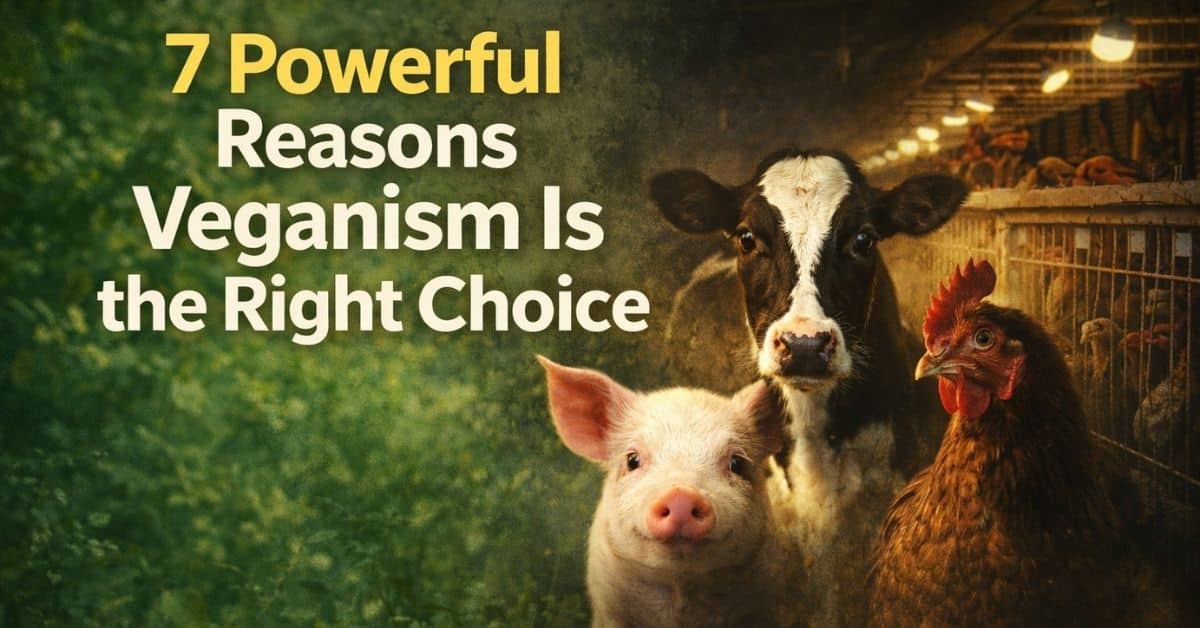
Rosenberg remains resolute. She has described farmed animals as individuals capable of suffering, routinely denied medical care and left to die in filthy conditions. As animal rights lawyer Mirais Holden put it, while Rosenberg has a release date, the animals she sought to help do not—a contrast that continues to fuel calls for her immediate release.
Perdue’s Petaluma Poultry denies that any animal abuse occurred at the slaughterhouse insisting it operates within with the law and regulations. The company is invited on comment further.