[Speaker 2]
Guidelines are promoting full-fat dairy products and dairy products in general. They’re promoting meat as well. But dairy and meat happen to be the number one and number two sources of saturated fat.
Many of these reviewers have been paid by Big Beef and Big Dairy, National Cattlemen’s Beef Association, the National Dairy Council, General Mills, National Cattlemen’s Beef Association, National Pork Board, oh and Nova Nordisk, otherwise known as Big Pharma. All of the recommendations in these new dietary guidelines somehow support the inclusion of all of these animal products.
[Speaker 1]
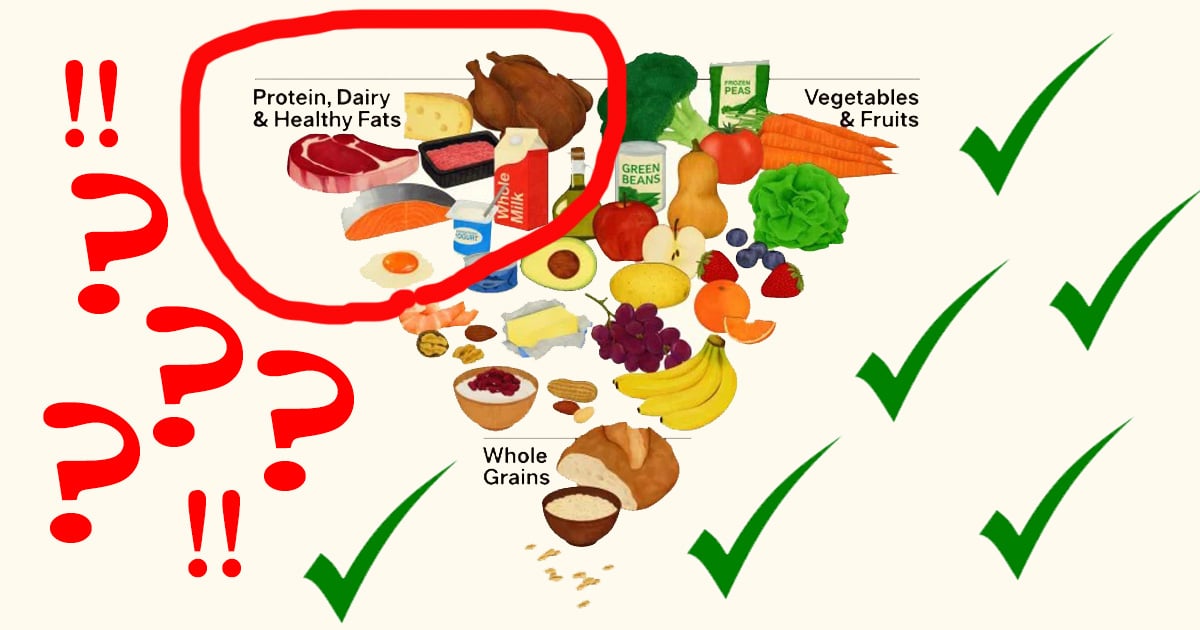
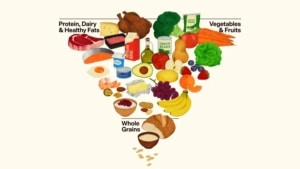
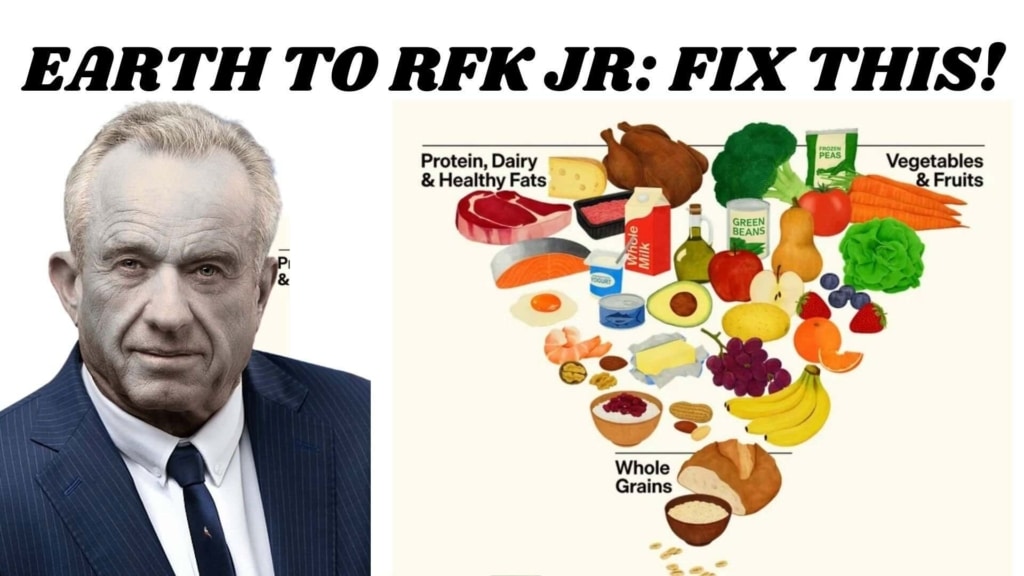
There it is, the controversial new food pyramid. And we’ve got some breaking news for you. And we’re happy to say that Physicians Committee for Responsible Medicine is petitioning HHS and USDA, Health and Human Services and the United States Department of Agriculture to withdraw the dietary guidelines over the unlawful industry influence.
We’re so excited to have Dr. Neil Barnard of Committee for Responsible, Committee’s Physicians Committee for Responsible Medicine and Chloe Waterman, Friends of the Earth with us. Thank you so much, both of you for joining us. We’ll start with Dr. Neil Barnard. What is wrong with this new food pyramid and what are you doing to fix it?
[Speaker 2]
Two big problems. The first is the process by which it came about. By law, it’s supposed to be transparent.
People are supposed to know what they’re looking at, what evidence is it? How did the people choosing it get picked? That was all done behind closed doors.
But apart from the process, the content is really something that food industry, especially the beef and dairy industries, would have written. Their fingerprints are all over it. It says promote meat, promote dairy products, and it really shows the naivety scientifically, but that’s what the food industry wants.
So we have filed a formal petition with the U.S. government to pull it back and start over.
[Speaker 1]
Tell us about this petition. It’s not a lawsuit. Health and Human Services and USDA are being petitioned to withdraw these guidelines.
How does that differ from a lawsuit and what is it that you’re specifically asking for?
[Speaker 2]
Okay. Well, there is a law called the National Nutrition Monitoring and Related Research Act that says when you’re pulling together dietary guidelines, you’ve got to have a transparent process. It’s got to be based not on some special interest, but on the preponderance of scientific knowledge at that time.
The committee has to be free of bias. But what we found, and as you were describing in the lead up, when you look at the nine people who put this together, the nine supposed scientists, five of them had beef industry and specifically Cattlemen’s Beef Association links, and overlapping five had dairy links. Three of them were linked to the low-carb industry product.
And then when you read what they come up with, they said, eat more meat, have more dairy, favor low-carb diets. And you’re thinking it is the most embarrassingly industry-influenced committee. So when I say we’re filing a petition, I don’t mean we got 200 signatures and mailed it in.
What I mean is it’s a formal legal process where we go to the inspector general at the USDA and said, this does not follow the law. We went to the inspector general at HHS saying this is not following the law. Now, they have a certain amount of time to get back to us.
If they don’t, we will be in court. In other words, that’s where the litigation comes in. Now, we’ve been there before.
Back in the year 2000, the dietary guidelines at that time, 25 years ago, were produced without transparency. Nobody knew what they were looking at. Six of the 11 committee members had industry ties at that time.
We sued. Now, Jane, the government has a lot of attorneys. Back at that time, we had one.
But it helps if you’re right. And the judge looked at our attorney and said, you are right. These guidelines are not fitting with the law.
And I have to say, after that, the process got so much better with each succeeding dietary guidelines. But we’re back to square one. And we’re going to be back in court if we don’t get satisfaction with our petition.
[Speaker 1]
Well, amazing work. Bless you that you’re actually challenging these. I want to go to Chloe Waterman of Friends of the Earth US, senior program manager.
I was really encouraged to see your news release very strongly outlining the reasons why this new food pyramid is a disaster. A lot of environmental groups, big ones, don’t take a stand on this. And I could list them.
And so I just want to applaud Friends of the Earth for being at the forefront of this issue, because it’s also an environmental issue. So let me just show a very little bit about the top part is the New York Times editorial, the new food pyramid brought to you by Big Meat. And below that is your news release, Friends of the Earth, Trump’s dietary guidelines reject science backed advisory committee recommendations for shifts towards plant rich diet.
So tell us, Chloe Waterman, what are the headlines of your stance on this, Friends of the Earth? Well, we completely agree with Dr. Barnard that this pyramid is not been driven by science whatsoever. It has been driven by the industry interests of Big Meat and Big Dairy.
And you see that. If we put if our plates looks like the food pyramid and people put that much steak and cheese and whole milk, we would be exacerbating cardiovascular disease. We would be exacerbating obesity, hypertension, diabetes.
This is not what the science backed recommendations in the Dietary Guidelines Advisory Committee, which was that group that was put together in a transparent process and made recommendations for plant forward dietary guidelines. And you know what’s convenient, Jane, is that the diets that are best for our health are also the diets that are best for our planet. So if we eat a predominantly plant forward diet, if we eat fruits, vegetables, nuts, seeds, legumes, whole grains, that is good for our health.
But those are also the foods that emit fewer greenhouse gas emissions that have less water pollution that contribute less to biodiversity loss. So the diets that are good for us are good for the planet. And this dietary guidelines is a failure on both counts.
Yeah. And Nilo Foroshkarian is saying PCRM is badass. You will get them again.
Here’s what I find so confusing about all of this. And that is that Robert F. Kennedy Jr., who is the mastermind behind this, has changed his tune on factory farming. He used to be, as a environmental attorney, very anti-factory farming. He went after Smithfield. He compared factory farming of animals to terrorism.
So you’re nodding your head. Let me go back to you on that, Chloe. What happened?
RFK Jr. has been a complete traitor on the issue of factory farms. I think if you talked to him today, he would still say that factory farming is bad. And that makes it completely irresponsible to be recommending a carnivore forward of meat and dairy heavy diet, because he knows, as well as the rest of us, that the vast majority of meat and dairy products in the United States are coming from factory farms.
So when maybe he can afford the higher quality, higher welfare animal products that don’t have as many pesticides in them, that don’t have the hormones and antibiotics that end up being stored in the fatty tissues of animal products, but most Americans are going to be eating meat from factory farms. That’s where most of our meat comes from. So these guidelines completely contradict his message and a core message of the Make America Healthy Again movement, that factory farming and this really pollution-intensive method that we have of raising animals in this country is OK.
It’s completely contradictory. And I just hope that more environmental organizations follow the lead of Friends of the Earth and make the connection between animal agriculture and climate change. It is one of the leading drivers, and it is the most ignored aspect of climate change.
Now, I want to go back to you, Dr. Neal. This idea of emphasizing meat and dairy, you see it there on the upper left hand, when Americans already consume more animal products than any other part of the world. Americans eat more than 66 pounds of pork per year per capita.
And of course, heart disease is the leading killer, which comes from clogged arteries that get clogged with cholesterol from animal products to a large degree. How is it possible that the simple math of if people are already eating more meat and dairy than they should, adding more on is going to make them sicker, not healthier, not get through to the people who came up with this? Or do they just not care?
Are they that cynical?
[Speaker 2]
Well, I think we have to put the blame where it belongs, and that’s really on industry. The National Cattlemen’s Beef Association, the dairy industry, their job is to promote their products. And that’s what they do.
And they’re very successful at it. And so they try their best to push it in schools and push it into other federal guidelines and that sort of thing. And so if you were a secretary of HHS, Secretary Kennedy or others, they’re entitled to have whatever views they want.
And lay people never have a complete understanding of good nutrition. So that’s what they need good, unbiased expert advisors for. And frankly, I think that the nine people who constituted the panel that pulled together the scientific findings, they really let the government down and they let the American people down.
Their biases showed through. It was not a balanced group. And so what really needs to happen is we pull these guidelines back.
You bring together true experts and a balanced panel of experts who can deliver to RFK, to the administration and to the public the information that they do deserve. Let’s face it. Their families are at risk for disease as well.
They need good information. And I don’t think they were well served by the members of this committee. That’s what needs to change.
[Speaker 1]
So people are asking, what can the average person do? Well, I can give you one answer. Support Physicians Committee for Responsible Medicine.
Support Friends of the Earth. Sign the petitions that go out against this. One of the problems we have here is that we’re kind of in uncharted territory where perhaps even if you prove the industry influence, which I don’t think would be very hard to prove, it’s right there for everyone to see.
It could just be ignored. It’s we’re sort of in an era of, you know, alternative facts. So how do we deal with this?
How do we and what are the implications, Chloe, for institutions like hospitals, prisons, schools, et cetera? Well, that’s something that’s very concerning about these new dietary guidelines, because most Americans don’t follow the dietary guidelines in their own diet. They do inform what ends up on our school lunch trays and in other public institutions.
So school meals, for example, we serve seven billion school meals in the U.S. every year, and the dietary guidelines govern the standards for those school meals and therefore what ends up on the lunch trays of those children. That’s a different process and a longer process. USDA still has to do a rulemaking process and propose new guidelines for the school meals that would align with these dietary guidelines.
That’s going to be a crucial opportunity for scientists and academics that should have been influencing this process that Dr. Barnard is talking about. For example, the scientists that are on the dietary guidelines advisory committee to be weighing in and ensuring that the way these guidelines are operationalized does not make our school meals even more meat and dairy heavy than they already are. Um, yeah, and everybody is saying thank you for fighting back.
So we’re getting a lot of response on that. Now, here is something that I find very bizarre. Okay, as Charles Dickens said, it was the best of times.
It was the worst of times. Or maybe he started with it was the worst of times. It was the best of times.
I don’t remember. But there are also some developments that are positive that, of course, have been completely ignored by mainstream media. And let’s discuss a couple of them.
One is that there’s this new law called the Whole Milk for Healthy Kids Act, which sounds terrible in the sense that it sounds like it’s pushing dairy. But within that, there is a new rule that says non-dairy beverages can be fed to kids at school without a doctor’s note. So that’s a positive.
I want to go to Dr. Neil Barnard, because in this upside down world we’re living in, you’d think, oh, my God, the Whole Milk for Healthy Kids Act. Now they’re pushing whole milk. And this is a disaster.
But it’s also saying that you don’t need a doctor’s note for soy milk or oat milk or almond milk. Take us through this, Dr. Neil, because I think it’s hard for people to navigate all of this contradictory developments.
[Speaker 2]
Jane, you said it. And I want to thank Chloe for her work on this as well. When this act was first proposed a long time ago, it was terrible, exactly as you said.
The whole thing was to put whole milk back into schools so the kids were going to get all the saturated fat and all the calories that had been taken out for a while. It was going to be put back. That was terrible.
It was also inevitable. There was no way that that act was not going to be passed. So we and others worked very hard to get what we could.
And so the first thing is, just as you said, Jane, right now, as of the signature on this law, which was, I think, yesterday or the day before, it’s now law. Any school can serve cow’s milk. They can serve soy milk.
So a kid comes in, they’re 16 years old, and they say, give me the soy milk. I’d like vanilla. The school can serve it before they couldn’t.
That’s a good step.
[Speaker 1]
Secondly, we got a little frozen there, but that’s OK. Go ahead. We got you back.
All right. Well, you’re hearing about this. We all froze for a second.
I think freezing is part of our new society. So we’ll get back to Dr. Neal in a second. What do you have to say?
Well, Jane, I think I can finish his thought on this because Friends of the Earth and Physicians Committee worked really closely together on this. He described one of the things this would do. The second thing that this new law does is it gives students who have disabilities, which includes lactose intolerance, an affirmative right to a non-dairy milk at school.
It used to be that those students would have to have a doctor’s note describing their disability. Now this note can come just from a parent, and those students have the affirmative right to get a non-dairy milk at school. For your audience watching, if your student is lactose intolerant, you can now write your school to let them know your student is lactose intolerant and right and requires a non-dairy beverage, and they have to give that to you.
For every other school, for every other student, your school is authorized now. They’re allowed for the first time to put swim milk on the lunch line, and that is a huge step forward. And then there was another positive development.
And this, again, I don’t know if this is like even a broken clock is right twice a day. I don’t know what’s going on here. But another positive development is Senator Schiff has introduced legislation to expand plant-based meal options for students.
I’ve got to read the fine print because this is huge. Of course, the mainstream media pretty much ignoring this as per usual. But here’s the quote, providing additional resources to school districts so they can provide more plant-based food options brings us a step closer to ensuring that all students can have access to healthy, sustainable meals.
As a member of the Senate Agriculture Committee, I’m proud to introduce this legislation. Wow. I mean, that’s huge.
Absolutely. This is a bill that our coalition, the Plant Powered School Meals Coalition, of which Friends of the Earth and the Physicians Committee are both members, have been working on now for three Congresses. But this is the first year that this bill is being introduced in the Senate.
So that is a huge milestone. And it shows the momentum that we’ve been able to build on this because of the student demand for these options. Students across the country are going to their schools and they’re saying, I want more plant-based options.
Some of them are doing it because they’re bringing their environmental activism to the cafeteria. Other students care about this because they just want a greater variety of healthy protein choices. But their schools are having a hard time getting all of the resources to provide these expanded options.
So this bill would give those schools grants to be able to expand healthy plant-based options so that plant-based options become the norm on K-12 menus instead of the exception. So how would you summarize all this? Because when I started looking into it, it started as a disaster for plant-based.
We’ve got this new food pyramid that puts meat, you see, it looks like a chicken, steak, cheese, fish, eggs, which are cholesterol bombs, packed with cholesterol, milk. It looks like dairy, yogurt. And we’ve got Dr. Neal back with us. So I’ll ask him, how do we balance all this out? We’ve got this horrible news with the emphasis on meat and dairy in the new food pyramid. But then we’ve got this great new legislation introduced by Senator Adam Schiff from California and that would expand plant-based meal options.
And then we’ve got the new non-dairy options for students. Where are we, Dr. Neal?
[Speaker 2]
I think we have to make the choices for ourselves and we have to make the choices especially for our children right now. And so that means the government isn’t going to put the food into your mouth. That’s your choice.
So there are healthful foods in schools. There are healthful foods at the store. Those are the ones to emphasize.
In the meanwhile, plenty of us are working to make the policies better, but we have to have the healthy foods. And that means the plant-based foods, the vegan foods for our kids.
[Speaker 1]
So, you know, we all know that veganism, the plant-based movement has been under attack. And just to give it the 30-second or 15-second recap, when Beyond Meat’s stock went public in 2019 and people from the mainstream media, which I used to be in, had ignored me for years and basically acted like I was a little crazy, suddenly started texting me. You were so prescient.
Oh, this is so amazing. Well, I think the meat and dairy industry saw that Beyond Meat, there they were on the NASDAQ, the most successful initial public offering in years. They freaked out and they declared war on the plant-based movement.
And the mainstream media, sadly, jumped on and has been writing a lot of negative articles, most recently in New York Magazine. But I do believe that every social justice movement doesn’t go straight up. It has its, it’s like a roller coaster, but the arc is positive.
And I do feel that there’s going to be a boomerang. I do feel that there is this overemphasis on, oh, meat’s back. I believe we’re a lot stronger than anybody’s giving us credit for, and it’s going to start showing soon.
My question is, how is that going to transpire? Dr. Neal and then Chloe.
[Speaker 2]
We are seeing this at every possible front. On the scientific front, the evidence supporting a plant-based diet is stronger than ever. The evidence that the optimal amount of meat in your diet is zero, that evidence is stronger than ever too.
The evidence linking milk to breast cancer and to prostate cancer is stronger than it has ever been. The American Medical Association now has policies promoting plant-based diets. Every restaurant you go into has options that are there.
None of that was there a generation ago. So it’s always a little bit of a stepwise path, but we are clearly winning, and there is no question that the diet of the future is a plant-based vegan diet.
[Speaker 1]
And I like to point out for those who say, oh, you know, the sky’s falling. The word vegan was only created in 1944, while Pythagoras talked about veganism back in 500 BCE, he did it as sort of meatless. There was no actual word for vegan until 1944.
So when we put that in context, Chloe, we’re doing quite well for a movement that is still in its infancy. Where do you see us going, Chloe, as we enter this new phase where, again, I have to quote Charles Dickens, it was the best of times, it was the worst of times. Plant forward is the future.
I agree. And this week, I’ve had the fortune to spend some time with some young people who are part of our Plant Powered School Meals coalition, high school students and college students who have been advocating for plant-based options in their own school district and for the policy changes that will facilitate more plant-forward menus. And they and their peers and their generation have no question that plant-based is the diet that is going to support their health, and it’s the diet that supports the health of the planet they’re going to inherit.
You know, I have to say, looking at this issue, and there’s something called the 80-20 rule, or is it the 20-80 rule, that 80 percent of the outcomes are based on 20 percent of the inputs. And when I read about that, I was like, that’s meat and dairy. It is a leading, some have made a strong argument, depending on how you calculate this very big subject, the leading cause of climate change.
But nobody argues. Everybody agrees it’s a leading cause. Then you have the leading cause of the health crisis, heart disease being America’s leading killer.
Then cancer, processed meat is officially cancer causing. You have human world hunger, where we’re feeding so much of the food that we grow, like more than 80 percent of soy goes into factory farmed animals. When people are dying of starvation, where we could redirect that soy to them.
So many of the world’s problems boil down to killing and eating animals for food. When will we hit a critical mass, do you think, Dr. Rao, and I quote Dr. Silas Rao, who has said that we must transition to a plant-based culture to avoid a climate apocalypse. When do you think that the so-called best and the brightest out there will actually wise up to this, given that climate change is no longer hypothetical.
It is real to wit, people I know losing their homes in the fires that occurred last year here in California.
[Speaker 2]
Well, I think you put your finger on it. What do people really care about? They care about the environment that they’re living in.
They care about their own health. There’s one other piece of this that they shouldn’t forget about, and that’s that people care about their children. They care about the health of the next generation.
So the meat industry or the dairy industry will try to come up with distractions. They’ll say, the problem isn’t meat. The problem is soy.
Soy causes cancer. Well, research showed that soy helps prevent cancer. Women consuming the most soy reduce their risk of breast cancer.
Men consuming soy reduce their risk of prostate cancer. And the other piece of this is birth defects. One of the latest things that the meat and dairy industry has been doing is saying, don’t worry about our products.
The products you should worry about are processed foods. Processed foods will hurt you. Well, it turns out, as you may remember, that we used to have spina bifida, the neural tube defect, in very large numbers.
And in 1998, the FDA said, put folic acid, it’s a B vitamin, into processed foods. So every box of cornflakes, every box of Wheaties, all breads, grain products were fortified. And spina bifida dropped by 23% within just a matter of years.
Now, with the beef industry saying that those products are the problem, by banning those healthy processed foods, they’re going to bring back the birth defects that will hurt women and children. We can’t let that happen. The problem is the meat industry.
The problem is the dairy industry. Now, don’t get me wrong. Those are business people trying to feed their own families.
But they, like the tobacco industry before them, can get into healthy industries, and we can all be better off.
[Speaker 1]
Well, I have to say that you’re taking the legal action. PCRM, Physicians Committee for Responsible Medicine, Friends of the Earth is in there in the halls of Congress. But social media is talking about this like crazy.
And I’d like to play a couple of social media clips and get some response on how it’s being framed, because a lot of people are looking at this food pyramid and going, this does not add up. There is something, I hate to say it, fishy, don’t like to use that phrase about this.
[Speaker 2]
Now, here’s Dr. Matthew Nagra covering more confusion. How they came to the conclusion that vegan diets tend to provide inadequate amounts of this long list of nutrients is actually unbelievable. What they essentially did is look at what would happen to nutrient intake if you took a vegetarian diet and then removed eggs and dairy, as well as fortified soy milk.
But then replace them with absolutely nothing. So the take-home message is, if you stop eating animal foods and fortified soy milk for some reason, and replace them with air, you get less nutrients. Mind-blowing stuff.
And the scientist who was responsible for reviewing the data on vegan and vegetarian diets for these guidelines didn’t even know that this is how the research was done until it was pointed out to him on X. I mean, his job in developing this scientific report for the new guidelines was to know these things. And unfortunately, this wasn’t just an egregious error that made its way onto a blog post or podcast.
These are the dietary guidelines for Americans for the next five years. Amazing.
[Speaker 1]
Using some humor there, Chloe, what’s so upsetting about these guidelines is that they attack a plant-based diet, proactively attack a plant-based diet, even while putting the vegetables up there on the right side. So none of it really makes a lot of sense. Well, Jane, I’m glad you picked up on it, because it is a little bit nuanced.
And I would say the food pyramid is particularly offensive to look at, in contrast with what the science recommends around plant-forward diet. When you actually look at the text of the guidelines themselves, they recommend more protein, but they do not present a preference for animal protein over plant protein. The written guidelines themselves actually say, have more protein, protein should come from animal sources and plant-based sources.
What they should have done is say, most, if not all, of your protein should come from plant-based sources, because that is what the science points to. And so if we are going to meet the higher protein recommendations from the dietary guidelines, it’s critical that people do that by consuming more plants. That message is getting lost, because the guidelines themselves are so confusing.
You put steak at the top of the pyramid, but you maintain the limit on saturated fat, which is the right thing to do. How can those things go together? The Trump administration set out to try to have clearer guidelines, but these are only more confusing.
Yeah, one of the obvious things, and a six-year-old child could figure this out, there’s only so many foods you can eat in a given day. Considering that whereas Americans are already over-consuming meat and dairy, and by the way, nobody mentions in any of this fast food, let’s be real for a second. The reason why two-thirds of Americans are overweight or obese is because of fast food joints.
People eating fast food at all the fast joints, fast food joints on the strip. That’s like, I would say, just crazy guess off the top of my head, at least 65% of the over-consumption of calories. They’ve done numerous stories where if you eat one of these fast food meals, you get more than your daily intake of calories.
It’s so shocking to me that they don’t, well, it’s not shocking, because obviously it’s about money and business, but they don’t mention the words fast food to my knowledge. Maybe they do. I haven’t read all the fine print.
They’re not emphasizing that the real problem is America’s miracle miles filled with fast food joints. When are we going to get to that, Dr. Neil Barnard? Because to me, that is the heart, the crux of the problem.
Fast food is a very relatively recent phenomenon. It literally started maybe 1960s, took off maybe 80s, 90s, but it has increased exponentially and the obesity crisis going right up there with it.
[Speaker 2]
Well, there’s nothing wrong with food being fast. It’s a question of what that food is. So if you go into Subway and you take all the meat items and the cheese items and so forth, and if that’s what you’re going to pick, you are likely to gain weight.
You’re going to have a high risk of diabetes. If you go in there and say, no, cut open that baguette and put in all the veggies and so forth, you’re going to get something that’s actually a pretty healthy sandwich. You can go into Taco Bell.
You can go into any one of the fast food chains. And if what you order is the plant-based choice, you’ll do better, even if it is fast.
[Speaker 1]
Well, I agree. At the end of the day, they’re just boxes on a street and those boxes can be filled with anything. And there have been efforts by sort of the more modern casual dining and or fast food in the manner of, let’s say, Chipotle to offer more vegan options.
And there are vegan options in some of the fast food restaurants. I agree with you there.
[Speaker 2]
Let me jump back in here, Jane, though, because you did put your finger on something really important. What they’re actually serving has been manipulated by industry. If you look at, for example, at Wendy’s, I can show you a contract that Wendy’s signed with the U.S. government to promote cheese. By law, the U.S. Department of Agriculture has to promote cheese. And one of the ways they do it is they contract with Wendy’s, with Burger King, with pizza chains to have more and more cheese in their products. I can show you these contracts.
And what has happened? Back a century ago, 1909, the USDA started tracking cheese intake in the U.S. The average American ate only about 3.8 pounds of cheese in a year. Today, are we eating 3.8 pounds of cheese?
No, we’re eating 40 pounds of cheese per year. Fast food is the vehicle that’s come in. But if you go to Taco Bell and you say, give me the bean burrito, whole cheese, that’s an OK choice.
And if you make the healthful choice at those places, you’re going to.
[Speaker 1]
Well, I know you have one of your podcasts that is a PCRM podcast coming up at the top of the hour, so I don’t want to keep you much longer. We’re so grateful for both of you giving your time. But I do want to ask you a couple of quick questions.
One is the media. Now, one of the reasons we started Unchained TV is that all these developments are completely ignored in the media. I looked actually for information on the new plant-based milk option that is now part of law, and I found one reference to it in one.
This is big news, and it is being completely ignored or almost completely ignored by mainstream media. The non-dairy options for students that are now available with a parent’s signature. You don’t need a doctor’s note anymore.
So there’s the media ignoring the story. And then the other aspect is, how do we, given that the news, the mainstream media is ignoring this, how do we let parents know that this is an option? And I’ll give you just an example.
We did pass a law, correct me if I’m wrong, Dr. Neal, here in California that says when you’re in the hospital, you have a right to a plant-based option. I can’t tell you how many times people have called me, Jane, I’m in the hospital with a broken arm and they won’t give me a plant-based. I said, it’s the law.
Well, they don’t know about it. So if there is a law that says plant-based milks are an option, but the parents don’t know about it and the schools are not enforcing it, how do we make it happen? I’d love to get both of you on this.
And it seems like you really want to say something, so I’ll let you go first, Dr. Neal.
[Speaker 2]
You are absolutely right. You’re in the hospital, you don’t have any choice, you’re stuck. And by law, what you said is exactly right.
You must have access to a plant-based meal while you’re there. Same thing. Somebody gets picked up for their awaiting trial or they’re incarcerated, they can’t handle what they eat.
By law, you must be able to get a plant-based item too. Schools aren’t there yet, unfortunately, so people do have to speak up for themselves. If the media doesn’t cover it, social media is your ticket.
So I think people should be using social media aggressively to make sure that everybody knows what their rights are.
[Speaker 1]
Thank you. Chloe. I agree.
And that’s why we’re picking up the slack where the media might be leaving out some of this. The Plant Powered School Meals Coalition, we have a website. We will have resources up next week with guidance for how parents can utilize the new law, how school food operators can utilize this new law to add plant-based options.
It’s going to be a big national campaign. We need parents from across the country who want these options for their students. We need the students across the country to make this known to their school food directors.
And we’re going to get it done. We’ll see soy milk on the shelves at school meals by the next school year. Well, again, I want to thank both of you.
You are very busy people. I feel honored that you’ve taken the time to appear on Unchained TV’s Truth Files. And I do want to also say, PCRM, thank God for you standing up to these guidelines and challenging them legally.
That’s what’s needed. And please keep us posted on your efforts. I’m going to put it up one more time so people who joined us late can see that PCRM is petitioning Health and Human Services and the United States Department of Agriculture to withdraw dietary guidelines over unlawful industry influence.
And I also want to give a shout out to Friends of the Earth. And if you look here, that’s their very strong news release that is filled with so many points about why these new guidelines are really terrible. And one of the points we didn’t get to is the toxic chemicals that are in meat and how if people increase their meat consumption, that could create other problems.
But I do want to give a shout out to Friends of the Earth for being an environmental organization that is looking at the food issue, because I cannot tell you how many environmental organizations I come into contact with that don’t want to see no evil, hear no evil. They have events where they’re serving meat. They’re not looking at this issue at all.
And I just hope what Friends of the Earth is doing rubs off on some of those other environmental groups, because food is an environmental issue. So thank you so much, both of you, very much for joining us on this edition of Truth Files with me. And I would love to have you come back as we continue to bring the real information to the people that is truly being ignored by mainstream media.
See you next time.
[Speaker 3]
Bye.