[Speaker 1]
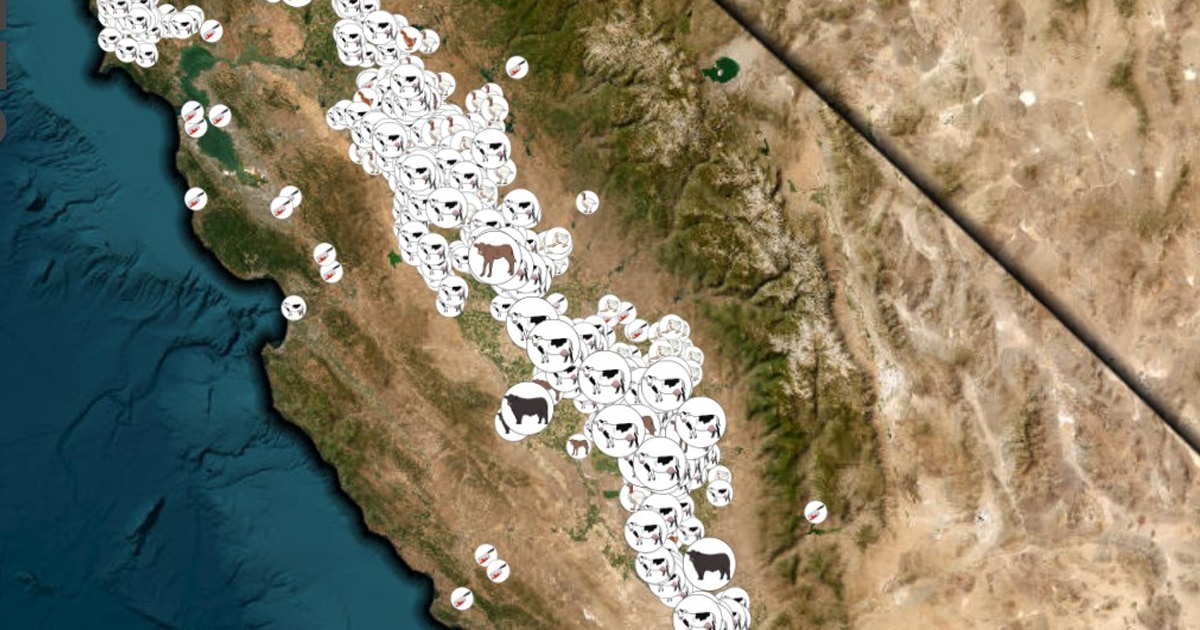
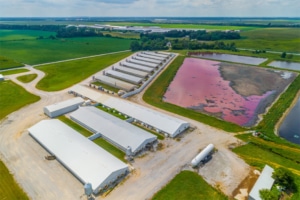
80 million animals are trapped in factory farms across California, and now there’s a way to see what’s been hidden. For the first time, you can explore every major factory farm in California. See where they are, how many animals they confine, the brands they supply, and the pollution they cause.
This data comes from public records, open-source research, and on-the-ground investigations connecting the dots the industry wants to keep secret. Factory farming drives drought, disease, and destruction, but now anyone can find out who’s responsible.
[Speaker 3]
From Proposition 2 to Proposition 12, California has always led the fight to challenge factory farming, but it’s hard to tackle a problem that you can’t see clearly. And with Factory Farm Watch, we can finally see the truth and start changing it. Explore the map at factoryfarmwatch.org.
[Speaker 1]
We are so excited at Unshade TV to have two of DXC’s leaders in this phase of DXC’s development. They’re known for protests. They’re known for all sorts of things.
Now they are known for this new factory farm map that is extraordinary. It is a breakthrough, and it is showing essentially what’s really happening behind the curtain. When you think of—and welcome, both of you—when you think of California, you think of beaches, you think of the tech industry, you think, of course, more than anything else, of Hollywood, do you think of factory farms?
But you’re pointing out that this state is a massive animal agriculture complex. Elmira Tanner, lead organizer for DXC, take it away. What was the impetus behind this, and what’s the importance?
Yeah, I think you’re totally right, Jane. I don’t think a lot of people think of California as having a ton of factory farms, partly because they’re hidden in rural parts that are less populated. They’re not in San Francisco and Los Angeles.
And also because I think we have this sense that California is more of a progressive state with better animal welfare laws, and that is true to an extent. But doing this research, we see that actually there are well over a thousand factory farms in the state. It is the number one dairy-producing state in the country.
A lot of people might think that’s Wisconsin, but no, it’s actually California. And this project kind of came out of Measure J, really, in Sonoma County, which was an attempt to end factory farming in Sonoma County through a ballot measure. And while we were working on that campaign, we created a very bare-bones map of the factory farms in Sonoma County, because we were repeatedly hearing from people in that community that, yeah, factory farming is bad, I don’t like it, but we don’t have it here in Sonoma County.
So we made this kind of basic map, had it on the campaign websites, and showed people, like, no, there are farms with hundreds of thousands of birds right down the street from you in some cases. And when, you know, I think we all know Measure J did not pass, but that kind of led us to understand that a lot of people just don’t know that this is a problem in their state. And after Measure J, we then embarked on the process of making this map statewide, but also including way more information about it that I think other maps, you know, there are other maps that exist, but this one has a lot of information about not just the specific farms, but also how ordinary people might relate to them in the grocery store.
So you don’t pick up an animal product package in a grocery store and see the farm, you see the brand name. And those brand names tend to have a lot of pretty images and, you know, I’ll say just straight up lies or deceptions about how those animals are being treated. And now you can find that brand name and look at the map and then be like, oh, that looks like a giant warehouse.
I didn’t think that that’s where this, you know, happy chicken was coming from. So that’s just kind of the backstory of where this map came from and why we made it. And it’s been a very long work in progress.
Well, I know you, Matthew Zirbel, were very involved in the development of this. It’s extraordinary. It really is.
It blew my mind. And we’re going to try to go to it live in a second. But here’s you explaining some of the key aspects of this map.
[Speaker 2]
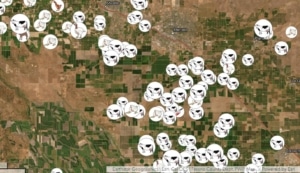
It starts off by showing all the facilities that we have listed that have for large mammals more than 500 and for birds, chickens and ducks more than 5000, just to make sure that we’re showing just places that really are the largest, very clearly factory farms. And I think one of the clearest things is just when you take a look at where animals are, where the density is, zooming in on any facility, this one you can see by the number here has 16,000 cows being used for milking. And there’s a very common thing I hear when I talk to people that, you know, California’s cows are really, you know, all of their animals are raised on pastures, is an easy idea to believe and very direct to dispel by looking here.
This is where cows live their lives, is these rectangular little feedlots.
[Speaker 1]
Wow, it’s so powerful. And I want to congratulate you for just the technical accomplishment. Let me ask you, how did you make this happen?
What is the basis for it? It’s amazing. I mean, you can zoom in and it’s like the Google Maps, but focusing on these factory farms, busting these myths, but not with just words, with actual video of the facilities.
[Speaker 2]
Yeah, we have a long history of people who’ve done direct investigations of factory farms, trying to show everybody in California or the world, just what conditions can be like in factory farms. And so there’s quite a number of drone shots on the ground investigative footage that we’ve looped into the map. And that’s a lot of what we’ve tried to highlight from here.
But then also just compiling, adding in more data from government databases and from our own separate investigation to try and find as accurate as we can get numbers for each of the facilities, as well as what brands they sell to. So it’s been a big effort from investigators, for volunteers, and from just work pulling in databases to compile and sort all of that information all together. So on a lot of the facilities, you can see very specific investigations that are linked there.
And on a lot of them, you can just see the overall overview of the farms and you can look and they’re the same from the outside. All the places that have been or generally most of the places that have been investigated versus places that don’t yet have investigations.
[Speaker 1]
I’m going to do something a little risky here and go live to the actual map. I was playing around with it. It is so extraordinary.
Everybody, you got to go to factoryfarmwatch.org, subscribe on the bottom, which is just putting in your email. Then you can go in deeper to, look at this. Look at this.
It’s absolutely amazing. I am not the tech whiz here, so we’re going to let Matthew tell us a little bit more about how this works. There’s all these filters on the left side.
I assume you can see that, these filters on the left side. Can you explain these filters? It says filter by brand, filter by facility type, filter by number of animals, filter by size ranking.
Build your own filter. I mean, it’s extraordinary. You can also filter by which factory farms had outbreaks of bird flu.
Unbelievable. Just tell us a little bit more while we’re looking at this live.
[Speaker 2]
Yeah, one of the most vital parts that people want to know is, if they see something in the grocery store, where did that really come from? The majority of our facilities are linked up. We’ve been able to find some information about what processors they sell to.
And then by looking further at that, we can see what brands, the actual brand name that shows up in the store, the companies behind those brands sell to. And it’s often different ones. Places will have some very agriculture factory sounding name, but they’ll have a very friendly human name as the name of the product.
And it kind of, for most people, envisions one very small facility, a couple chickens in a backyard. But you can see by filtering through, it’s a set of factory farms.
[Speaker 1]
Well, I’m going to jump in and say I just put in Sonoma County, California, and it immediately jumped to that. And then I could get a little closer and you can see, literally, you can get right down to the addresses of these facilities. So I’m going to just put in, for example, just for fun, Riverside, California.
Let’s see. And there we go, Riverside. Now let’s see what happens when I put enter.
Boom. Wow. And there you see to the left, there’s a whole bunch of dairy facilities and cattle facilities.
Truly extraordinary. A lot of people are asking, when is this going to come to other places? I’m going to remove that before I make a mistake, because that was pretty good that I didn’t mess it up there.
But Elmira, people are wondering, when is this coming to their state? Well, no promises. I know that’s a very common question.
We’ve already gotten emails from people about different states and even different countries. And I’ll be honest, this took a year. Of course, not full-time people working on this, but it was an incredible amount of work to do a lot of the brand stuff is where a lot of the work came because that involved, in some cases, literally parking outside of a facility and following that truck, sometimes for hours to see where the animals are going or where the milk is going, because they don’t disclose this publicly a lot of the time.
And so it’s an enormous amount of work. And our vision is not that we just put this map out and then like, OK, we put the map out and that’s great. It’s actually almost just a step one, because it is a launchpad for a lot of campaigning to happen.
People using this map to find places to investigate in their facility. I’m sorry, in their vicinity. And then also kind of adding more information and being able to show journalists and legislators look at the scale of the problem.
So now that we’re, in a sense, done with making the map, and of course, it’s going to keep getting more stuff added to it, updated, et cetera. Now we’re ready to start the campaign. We’re a campaigning organization.
So we have no plans. I know that’s not the answer that people want to hear, but we do not have any plans of making this for any other state. Our work is very focused in California here.
We think that this is the place to make the next big step forward in the fight against factory farming for animals. That being said, people like Matthew, who are the technical people behind this, are happy to talk to folks in their area to provide all the things we used to make maps in your state. And it is very state dependent in the sense of how difficult it is to get this information.
My understanding is there are some states that make more information available than California. So then a lot of it becomes easier to do. Also, states like, for example, the dairy and the beef industry are actually a lot more complicated to get your head around in terms of brand relationships and stuff than more vertically integrated industries like poultry industries.
So it really depends on how much work it might be for your state. We don’t have any concrete plans right now, but we’re happy to help anybody do it. And we’re not saying no, just not right now.
Well, Nilofar wants to know, when’s it coming to Texas? All right, Nilofar, email us. We’ll tell you what to do.
And by the way, Matthew’s are pulling on me. I have no idea how the back end of this thing works. Well, what’s interesting is that you would think, OK, Texas, that’s where all the factory farms are.
No, California is the biggest dairy state. And, you know, people don’t believe it. In fact, I was talking to a very famous animal activist and he said, no, no, it’s Vermont or Wisconsin.
I said, no, double check. Let’s listen to this and we’ll talk about it on the other side. California voters have passed some of the or the strongest animal welfare laws in the state.
So Prop 2, Prop 12. But these never get enforced because they’re unenforceable when animal cruelty is really built into the backbone of that entire system. It’s going more into like what factory farming in California actually looks like.
So we actually are the number one dairy producing state in the entire country, not Wisconsin or some of these other places. But we actually produce more dairy than any other state. And we have more dairy cows confined across factory farms than any other state.
One of the reasons why I think this is so powerful is, yes, you’re shattering the illusion that so many people have said, well, terrible things are happening around the world, but not in California. We’ve got Prop 2. We’ve got Prop 12.
So everything’s good. And if, in fact, it’s not being enforced, then that just gives consumers a false sense of security and a feeling of freedom to go and buy animal products. Amira.
Yeah, I think beyond Prop 2 and Prop 12, I think the biggest issue with enforcement in California is California’s general animal welfare laws. On the books, California has really strong animal welfare laws. And I think it’s like Prop 2 and Prop 12 are these huge step forwards and also just the existing laws in California specifically that’s under the Section 597.
So 597B, for example, says it is a crime to cause unnecessary suffering to animals. And that is happening every day on these factory farms. But prosecutors have discretion.
They don’t have to prosecute. And we see time and time again when we report violations of these laws to sheriff’s office, district attorney, attorney general, nothing is done other than maybe prosecuting the activists. Well, go ahead.
Go ahead. Yeah, so I think that’s one of the biggest issues here. It’s this weird contradiction where I think it is true that California is on the forefront.
We have the best animal welfare laws. And that just kind of goes to show how much further we have to go, because what we have is the best and it’s nowhere near enough. And I really encourage people to look at 597A and B, for example, and just see like, wow, these are actually really strong laws.
California does not have a livestock exemption like some other states does. And we need to hold our elected officials, for example, district attorneys and the attorney general accountable for actually enforcing these laws. And there’s a very interesting law in this animal welfare statute.
It’s 597T that says that anybody who’s confining an animal must provide them with adequate space to exercise. And I think in some of these instances, some of the things that we’ve documented, like the veal crates that are still being used in California, just not for veal. I don’t know how anybody can make an argument that this is adequate space to exercise.
Especially when these animals who are babies are kept in these places for two to three months. And we’ve reported this. And a lot of them actually are even smaller than what you’re showing on the screen.
This is actually like the luxurious version of what this looks like. Most of them or yeah, most of them in California do not have the like extended bit where the animals can even leave the crate. And a lot of them, most of them don’t have any bedding or straw.
And we’ve reported this and we’ve gotten responses from the district attorney and the counties that we’ve reported this saying, well, it’s industry standard, so it’s not a violation of the law. And that is a complete misunderstanding of the law in California, because California has laws that don’t require whether the things that are happening are industry standard or not. And so I think this is just a really interesting avenue and one of these campaigns that I think can launch from this map to address this issue in California, because it’s happening to hundreds of thousands of baby cows every year in the state.
I spent many, many weeks getting signatures for Prop 2 and for Prop 12. I actually threw a party for Prop 12 that was quite the party, hundreds of people. And so it really devastates me personally to see that despite Prop 2 and Prop 12, these laws are not being enforced.
And I have a question. Now, this I got from a public site. This is a British crate system or calf system, whatever you’d call it, a hutch.
So this is from England. But let’s go and just look at the details of Prop 12. This is a government website that says, basically, California regulators require veal calves, breeding pigs, egg-laying hens to be housed in systems that comply with specific standards for freedom of movement, cage-free design, and specific minimum floor space.
These regulations also prohibit a farm owner or operator from knowingly confining these specific animals in a cruel manner, as well as prohibits a business owner or operator from knowingly engaging in the sale of these products from animals housed in a cruel manner. Now, there are hutches. You in this factory farm website that you’ve just launched, you can zoom in and see hundreds of thousands, possibly many thousands of these hutches here in California.
What is the legal argument to question whether that is legal or not, Elmira? Yeah, so disclaimer, not a lawyer. But I think there’s two things here.
So people might be thinking, I thought this is illegal under Prop 12. But it’s not illegal under Prop 12, in my understanding, because Prop 12, which I think this is the issue that people just don’t know, Prop 12 only applies to baby cows being raised for veal. So it’s very interesting that you can have the exact same crate.
And if the cow in there is being raised for veal, it’s illegal. And if the cow is being raised for beef, i.e. just killing them when they’re older or to go back into the dairy industry, then it’s not illegal under Prop 12. However, as I was mentioning earlier, like Prop 2 and 12 are these additions to pre-existing animal welfare laws in California.
And there is a law that says, like 597T, no brackets or anything around that, people can look that up, animals must be provided with adequate space to exercise. And I know you haven’t shown an image of some of the crates that we have documented in California, but they are approximately 11 square feet. And that’s not 11 by 11.
That is about two and a half feet by four and a half feet. Multiple instances of filming these calves where they’re turning around, they cannot turn around without touching the edges of their crate. And they’re in there for eight weeks at least.
And I do not know how anybody can say that that is not a violation of 597T. So, yeah, I don’t think it’s a violation of Prop 12 because Prop 12 doesn’t cover those types of animals in the same way that Prop 12 doesn’t provide space requirements for chickens raised for meat. It’s only for egg laying heads.
So it’s just like Prop 12 is quite limited. And I think that is just something that a lot of people are unaware of. And on top of that, though, it’s almost the whole thing is irrelevant because this is illegal.
I think this law is being violated hundreds of thousands of times every year in California. Arguably, every single day for each of these calves is a different violation. And nobody so far is willing to enforce it.
And I think that is something that should change and hopefully will change this year. Well, the meat industry took Prop 12 all the way up to the US Supreme Court. And the US Supreme Court upheld Prop 12.
Getting back to your issue that you feel that these crates, these what have been called veal crates but can be used as hutches for, let’s say, dairy calves are illegal for reasons other than Prop 12. How about getting one of these animal rights law groups to challenge that in court? Without specifics, I think we can say that that is something that is being discussed.
Well, excellent. I think this is, again, if you’re joining us, this is factoryfarmwatch.org, this extraordinary new map that is interactive. It basically provides a Google Map overview with details of every single factory farm in California.
And you can get as close as you need to find the factory farms in your area or in some other area and get all sorts of information depending on the filters. And you can filter it by brand. You can filter it by facility type.
You can filter it by the number of animals. And what I find fascinating is you can also filter it by have these farms suffered avian flu and are they getting government payouts? Do we have investigative footage, the ranking of it?
You can build your own filter. Matthew, how do you envision this being used by the general public since you were instrumental in designing this?
[Speaker 2]
I know when I recently took a trip out through some parts of California, I was looking up. Every time as you look left or right, sometimes you can see multiple facilities at the same time. And being able to use it to spot my location and say, oh, this facility right next to me, I can actually see online that they have 10,000 cows in there.
It does not look like a facility large enough to have 10,000 cows or this place has 200,000 chickens. And I can also see that they sell to this brand and that brand. That’s one of the ways that I find very interesting to use it.
For everybody just in normal conversation, though, to be informed for themselves and to be able to show other people that they’re talking to, I think is very good. And then also, of course, talking for legislation. And our hope is that legislation eventually can bridge some of the gaps, the issues that we’re seeing from the map.
[Speaker 1]
All right. Let’s learn a little bit more about how this might be utilized. It’s the first time that any of this data has been compiled into a single place and is accessible to anyone and everyone.
And this data was aggregated through multiple different data sources, including public records, open source, government, environmental databases, manual Internet research, and even field investigations like following transport trucks and slaughter trucks to identify hidden supply chains. And the end goal reiterating is just really to have us all get together and demand change to end factory farming in California. So whether you’re a policymaker pushing forth policies to end factory farming in California or an activist or just an everyday concerned citizen, we really believe and hope that this is a useful tool to join this fight with us.
So people who see this, what would you suggest they do? I know, Elmira, you have this action kit. Can you tell us more about that?
Yeah. So like you’ve said, the first step is just make sure you sign that letter, especially if you’re in California, because it actually automatically sends an email to your specific assembly member in the state legislature, depending on what your zip code is. And it kind of encourages the assembly member themselves, as well as the governor and the attorney general, Rob Bonta and the Speaker of the House and the Senate to look at the map and gives them kind of like a menu of options of what they could do as policy to kind of tackle this industry.
But then that’s really easy to put in that information. Then there’s a lot of other things that people can do, including things online. Also, if you fill out this form, we’ll mail you stickers that you can use and posters to put up to raise awareness.
And then also there is kind of some online groups that are forming to do what we call plant code tracking, which is like literally grocery store research. You go to a grocery store, you pick up a brand, you can see how it’s being marketed, and then you take a photo of the plant code. And then from that, we can start to that’s like kind of how we link a slaughterhouse or link a processing plant to what is actually being sold in a store.
So that’s very helpful. And then there’s people doing protests to raise awareness, put pressure on companies. Just this morning, I’m sure for a lot of people probably watching this are in L.A. since that’s where you are. Jane, the bougiest grocery store of them all, Air One, which is like just a ridiculous grocery store chain, had their big West Hollywood grand opening. And activists in L.A. have been asking Air One if you’re such a high end grocery store, like why are you supplying from factory farms? And they, of course, haven’t answered them yet.
And they disrupted their grand opening. And we know that they’re supplying from factory farms because you can go into an Air One and pick up a brand and then find, OK, what what farms are supplying this brand? And like, oh, wow.
Yeah, they’re literally just like another farm that would sell at Walmart. So there’s like so many different things that people are doing. And there’s a lot of different options depending on, you know, if you’re somebody who has 15 minutes a week or wants to really get involved in organizing.
But ultimately, our goal is to shift public opinion in the state of California to get enough people willing to vote for a policy or support something that would put a really big dent in this factory farming industry. For example, a moratorium where we don’t allow any new facilities to be built and no expansion so that we can start to dismantle the ones that we have or funding for transitions to plant based agriculture or enforce like actually putting pressure on the attorney general to enforce these laws, you know, something something like that. And I think we do have, in a sense, the public on our side to a degree.
I think most people do not like to see animals suffer. It’s just not high enough, I think, up on that priority list because there are so many pressing issues and showing people just how terrible the situation is and how urgent it is, I think, is really important. We invite everyone on any time.
We’d love to have you on or any companies mentioned or any companies in this map. There’s 1300 factory farms that are documented in this map. You know, what I find so interesting about direct action everywhere is you’re you’re always changing and growing.
Some organizations do the same thing year after year. Obviously, you’re best known for Open Rescue. This is one of the most dramatic and highly publicized open rescues that have occurred on DXC’s watch.
This is Zoe Rosenberg rescuing four chickens from a slaughterhouse truck. This video went viral around the world because she was arrested, prosecuted, convicted and ultimately just was released from house arrest. And she also did some actual jail time.
So, you know, DXC keeps sort of mixing it up and doing one thing after the other, trying different things in the wake of this trial. Actually, we at Unchained TV had a proposal. And what we called for was cameras, live cameras that are broadcast publicly in every factory farm and slaughterhouse in California.
And the reason I said this was when it became clear that a lot of the videotape that the defense in Zoe Rosenberg’s trial wanted to use, showing her motive for going into the facility, was, well, take a look at what’s happening in the facilities that are raising these animals that are going to slaughter. And that was not allowed by the judge to be shown. And then just Googling it, I saw that Spain has slaughterhouse cameras required.
England has slaughterhouse cameras required. And I believe there is at least one or two other countries, maybe Israel. But even though a California politician expressed interest in following that up, it never really went anywhere.
But I guess the idea is always sort of poking holes in the system and trying to separate the myth of the happy cows and the happy hens and the happy animals grazing on the fields with the reality of a factory farming in today’s world. And the fact that no matter what anybody says, 99 percent of all animals, at least 99 percent, come from factory farms. So, you know, big picture as the lead organizer.
What does this latest attack say about your overall mission and strategy? Yeah, I think you’re right, Jane, that we change things up a lot. And that’s like one of my favorite things about Direct Action Everywhere.
Obviously, we have the same mission and we have our set of five values, you know, in terms of always being nonviolent in our approach and understanding that community is very important and those sorts of things. But within that, I feel very confident that nobody should be super confident on what the thing is that’s going to be, you know, the next big, I guess, leap forward in ending animal agriculture. And I don’t think it’s going to be one thing like it’s not going to be, oh, there’s no factory.
There’s tons of factory farms and then tomorrow there’s none. Obviously, that’s going to take a lot of incremental steps and a lot of time to transform our food system and a lot of different approaches. And we don’t know what’s going to work.
And so we do try a lot of different things with this ultimate theory of change and strategy of putting pressure on systems and institutions to make more animal friendly policies. And, you know, we are certainly not abandoning some of the other things that we do. Open rescue and investigations are and will continue to be a key part of our work.
And I think work really well together with this map, because the more investigations and rescues that we do like that can then be added to the map and continue to kind of show that this is not just one bad farm and it’s not one bad worker. This is just an inherent product of what happens when we treat animals like machines and when we only look at them in terms of economic output, because then there is no motivation to provide them with any sort of level of veterinary care beyond what their bodies are worth on the market and all of that. So that’s kind of where I think we are in our strategy with this.
Well, I would personally like to see a road tour. So many environmentalists have not made the connection between animal agriculture and climate change because that information is suppressed by the mainstream media. You know, look at the advertisers, big meat and big pharma for the most part.
So the mainstream media is not talking about the impact of animal agriculture on the environment. But obviously, water pollution would be one obvious. If you’ve got more than two million cows in California that are putting out cities worth of manure, we all know cows produce more manure than human beings.
Where is all that manure going? And so, Matthew, maybe you could address this, getting this information. And the other thing I like about it is it’s not particularly graphic.
In other words, so many people don’t show me, I don’t want to see. Well, you’re showing maps, you’re showing Google views. It’s if there may be some graphic footage somewhere in there, but it’s something that I think anybody, particularly, let’s say an environmental organization that invites a bunch of people to a Zoom might be able to watch without saying, oh, I can’t look at any of this.
Have you thought about doing that? I personally am a member of several environmental groups to try to open the door. Like when they have events, I’ll say I’ll provide the food and we’ll go over there with a whole bunch of vegan food so that people can see, oh, wow, yeah, this tastes OK.
Because you wouldn’t believe, well, you would, how many environmentalists and members of environmental groups are just chowing down on steak or meat, beef, chicken, whatever, and they’ll serve it at their events. So my feeling is, you know, join all these groups. And it is a lot of work, but go in there with just literally carrying food, which we’ve done with several environmental groups.
And you know what? The response is often extremely positive. Similarly, have you thought of perhaps doing presentations to environmental groups in California?
[Speaker 2]
Yeah, we absolutely have. I think there’s a growing consensus in environmental groups that animals, you know, an increasing amount of understanding of animals being important to environmental groups. And we have, you know, very publicly numbers on our website about how much, how many emissions each facility emits, as well as the total number of emissions.
And it’s been well-attested both on our website and outside that the dairy industry especially makes up about half of California’s methane emissions, or more than half. And so, yeah, we’re interested in doing more outreach. We’ve been talking with groups, trying to discuss, especially in the Central Valley, where people are very directly impacted by the water.
They can’t drink the water there. It’s often just kind of taken for granted that, yeah, you have to go buy a big jug of water routinely, or in some places the government is even paying for that as well, because the water is polluted often by nitrates that leach into the ground from animal manure and from synthetic fertilizer as well. But animal manure does tend to leach more nitrates into the ground, is my understanding.
And so, reaching out to people who are worried directly for the impacts precisely to them, as well as people who are concerned about the impacts on the environment as a whole is a big part of things that might be part of upcoming strategy.
[Speaker 1]
Well, I think this is incredible. I want to thank you both for joining us. Final thoughts.
Of course, they’re not final, but final thoughts for this podcast. Matthew, we’ll start with you.
[Speaker 2]
It’s great to be on, great to be able to talk to people about the real size and scope of factory farming. And I really hope everybody is able to use this, yes, with the tools and everything, but also just directly in their life talking to people that they know if they need to let people know this is what factory farming is. This is the size of it.
This is what it looks like.
[Speaker 1]
All right, Elmira. Yeah, like what Matthew said, I think this is a platform. It’s not a final product.
So, we want to keep adding to it. People are out there documenting a facility near them, then send us the footage and we’ll add it. Or if you want to use it for your campaign, a brand that you’re really motivated by, facilities by your house, places that we’re paying with our tax dollars to bail out, even though they don’t have to make a single change to their operation.
They have avian flu. They don’t have to do anything, but we give them millions of dollars. Whatever it is that you’re super motivated by, I think we can use this map for a launch pad for campaigning.
And that’s our goal with this, is that it kind of becomes this hub for a lot of different things, regardless of what issue that you’re most motivated by. And to sign the letter, if you haven’t already, so that a lot of politicians are getting bombarded with these emails saying that they need to do something about factory farming in California. Well, I’d like to say it’s an extraordinary technological achievement.
Kudos to Matthew, Elmira, and the entire team that developed this. I personally think that other major animal rights organizations should fund it so that it goes coast to coast and global, that every single state has the power to do this. And I certainly hope that environmental groups get the opportunity to see this because it takes, in a way, it’s very emotional when you’ve zoomed in on those feedlots.
It touched my heart, but it’s also cold, hard facts they can’t argue with. That’s what I love about it. It’s take a look at this.
This is evidence. This is a Google map. Here’s your myth.
Here’s your fantasy. Here’s the reality. And you decide.
So I really hope that there is a way to get this to environmental groups, conservation groups. And just to sum it up, as Karen says, bravo. We’ll leave it at that.
See you next time. More to come on this subject. So it’s a vegan Netflix.
Okay, that’s the craziest thing I’ve ever heard. I love Unchained TV.
[Speaker 3]
Unchained. Unchained TV. Your life will change.
It’s just that easy.
[Speaker 1]
Unchained TV has all sorts of content for everybody. Unchained TV changed my life. Unchained TV is crushing it.
I love Unchained TV. Unchained TV is my go-to. Unchained TV.
Who knew?
[Speaker 3]
Unchained baby, yay!