[Speaker 1]
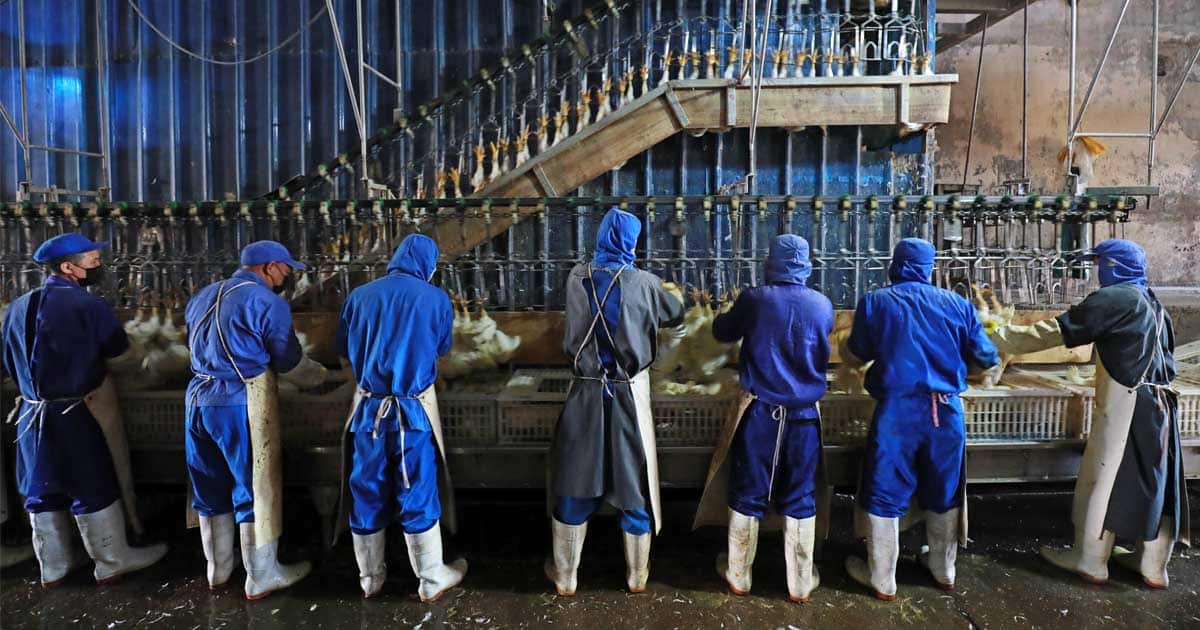
There it is. Slaughter. Horrible under any circumstances and now the USDA wants to kill even faster with high-speed killing.
What have we come to? We’ve got a team of experts here to discuss it. I want to go straight out to Leah Wilborn of InDefensive Animals.
For those who don’t know, why is this so horrible?
[Speaker 2]
Well, first of all, like slaughterhouses aren’t terrible hell holes for animals enough already, this new proposed rule is pretty much guaranteed to increase suffering for animals. First of all, the animals are who I’m here to defend, first and foremost. When slaughter lines are set up, workers, of course, are rushing, they’re under pressure, extreme pressure and intimidation from their bosses, mistakes are made, injuries happen, and the first to be harmed are the animals.
So those in these situations, these animals, oftentimes I watch hours and hours, unfortunately, of slaughterhouse footage in my work in order to do videos for alerts for InDefensive Animals. I’ve seen hours of footage in slaughterhouses without these speeds being sped up already. And a lot of the time, these precious individuals are still conscious when they’re being slaughtered.
So these sped up slaughter lines are going to increase their suffering, are going to make it so that workers don’t stun properly. And even stunning doesn’t even guarantee that the animals will be unconscious while they’re slaughtered. So it’s a horror show.
[Speaker 1]
It is a horror show. And I want to go to Jose Oliva. Thank you so much for joining us, sir.
And you speak up for humans, the people who are forced to kill. While, you know, so many Americans run around talking about, oh, peaceful, love animals, and yet they’re not coming to terms with the fact that there are people who have to do this day in and day out. You’re with Heal Food Alliance, and you’re the campaigns director.
Jose, tell us the impact that higher speed killing lines will have on the human beings whose job it is to do the killing.
[Speaker 3]
Yeah, first of all, thank you for having me. Secondly, yes, the impact on humans is also egregious. The conditions in these plants is dire.
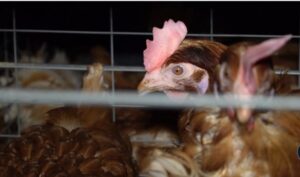
Most of the workers, and just for context, there’s a little bit over 27 million food workers in the United States. And that includes farm workers all the way up to grocery store and restaurant workers, right? So it is the largest workforce in the U.S., and the lowest paid and the one with the worst conditions. So in this particular sector, what we’re seeing is that for poultry, for instance, or for chickens in particular, the line speed was already over 140 birds a minute. So just imagine doing a repetitive motion many times during one second for a 12-hour shift and knowing that if you step away from the line, you’re going to get a red mark. And after three red marks, you are fired.
And that means that if you have to use the bathroom, you will get a red mark. If you are ill and you have to step away, you will get a red mark. So folks have basically started to use diapers, adult diapers on the line so that they don’t get the red mark.
And that’s just one example of the many horrendous things that these workers have to do. Repetitive motion illnesses like carpal tunnels is so prevalent in the industry that the company doctors don’t even recognize that as an illness for the workers in that industry anymore. And things like being able to go home and have a peaceful evening after work have become sort of almost a real, people can’t do that anymore because they have PTSD from seeing and killing animals all day long.
So it’s just a horrendous industry all around. And taking away even the slightest way of protecting workers in it just makes it that much worse for everybody.
[Speaker 1]
Tell me once again, how many they’re killing now per?
[Speaker 3]
In chicken particularly, they all have different line speeds because the animals obviously are different. But in chickens, it is 140 birds per minute that are going by the person and the person has to do whatever cut or whatever part of the animal that they’re removing. They have to do it in less than a second because they are having so many birds flying by, no pun intended, right?
But that is literally how the industry operates.
[Speaker 1]
Wow, thank you for that. That, whoa, so, so I almost don’t have words. What kind of society are we?
What have we become? I’d like to go to Amanda Hill and also Delce. You’re both with this incredible organization, Vermont Law and Graduate School, Animal Law and Policy Institute at the Vermont Law and Graduate School.
It is a mouthful, but that’s because you’re doing incredible work. Amanda, just give us the lowdown and then we’re going to save the best for last, Delce, after that.
[Speaker 2]
Oh, well, in that case, well, let me be quick. Well, thank you for having me. Thank you for this important discussion.
What I’d like to add is this is not a new topic, but this is the first time they’ve given up on really, this particular administration given up on regulating line speeds at all, essentially. So, you know, Jose was talking about 140. Well, now they’re saying 175 and maybe no line speeds when it comes to poultry.
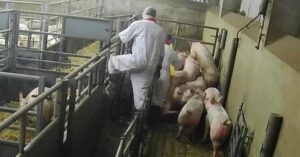
The same is true with pork products and pigs. You know, we, we, we were saying, you know, roughly three seconds or two and a half seconds to inspect a 250 pound hog. And now we’re looking at, you know, whatever works for the plant and we’ll just let the USDA inspectors watch out for us.
But what I would like to tell your, your audience, Jane, is, you know, our watch, our federal watchdogs are not watching. And it’s not, it’s not because they don’t care about the public’s health. It’s not that because they don’t care about animal suffering.
It’s because they are impeded from doing their job every day. And they are, are calling out for, for help. And they’re looking for people like us to really move the USDA to do the right thing and start listening to their inspection personnel and start really paying attention to all the externalities that occur when a federal inspection is weakened to the point that it has been.
We’re looking at threats to the workers themselves, which Jose discussed and we talked about. Of course, the animals are very much committed to this process, one way or the other. But what about the consumers at the end of the day?
Are they getting cheap and more abundant pork? I would say not. They’re getting potentially very dangerous products that are very much degraded from the wholesomeness that they had once known even just 10 years ago.
So this isn’t a slippery slope. This is a, this is a cliff and we’re on it. And we need people to start attention.
[Speaker 1]
All right. Wow. We’re getting comments from people.
Let’s not call these animals, pork, beef, and poultry. They’re pigs, cows, chickens, turkeys. They are individuals.
Absolutely. It’s getting worse. There are more and more chickens in the UK.
It’s disgusting. Go vegan if you’re not. Nilo Farr says, I have successfully submitted my comments and many in my Signal group have as well.
Excellent. Thank you, Nilo Farr. I also submitted my comment right here.
And, you know, I didn’t do it perfectly. I made a mistake on one word. Instead of billions, I put billion.
But you know what? That’s not the point. The point is to get a lot of comments in.
We need to get a lot of comments in. So I just want to let everybody know that the two places to comment, one for poultry and one for pigs, we are putting those in the comment section. And they’re also in the introduction.
If you do nothing else, comment, comment, comment. It’s so important. I commented.
We saw Nilo Farr commented. We need to get those comments in. But even more than that, we need to be strategic about how we are going to fight this.
So enter stage left, Delci Winders. Delci, you are with this incredible organization, Animal Law and Policy Institute at Vermont Law and Graduate School. You are the director.
Tell us, what are your plans to stop this? Because as much as we’d like to say that comments will stop it, there’s got to be more than that.
[Speaker 4]
Yeah. And unfortunately, this is an issue I’ve been working on for too many years because industry and the USDA keeps trying to deregulate and speed up slaughter. But there’s some really incredible coalition work that has been fighting back for years.
And folks are working together, Jose and Amanda, and many others are working together to make clear the animal welfare, the environmental, the worker safety, the consumer safety impacts of this. And so the comment period, you know, of course, in an ideal world, we would persuade the USDA not to do this. But I’m a little more cynical than that.
I’ve been doing this work for too long. So really, this is our opportunity to build a record so that if and almost certainly when the USDA decides to move forward with what it has said it wants to do, we are ready to sue over the rule. And we have put all of the evidence about the, I mean, we know from undercover investigations and eyewitness testimony in pilot high-speed slaughterhouses about the animals who are going into scald tanks fully conscious, the downed animals who are having a hook put in their mouth and dragged.
We have all that evidence. So we’re getting it in front of the agency so that if and when we need to sue, that will be in front of a judge at the appropriate time.
[Speaker 1]
Assuming you are going to sue, do the comments help?
[Speaker 4]
Yes, absolutely. Comments are hugely helpful. The entire legal process is built around the comments.
And so the agency actually has a obligation to consider and respond to all of the comments that it receives. It’s much more powerful to submit individualized comments. Oftentimes, organizations will send language that you can submit, and that’s certainly better than nothing.
But if you can tailor them, that’s even better. And that is what the agency has to consider. It’s not allowed to just ignore information that’s in front of us, in front of it, rather.
And if it does so, then a judge can overturn it. And that’s exactly what happened a few years ago when they tried to do this exact same thing before. And with pig slaughter, they refused to consider the worker safety impacts.
There was voluminous evidence submitted with comments about the many harms to workers that Jose mentioned. And a court said, you failed to consider the impacts on workers. Therefore, you cannot speed up the slaughter lines.
[Speaker 1]
Wow. Well, I think you’ve really underlined the fact that don’t assume because Delcy is going to sue that you don’t have to make comments. The comments are super important.
And I want to put them up in various ways because you could take a snapshot right now. Anybody who’s watching, just grab your phone camera and take a snapshot of this. These are the two comment pages.
We also put these in the comment section if you’re watching on social media. And if you’re watching on the Unchained TV streaming app, they’re in the description. But the point of this entire exercise is to get people to comment.
I saw in one of them, there was about a thousand comments. We had to get a lot more comments than that. Leah Wilborn of InDefensive Animals, I know that you’re getting ready to do a massive email blast to your many hundreds of thousands of followers.
For those who are sitting there watching this saying, this is awful, but oh my gosh, I’ve got a list of to-dos a mile long. I’ll put this in the burner. What would you do to encourage them to take a snapshot of this and follow through and make comments?
You know what I did? I copied and pasted my comment for the chickens and I put it right into the pigs. So you could just write one comment and you could also have AI help you.
Somebody emailed me and said, I can’t think of what to say. I’m paralyzed. I put it in AI, I said, here’s an idea, but why is it so important for people to comment?
[Speaker 2]
Yes, absolutely. So InDefensive Animals, we are going to be sending out an alert very soon, working on that video right now. And we are also in deep solidarity with Animal Outlook, who’s also been doing work on this and sending out email blasts.
Free From Harm is another organization that really challenges those in Congress. So when we send out our alerts, this goes to around 200,000 people around the world. And these alerts can be shared on social media, of course, and we put in a suggested comment, but people can submit their own personalized comment, which absolutely is usually more effective.
And also there is another way. So I would suggest www.idausa.org slash take action and keep your eyes on that because this alert will be coming soon. But I would also recommend these links that Jane has posted, share all over social media, please.
And also there is a capital switchboard phone number that anyone can call because pressuring our senators and representatives. So if you call, now Jane, here’s the phone number. I only just thought of this before, but we are going to add this to our alert, but it’s 202-224-3121.
That is 202-224-3121. You just call that number, you enter your zip code, and it’ll put you through to your representatives because it’s very, very important that people in Congress are feeling pressured by their constituents because unfortunately the USDA has an inherent conflict of interest. They are the agency in charge of supposedly regulating this slaughter industry while also in charge of marketing it and promoting it and funding it.
So sadly, as our other wonderful guests have pointed out, we can’t really rely on them to do the right thing. So they have to feel pressure. And I also absolutely want to say that of course, in defense of animals, all of us, we are absolutely advocating for the humans in this situation too, because working in slaughterhouses is one of the most, if not the most dangerous job that anyone can do in the country.
And the majority or many, a large percentage, we don’t have the exact numbers, are undocumented immigrants who face intimidation and all kinds of punishments and faced with deportation if they need to go to the bathroom, if they’re suffering. There was a worker who died last year. He fell into a machine of blades and it killed him.
And he was an undocumented immigrant with a family at home and children. So this industry doesn’t only not care about animals, it doesn’t care about humans either. And we need to get real with the public about that.
[Speaker 1]
Yeah. Let me show you what Agriculture Secretary Brooke Rollins said, that this is bringing our regulations in line with proven real world capabilities. When I saw this, I said, oh my God, I mean proven real world capabilities.
If I have an automatic weapon, my proven real world capability would be to fire it many times. Just because you have the capability to do something doesn’t mean that you should. It’s actually a terrifying thought.
As a woman, it really saddens me that it’s a woman who’s the Agriculture Secretary pushing this as I would hope that there would be some shred of nurturing in her soul that would look at the horror that these animals go through and realize that they’ve already lived completely miserable, torturous lives. And then to speed up their killing at the end of their lives is just unconscionable. But I want to go back to Jose because this is obviously also a problem of consumption.
There are so many people I know personally who go out and they’re doing their yoga and their namaste, ahimsa, blah, blah, blah. But they’re completely blind to the fact that there’s an entire category of people who are out there doing their killing for them, who are on the lowest rung of society, who do not have much choice about what jobs they’re going to have and who are being persecuted. And now, to the point where they have to wear adult diapers on the kill line so that they don’t get fired.
And now this. What would you say to those people, those consumers who just want to distance themselves from this entire process?
[Speaker 3]
Yeah, I would say that the way that we shop has an effect, right? So obviously, we should always look for the labels that have humane in them. But we should also remember that one individual shopper is not going to make a difference.
There is much more power, and I want to stress this word power because I think we forget how change happens, right? Change doesn’t happen because there’s a benevolent government that gives that demand to us. It happens because there are people who grow power and are able to demand that something changes.
So in this case, what we’re talking about is actually bringing together, I think Julia said it really well, right? Not just the folks who care about how the animals are treated, but folks who care about how people are treated, how the workers are treated. People who care about what these factory farms are doing to the environment.
People who care about their own health, right? Because this is literally impacting how we as human beings are able to grow and sustain ourselves, right? So all of that means that if we get all of those people together, we will have a lot more power.
So the comments are great, the lawsuits are great, but also people power, right? We need to demonstrate to the USDA, to the Trump administration at large, that we are not, as a people, are not in agreement with this. And we are willing to mobilize in order to get that, of course, I’m talking non-violent mobilization, but we are willing to mobilize in order to get this done, right?
So people who are literally dying because of these changes in the line speed and then some, right? It’s not just the line speed, but the industry as a whole has been very deregularized. There’s no regulations almost in the industry during the Trump years.
And that means that folks, like Lydia said, right, could fall through a cage that wasn’t secured correctly. One of the most horrible and undignified ways of dying that I can think of is falling into a manure pit. And that happens all the time to workers.
And why do workers not stand up to their bosses to do something? Because, yes, there’s a lot of undocumented workers and the best strategy is to essentially to not lift your head up, right? Because if you do, then you’re identified and you can be fired or worse, you can be deported, right?
And especially in this environment that we’re seeing around immigration enforcement, that is a real threat. It no longer feels to these workers, like it’s just a threat, right? It feels like, yes, this could actually happen to us.
[Speaker 1]
Wow. You have been so eloquent on this subject. And I think it’s very important for those of us who are in the environmental movement, the animal movement, the plant-based movement to join forces with people who are in the workers’ rights movement.
And that’s why I’m so thrilled that you’re on today, Jose, talking about this. I want to just put up some of the comments that are coming in. Donnie Moss says, as it is, slaughterhouses are medieval torture chambers.
When future generations see footage of animal slaughter, they will probably think they are seeing AI. Humane means nothing. Wake up and go vegan.
There’s more suicides now because humans don’t want to kill them. And that’s one of, my understanding, is a higher risk of suicide to some of these people who are in there killing every day. Tina Walker says, don’t pay for the murder of these vegans.
Go vegan’s the only way. And thank you for a shout out to Unchained TV. Michelle says, this new rule is nonsensical and extremely cruel for both the animals being slaughtered and humans doing the killing.
It’s beyond depraved. How greedy are these corporations of government to risk all lives? Horrific.
Unacceptable. Okay. And then we just want to put up the phone number again, 202-224-3121.
Call your representatives and tell them you don’t want this. Paul Paris says, don’t kill them faster. Don’t kill them slower.
Just don’t kill them at all. I want a government that wants to help pigs and chickens live longer. We share this planet with other life forms and other animals, and we need to be better neighbors.
Simple as that. Okay. They don’t care about the workers.
And then the most important thing, here are the comments. Toronto Pig Save shared this. Again, you can take a snapshot of this, and then literally it’s not that difficult to copy, you know, regulations.gov forward slash comment on forward slash FISS, and then those numbers. It’s not the hardest URL in the world, but it is crucial. These pigs and these chickens cannot comment for themselves, people. So please, whatever you do, take the time.
It took me five minutes to do it. Five minutes to speak, because I think a lot of times in our movement, we want to talk amongst ourselves and spend a lot of time beating our chest and saying how horrible it is. But the important thing is to tell those in power how you feel.
So I want to go back to Delce and talk a little bit more about the lawsuit. Again, public comments really helped the lawsuit. But tell us what your strategy is.
I don’t want you to give away any inside baseball that could help you down the road, but this must be a monumental undertaking. Tell us more about what you’re doing.
[Speaker 4]
Yeah, and I really want to underscore that it’s not just me. It’s not me alone. There are a lot of organizations involved, and one of the beautiful things about industrial animal agriculture is that it harms everybody except for this really small handful of multibillion-dollar corporations, multinational corporations.
And what that means is that we have this amazing power across all of us, as Jose was saying. And so this moment, this is our limited window. We cannot introduce any more evidence, any more information down the line.
This window, which ends on April 20th, the comments is the only way to get evidence into the record. And so we are getting evidence into the record about the impacts on workers, about the environmental impacts. And one of the important, often overlooked things about this is it’s not just impacting things at the slaughterhouse.
It is facilitating the raising and slaughtering of millions and millions more animals. So the last time the USDA tried to do this, it estimated that 11.5 million more pigs would be factory farmed and slaughtered every year. And so there is no legal oversight of those animals at the factory farm, no federal oversight, no state oversight.
There’s this limited window when there’s ostensible oversight at the slaughterhouse. But we really need to get all of that evidence in front of the government right now, because that is going to put in motion everything that we can do for very possibly years to come. These fights are not swift.
[Speaker 1]
I want to talk to Leah of InDefensive Animals and ask you, how are we really going to mobilize people? Because there is sort of a sense of overwhelm. There’s so many horrible things happening on so many levels, on so many fronts.
But for those who are going to comment, some ideas about what to say. Somebody just said, I need to get some ideas from IDA on what to comment. So you’re here, you’re representing InDefensive Animals.
What would you say to that person?
[Speaker 2]
Well, I think it’s really important that we all are educated on the fact that this is inherent in all of animal farming. This is not just industrialized. This is not just factory farming.
I wrote an article for the InDefensive Animals website called Fixating on Factory Farms Limits True Reform for Animals and the Environment. Because when the industry sees that people are getting upset about animal cruelty, they just relabel and they have humane certifications. I just did an alert on humane certified.
That’s also in the IDAUSA.org slash take action. We are targeting the certifiers themselves because they too have a conflict of interest. They are getting paid by producers to give out those certifications and those certifications help to increase sales.
Now, whether it’s a small farm, a local family farm, or a factory farm, all these animals are exploited and they’re all sent to the same slaughterhouses. This is the underlying issue that we have to face is that it really does come down to a large part of it is consumption. The other part of it is the subsidies, the skewed subsidies system.
800 times more public funding goes towards animal ag than towards animal free alternatives. Even if we aren’t buying animal products, our taxpayer dollars are going towards this. This is an inherently corrupt system.
This is what politicians need to be pressured about, which is you can’t be taking money from industry anymore. It’s a very similar issue to elections is when politicians are taking money from constituents or not from constituents, but from industries to influence what they sign bills and pass bills on. I believe that we really need to talk to and pressure politicians in Congress and the USDA and say, you must start transitioning this food system to a slaughter free plant-based food system.
It is the only way to save our planet, to save animals and humans. It can also help to solve world hunger because we could feed over 4 billion more humans if we switched over to plant farming for humans and the top nutrition organizations in the world have stated that a balanced plant-based diet is healthy for all stages of life. This is the future and this is what we need to be advocating for.
[Speaker 1]
Here’s this gentleman. Mike says, is there a website with simple suggestions on what to write? Here’s the thing.
I put some stuff in the comment section. If you’re watching this, let’s say on Facebook, the introduction has three key comments that you can make. You can also just speak from the heart.
The comments are heightened animal suffering at accelerated speeds. It becomes nearly impossible to ensure that animals are stunned properly. You’ve got the severe worker hazards.
They face a dramatic increase in repetitive motion injuries. You’ve got compromised food safety. This means less time for inspectors to identify fecal contamination, abscesses, or disease.
You can also just speak from the heart. That’s what I did. What I said was, and again, I was doing it quickly before the show.
I forgot one little letter. Instead of billions, I wrote billion. Here’s what I wrote.
Dear Secretary Rollins, killing faster is not going to solve our affordability issues. It’s only going to increase suffering for billion, meaning billions of pigs and chickens already living miserable, torturous lives, and increase the risk of injury and poor decisions for the people on the lowest rung of society whose job it is to kill these animals. The decisions we make in life should never just be about what’s going to make something cheaper.
There are serious ethical considerations here. It is morally reprehensible to cause unnecessary suffering. Faster speed lines will cause just that to animals and humans.
I implore you as a taxpayer and a consumer not to move forward with this reckless plan to kill faster. Please, Americans don’t want to be forced to subsidize institutionalized cruelty and sadism. That’s what this would do.
Don’t do it, please. I didn’t consult encyclopedias. I just told them how I felt.
That’s all you have to do. It doesn’t have to be war and peace. It can be a short comment.
The main thing is to get those comments in there. If you love animals, if you want to advocate for workers’ rights, if you want to advocate for the environment, this is an environmental catastrophe because more animals will be being killed. One day, as we hurdle toward a climate apocalypse and animal agriculture’s role in climate change is being ignored, I just finished a documentary on this called The Climate Dealers, where animal agriculture’s impact is systematically underrepresented.
It’s deceptive accounting and they know it, but there will be a moment where we will have accountability, meaning the human race will face accountability. As a very brilliant man, Silas Rau, a systems analyst, said in this documentary, people think they can just keep going on as usual and nothing’s going to change, and that climate change is something way over there. What he said that I thought that really struck is the economy lives inside the ecology.
When the ecology collapses, the economy will also collapse. This gets back to the whole justification for this. I’m going to put up the USDA press release headline, USDA takes action to lower food costs on consumers and strengthen the supply change through proposed changes to line speed rules.
Amanda Hitt, they’re basically saying, well, we have justification because we’ll make this cheaper, but that’s very short-sighted thinking. Your thoughts?
[Speaker 2]
Yeah, I think that the hope is that it will make things cheaper. If I could just tag a little bit off of your climate conversation and the impacts of climate on pigs, for example. I had an opportunity to talk to a former USDA veterinarian.
One of the things she was talking about was with climate change, we’re seeing a lot of really abnormal peaks in temperature, really high record heat days. In one facility, she witnessed pigs being driven into the slaughter line at very high speeds, but they were panting heavily and collapsing because of the extreme heat. When she asked about why they had not turned the misters on to cool the pigs down, she discovered that they were saving on their water bill, the plant was.
This isn’t small. When Secretary Rawlings makes the claim that we have a capability, she says, bring our regulations in line with proven real-world capabilities. She has never proved that she can operate a safe and humane slaughter line at the speeds she’s recommending that we adopt in these proposed rules.
I push back on that a lot. As far as the costs of meat, I just want to reiterate to the people that are watching and if they hear those claims that say, oh, well, we need to make this available for more people more cheaply. Please understand that you’re doing so at the peril of your own health as a consumer of those products, but also at great environmental cost.
Again, thinking about the water consumption alone and absolutely with the handling of animals and the complete lack of concern about human safety and plant workers.
[Speaker 1]
Again, if you’re watching, just take a snapshot of these links and then you can just type it out, put those URLs in. I commented. It took me five minutes to comment.
You can comment as an individual, as an organization, or anonymously. Actually, when I tried to comment anonymously, it wouldn’t go through. It said it was an error, so I commented as an organization.
I don’t know if that’s an interesting way of finding out who’s opposed to this, but yes, we commented as an organization. It’s not so much trying to win a penmanship or a writing award. It’s about getting those comments in.
These people will glance at these comments and they will see how many people commented. That’s the main thing. Don’t worry about, oh, I’ve got to have the most brilliant comment on the face of the earth.
No. The point is to get large numbers of people commenting. Nothing could be more important than this.
That’s why, thank you, Adita. Thanks for covering this. Thanks for the work everybody here is doing to get this done.
So many people are saying, hey, yes, climate change is upon us and animal agriculture is a leading cause of climate change. Whether or not you want to admit it, whether the powers that be admit it, because they’ve been co-opted by the meat and dairy industries. Media, I was in mainstream media for 37 years.
I could tell you unequivocally it is co-opted by the meat and dairy industry. All you have to do is look at the advertisers, Big Meat and Big Pharma, almost every commercial with a couple of insurance commercials thrown in. The government has been co-opted.
As you’ve heard, it’s a conflict of interest. So this is a David and Goliath battle. But if everybody gets together, and at the very least makes these comments, then you can go to sleep tonight knowing, okay, I did my part.
Here we go. Some final comments, and then we’re going to get final thoughts. We are sold.
Now I would suggest having suggested comments on a webpage with a URL you can give out. Okay, that’s something maybe IDA can put into action. Great idea.
And Tom says animal agriculture and fossil fuels are by far the biggest contributors. Yes, but people talk about fossil fuels. They don’t talk about animal agriculture.
And the mainstream media isn’t reporting on this. Yes, I think we need to go back to that quickly. You know, we here at Unshade TV report on stories that should be reported on the mainstream media.
And I’d like to go to Jose on that, because we know in the animal rights world that stories about animal suffering are routinely ignored or distorted by mainstream media. But workers’ rights, the lives of these workers, especially when it intersects with another big story, which is the immigration issue, is this issue getting the kind of coverage it deserves, Jose? And what can we do to get the New York Times, CNN, Washington Post, MS Now to cover this?
[Speaker 3]
First of all, thank you, Jane, because you are covering it, and that’s one step in the right direction. You know, part of the problem is that the same industry leaders that are the ones that are controlling our Congress are also controlling the media. And when I say controlling, I don’t mean, you know, in some back room, making a deal, telling people this is, or telling the reporters, this is how you have to report on this issue.
It’s more insidious than that, right? The way that it operates is the same way that it operates in Congress, and that is that these folks are the ones that are paying the bills, right? So if they’re paying the bills, you don’t bite the hand that feeds you.
And thus, what you do is you go with the program, right? And why are you going to the boat if you are literally in the boat? So my sense, and I’ve been saying this all along, and this is what HEAL stands for, right, is that we have to look at this systemically.
This is not just one thing or one issue that is affecting one group of people or one group of animals. This is a system that is built around exploitation and extraction. And until we all get on the same page and address the system, we’re going to continue to see this, right?
And we’re going to continue to see it not just in animal agriculture, but in a number of other spaces, right? So to me, yeah, the media is a culprit, and they’re going along with it. I don’t know that we’re going to get coverage or the kind of coverage that we deserve around these issues, even if we are the ones that are working in these plants.
And we’re literally, like I said earlier, right, 29 million of us working in this country to feed the people of this country, whether it’s on farms or these processing plants or warehouses or transportation or the grocery stores or the restaurants, right? Who works in all those jobs? It’s mostly immigrant workers, right?
And that to me is something that the media will continue to ignore essentially because their advertisers are not going to be with the program if they start reporting otherwise.
[Speaker 1]
Well, I was in the media for many years, and I think there are creative ways to get the media to force their hand on occasion, even if it means going right to the headquarters of the media and standing in front of the main headquarters in New York City and Washington, D.C., and making it honestly about the immigration story. Because I know from being in mainstream, having been in mainstream media for many years, that stories come in trends and impacts. And when there’s a big issue, there’s a tendency for reporters to cover that issue, okay?
I’ve seen it with many things. I saw it with the AIDS crisis. I saw it with Me Too.
I’ve seen it with Black Lives Matter and many, many other issues that when it becomes the dominant issue of the day, reporters will cover that issue. Assignment editors will hand out assignments for that issue because that’s a big issue that is trending. And so with immigration trending right now, I think it would be a perfect opportunity to intersect this with the immigration issue and get the New York Times and CNN and MS Now to report on the fact that this will make already difficult, difficult lives even more torturous, and do it from a human rights perspective.
I think it’s wonderful that we’re finding commonality with the human rights movement because animal rights is human rights. Human rights is animal rights. Animal rights are human rights.
Human rights are animal rights, however you want to say it. So I just want to get final thoughts from everybody. I know you’re all very busy, working hard on this issue.
Let’s start with Leah from In Defense of Animals. Your final thoughts.
[Speaker 2]
Please, everyone, share this on your social media. If you don’t have social media, email everyone you know. And with these two links and just all you need is three, four, five bullet points.
If you care about animals, if you care about workers, if you care about immigrants, if you care about our planet, and have people recognize that this industry, animal ag, is not helping, it’s actually hurting all of us, including the absolute most defenseless and vulnerable humans and precious animals.
[Speaker 1]
And I keep putting it up. I’m putting all the comments up. You can go through and just literally copy this off the comment section.
Next up, Amanda, what is your final thought on this subject?
[Speaker 2]
I would just let people know that this industry hasn’t been able to self-regulate since the late 1800s with Upton Sinclair’s The Jungle, and nothing has changed since except for they’ve gotten bigger, faster, and more consolidated, more powerful. So now’s the time for you to speak up, and we certainly hope that you do.
[Speaker 1]
Excellent, thank you. Your final thought, Delcie?
[Speaker 4]
Yeah, I want to take a step back, because like I said, this has been going on for a long time, more than a quarter century. And so if folks are getting interested and getting involved and using law and policy as a lever to advocate for farmed animals for other animals, we would welcome you joining us at Vermont Law and Graduate School, whether it’s for a short online class, getting a certificate, or getting a full-on degree if you want to. And you can get information about that at vermontlaw.edu slash animal law. And we have students who are working on this very matter. We’re very focused on hands-on experiential training.
[Speaker 1]
Wow. Oh, that sounds very enticing. I would love to do that.
Jose, your final thoughts, sir?
[Speaker 3]
My advice is going to be very similar to yours. People should take action. And yes, the comments are really important.
Let’s get comments in, but also organize. Get yourself together with other people that are like-minded and begin an organization or join an organization. There are many organizations all over the country who care not just about this issue, but all of our food system.
Look us up. We have over 60 members all over the country. We can connect you to the organization that is nearest you.
This needs to end, and we need to end it now.
[Speaker 1]
Thank you so much. My final thought is no human being should have to wear adult diapers on the job because they’re not given the opportunity to relieve themselves, and that they’re so terrified of being deported or fired. There’s also a lot of people who get out of prisons and they’re directed to the slaughter industry.
It’s unconscionable. It’s terrible for animals. Obviously, it’s terrible for humans.
And I’m just going to say, people, if you’re eating animals and you’re saying this has nothing to do with me, I respectfully correct you and say it has everything to do with you. At the end of the day, this is a consumer issue. If you want to save money, you can get a sack of brown rice and a sack of black beans, and you can live more cheaply than eating any animal products.
This myth that, oh, eating a plant-based diet is too expensive, it’s a PR scam. It’s not true. And so I would urge you to look at what’s on your plate and realize that a solution to a lot of these problems is right there on your plate.
But the most important thing right at this very second is to comment. And so I urge everybody, please comment today. The pigs, the chickens, the turkeys cannot do the commenting.
And I’m going to put it up one more time just so that everybody has it. No excuses. If you said I missed it, just whip out your camera right now and take a shot, and you can easily copy down those URLs.
It takes literally less than five minutes. You can copy and paste the first comment for the poultry down to the second comment for the pigs. Get those comments in.
It literally is a life or death matter. Thank you so much for joining us. And I’m going to leave us with a video that was taken a couple of years ago at a vigil for pigs here in Los Angeles headed to slaughter.
I won’t show you the whole thing, but just to give you a taste of just the extraordinarily awful lives these intelligent animals live up until the moment of slaughter. That’s something we also have to change. Thank you very much.
Let’s do this. Let’s stop the speed up.
[Speaker 5]
The reason we’re here is to give water and bear witness to the pigs. So when the truck comes up, you’re going to wait until it comes to a total stop, and then you can approach. And if you brought a sprayer or a water bottle, that’s when you’re going to give water to the pigs.
[Speaker 1]
Eat your bacon, eat your ham, eat your hot dogs, all of them. This is the reality of animal agriculture that most people don’t want to face. They want to pretend that these animals live happy, lovely lives, frolicking in the dirt, and they don’t.



 Veganuary 2026: 30 Million People Tried Vegan—The Remarkable Rise of the Movement