
Wild Horses Face a Critical Fight as Advocates Challenge Federal Roundups
Share This
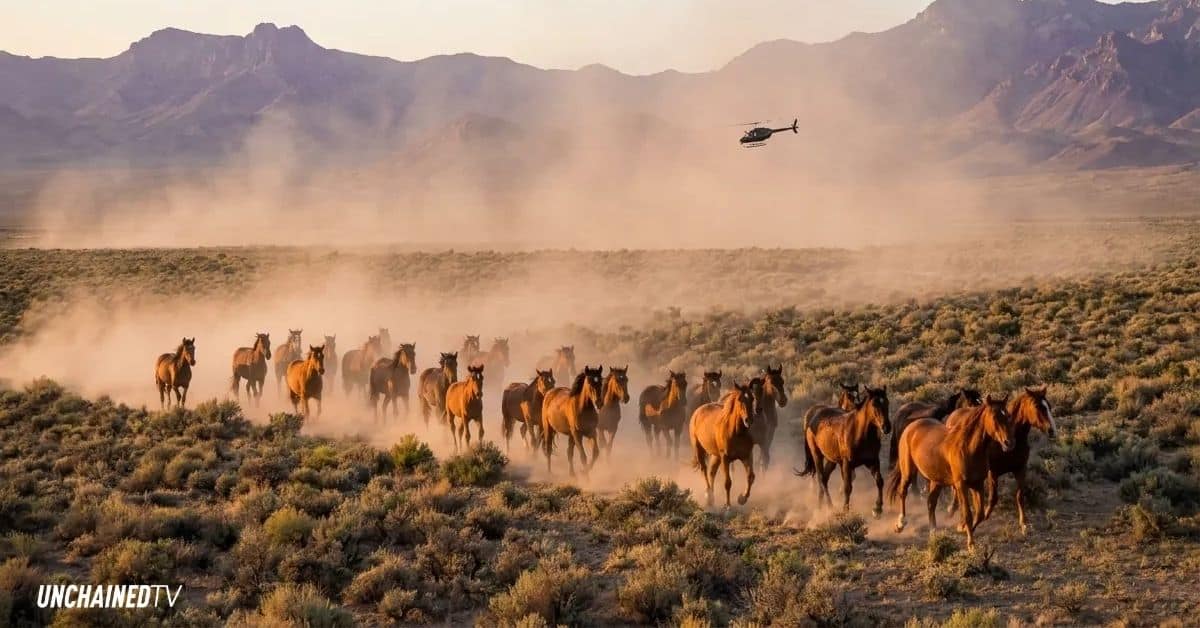
An emergency town hall is sounding the alarm as advocates say helicopter roundups, shrinking protections, and political pressure could reshape the future of America’s wild horses.
Lancaster, PA – July 21st, 2026
The thunder isn’t coming from a storm.
It’s the sound of helicopters sweeping low over the American West, driving terrified bands of wild horses across miles of rugged terrain. Dust fills the air. Foals struggle to keep pace with their mothers. Families scatter. Some horses collapse from exhaustion, while others suffer broken bones or fatal injuries in the chaos.
For decades, this has been the reality of the Bureau of Land Management‘s (BLM) wild horse roundup program—a practice the agency says is necessary to manage growing populations on public lands. But to animal advocates, it represents one of the nation’s most overlooked animal welfare crises.
That debate has taken on renewed urgency.
In a recent Emergency Town Hall for Horses, hosted by Action Hour and featured by UnchainedTV, advocates, legal experts, and longtime wild horse defenders came together to warn that America stands at a crossroads. They say decisions being made today could determine whether wild horses continue to roam the West—or spend their lives confined in government holding facilities.
How You Can Help
Organizations like Heart of the Wild Equine Rescue work tirelessly to save captive wild horses and burros as they come up for auction, competing against the kill buyers who put the animals on trailers for a hellish ride to Mexico or Canada where they are slaughtered. Every dollar helps as the horses are often sold for much less than the general public would imagine. Sometimes, five or ten dollars means the difference between life and a torturous death. This also involves a constant struggle to find adoptive homes for the horses and burros who are saved from the kill buyers.
A Symbol of Freedom—Caught in a Political Fight
Congress passed the Wild Free-Roaming Horses and Burros Act of 1971 after public outrage over the treatment of America’s wild horses. The law declared these animals to be “living symbols of the historic and pioneer spirit of the West” and placed them under federal protection.
More than fifty years later, few issues remain as controversial.
The BLM claims horse populations can double every four to five years without management, claiming that these roundups, which they euphemistically call gathers, are necessary to protect wildlife habitat and prevent the horses from starving.
Animal activists call that rationale nonsense noting that, at the start of the 20th century, there were millions of wild horses roaming the nation. Today, there are only an estimated 85,000 wild horses and burros roaming western public lands, while more than 60,000 are packed into government holding pens. Critics say the real reason the horses are being rounded up is to make room for cattle grazing by a beef industry that has co-opted the Interior Department, much as it asserts undue influence over the USDA and many other agencies of government. Horse rescuers and advocates argue that livestock grazing on public lands receives far greater priority than the wild horses Congress intended to protect.
Clearly, the helicopter roundups subject horses to extreme fear and physical stress. Critics point out that the roundups frequently separate family bands, and funnel thousands of healthy animals into long-term holding facilities where they languish at enormous taxpayer expense. As to why captive wild horses and burros are ending up at auction at such a high rate that numerous non-profits are devoted to rescuing them from the kill buyers, it boils down to the details of the BLM’s Adoption Program and what critics call glaring loopholes. The video below is decades old, but it highlights concerns that have not gone away.
Roundup & Repeat?
Animal advocates argue that the current system has become a cycle: remove horses, house them indefinitely, then repeat. Instead, many are calling for government management strategies that allow more horses to remain free on the range while cutting back on the number of cattle that can graze on public lands for the benefit of private corporations.
Why Advocates Say This Moment Matters
The Emergency Town Hall comes during a period of heightened concern among wild horse organizations.
Recent federal planning efforts, ongoing roundup schedules, and broader policy discussions surrounding public lands have prompted advocacy groups across the country to mobilize supporters, submit public comments, and raise awareness through education campaigns.
For many involved in the movement, this is about more than one roundup or one management decision.
They believe the future of America’s wild horses is being shaped right now.
Throughout the town hall, speakers urged viewers to stay informed, participate in the public process, donate whenever you can to highly regarded horse and burro rescue organizations and recognize that these animals are not simply another wildlife management issue—they are part of the nation’s shared natural and cultural heritage.
More Than a Western Icon
For generations, wild horses have embodied something uniquely American: resilience, independence, and freedom.
Whether viewed through the lens of conservation, animal welfare, history, or public policy, few animals inspire the same emotional connection.
The question facing the country today is not simply how many horses belong on public lands.
It is how America chooses to honor the promise it made more than half a century ago.
As helicopters continue to stoke terror and panic among wild horse herds on the western horizon and advocates continue pressing for change, the future of these iconic animals remains uncertain.
For those fighting on their behalf, the hope is simple: that future generations will know America’s wild horses not through photographs, documentaries, or government holding facilities—but by seeing them where they have always belonged.
Free.
Video Transcript
Welcome to Action Hour podcast. I have breaking news. America's wild horses need your help today. Major decisions are being made and hundreds of horses face helicopter roundups that could separate families and send many of them into government holding facilities.
Today I'm joined by three leading wild horse advocates to explain what's happening. Let's talk to them now. Welcome. I'm here with Karen Sussman and Craig Downer.
Both are wild horse advocates and I would say experts. They've both been advocating for wild horses for many, many, many years and we have some breaking news for you today. We have action you actually have to take today. Yeah, I gave my input on the 30th of June and this is a very serious proposal because it largely exempts the public lands ranchers and the BLM and I guess it probably influenced the Forest Service too from abiding by environmental laws and Wild Horse and Burrow Act when it comes to their plans for the wild horses.
In other words, they're not valuing the wild horses and burrows and they're letting the big monopolizers of the public lands call the shots and that's outrageous. But why is it so important? Like what happens to the horses when they're rounded up? Yeah, well they'll be eliminated pretty much from their legal areas or taken down to extremely low genetically non-viable levels and they'll allow the ranchers to have even more of a monopoly and the other interests in their legal habitats where they're supposed to be the principal resource recipient.
So they're really subverting the true intent and spirit of the Wild Tree Roaming Horse and Burrows Act and ignoring the general public in this wonderful quality of life issue by treating these wonderful animals as misfits and the truth is they're all the opposite. They're actually deeply rooted North American natives that are wonderful restorers of ecosystems as a keystone species. It's always been, you know, the cattle ranchers or other corporate interests come in and take over the horse's land that's theirs but it seems like it's accelerated.
Do you feel Karen that it has and if so why do you think it's suddenly it's even with all of these action items we have so many things happening to the horses. Why do you think that's happening right now? Well I believe that it has been going on throughout history where the cattlemen have always had a greater right to the land even though that they have a privilege the horses have a right but this is continued but in this particular administration they're very proactive cattle and what they're going to do is reduce all kinds of regulations that the cattle people have to do in order to
contain their keep their permits going and there's going to be fewer regulations for the cattle when in essence there already has been for years no regulations for cattle people. The BLM has been and the Forest Service has been negligent in being able to monitor the habitat to determine who actually is doing damage when they find out that the cattle are doing the damage they ignore it. Yes that seems to be the story that we continue to hear and this like I said this has been going on and it seems to be accelerating we are not Unchained TV is not a political channel or animal rights and conservation channel so we do not take political sides we want to state that right now but we are not in favor of either side approaching and I
think both corporate interests on both sides have done so in the past. Craig yeah that's that's for the Montgomery Pass wild horse herd that's one of the most pristine un-PCP'd, un-gonocond, un-castrated herds that's been studied for many years and it's a vibrant vital herd that they're trying to gut this herd and I did an appeal on this and now and we're doing we've done a TRO and so have two Native American tribes so it's not certain that the roundup
will start however I think it would be good if you contact the Inyo National Forest and I've given you the the website and you just go on contact us and you can voice your opinion and that's bound to to have make a difference if you're yeah I want to make Craig I want to make sure I can bring up the right one oh here we are Montgomery
herd correct uh yeah I sent you that yeah that's it right there it's up in the corner now so Craig as Craig's explaining and talking uh tell us a little bit more about why they're picking on this herd and what is so uh wrong with what they're doing the science behind it it's because we delved into this both the uh the medical doctor and the professional nature
filmer yeah Sherry Tobin and Carl Mrozek and we discovered that this is kind of a setup against these animals whereby they have excluded them from vital water sources and basically not given them any value in their own right but they've paved into the mainly the ranchers cattle and sheep there are a lot of sheep there and also to people who just use the wild horses as a
political pawn to favor say game hunting interests including there in California so it's really a terrible thing they're they're trying to do they're trying to scapegoat the horses for all kinds of things just because they move around and not taking any measures to take steps to avoid avoid these problems uh which some common sense steps could be taken and and they could avoid these problems okay Karen
can you go ahead and comment on that well so just to remind you we're talking about the Montgomery Pass horses go ahead right and basically it would be a simple a letter to the government to say please save these horses from being rounded up when you round up these horses you destroy their family bands and destroy them forever do not round up the horses right that's as
simple as that they have to get into detail they're just people who are concerned about these horses just a simple sentence or two that's all they really need to say right and I want to just just tell people how important this is to take these actions today now even if we are past the date you're seeing this afterwards still contact them because once we raise that public
awareness or rather the our politicians once we raise their awareness that we are watching we see things change we we just went through the Ridgeland Farms dogs and that lab closing so many things happening when when activists take action so please those of you out there watching whenever you see this please click on these links and take the actions we're talking about there's another really devastating proposal
which is to exclude the environmental oversight of the public lands ranchers and the input on that is due on July 13th and that's extremely important because if they exclude them from Endangered Species Act and National Environmental Policy Act and all the other acts you know Wilderness and Administrative then that would give them even more monopoly on the public plants in other words they would be totally calling
the shots for the BLM and Forest Service on public land ranching permits. Yes and with that one I've also set up I believe a link which I'm going to put at the top all of these links of this broadcast but if you scroll down in there you will see who to contact and there's even a little paragraph of what to say because a lot of times people are afraid to speak but let me tell you your voice has so
much power I think a lot of people get intimidated and they shouldn't this is so important. Yeah and if you've been there mention that that I go here and it's a big part of my life you know for my quality of life and what it means to them personally yeah. Okay we want to move on so that we can cover everything and I will give you guys each a chance at the end if we miss something that you feel is really important but Karen I want to put the focus on you and the Heber Herd I know you've been really really busy so tell us what is going on and how people can help you support you.
Okay our organization's been involved in saving the Heber Herd of Northern Arizona they're the really in my book the last herd on public lands that has literally been untouched from roundups and from a lot of manipulation and it's been more than 20 some years so in 2007 we filed a stipulation agreement with the Forest Service that they need to manage them in three areas and so we
have participated throughout all these years to make sure that we can protect this herd and very interestingly just in January the acting superintendent his name is Mr. Miller he put out a a word he put out a letter stating that these horses are not even going to be protected under the wild horse and burrow free roaming wild horse and burrow act but they are going to be unauthorized livestock and so for if they're unauthorized they don't fall under any law so we are in court as of April 23rd ISPNB is suing them right
now and the court case is proceeding I imagine that by July 15th we'll have an idea of when we're actually going to be in the actual court we've been just filing papers back and forth but the Forest Service has completely defied these horses as wild and free roaming and honestly this is what we won in 2005 when we initiated the lawsuit and the stipulation in 2007 they've
completely ignored it and just say that they're unauthorized so everybody please write please contact us we can help you to let you know what you need to be doing as we move forward because the case is going to continue to change throughout the next two weeks great and as you see right next to Karen that is the link you just take a picture of that with your
phone I'm sure everybody's familiar but if you're not you go to your camera you take a picture of it with your phone a little box comes up at the bottom you see that folks you see that and then that shows you it's going to the website so there you go that it's as easy as that contact Erin she needs your help she's doing amazing work as is
Craig. Craig I'm going to let you weigh in here on the Heber herd because I know that you work with all the yeah I did a study I've worked a lot with Karen and ISPMB and I did a study in 2021 that worked with assistants there that Karen introduced me to and it's a wonderful herd it's known to be self-stabilizing and also to be very good catastrophic wildfire
preventers by taking down the dry flammable vegetation but there's some kind of mean-spirited people around there that even they shoot them every year or so especially around Christmas and New Year's and there just seems to be kind of a negativity and that the Forest Service is in on this the Apache Sitgraves National Forest there in the Black Mesa Ranger District so yeah I really have so much
admiration for these herds such beautiful animals and they need we need officials that really protect them and not always look for excuses to get rid of them or cripple their populations and same thing with the Montgomery Pass or any of the herds like the Callahan herd in Nevada or the Pinot herd here where I live they're just everyone is special in their own right and all the
borough herds too wonderful borough herds and I heard that many of them are being decimated like the Lake Pleasant borough herd in near Lake Havasu in Arizona. Okay I want to cover the other two action items we have and then I'll circle around to each of you and anything we didn't discuss we'll get into more. The next one I believe is the Virginia Range herd the what is it called the Washoe herd?
Yeah the Indians. Okay let's hear about what's going on with that and Karen if you want to mention that. Yeah I've been really involved in that and I did an article in the Reno News and Review but this is really a nasty move by the between the Nevada Department of Agriculture and the Bureau of Land Management. They issued a categorical exclusion which excludes them from the NEPA requirements to do an environmental impact study and this is a major part of the historic Virginia Range herd.
Remember that's the cradle of the wild horse movement in America is the Story County and the Virginia Range that's where wild horse Annie first got going you know so this would just be atrocious and it would put them in if they were fenced off for that southern end of the Washoe Lake where they're by the way having a really good effect by creating beautiful meadows and all
the kind of birds and insects and there's a lot of willow trees and cottonwoods and it's a thriving ecosystem it's just a nasty thing and there are certain common sense things they could do on that east lake road like putting in certain overpasses, putting in lower speed limits, speed bumps or certain fence patterns that would enable them to cross without having the collision so they don't have
all that many collisions really there and they wouldn't put them into that desperate situation where they had to go up into the dry mountains where they claim their springs but there really aren't very many springs and many of them have with the droughts they're much lesser and that would force them over into Highway 50 to get to the Carson River and that's where they really would be
hit on Highway 50 because there's a lot of people that commute from Carson City out to those urban communities out by Silver Springs so I think we can win on this and some politicians are coming in now on the side of the wild like well that's that's encouraging I can I just want people to know that here is the link again each of these links are here
so you can go back freeze the camera click uh freeze the video and then click your camera get the link and just sign this petition uh this is we've seen this with other even with other other animals we saw this with the tule elk they tried to starve them out and and luckily people took action yeah and it takes the public's action I can't emphasize enough these
people are only two people they do amazing work that was point raised without your help point raised to the elk that we saved yeah I was part of that I went and testified and I used to go there when I was a student at Berkeley to study the seashore okay Karen did you want to weigh in on that at all what we were just talking about uh
the current roundups yeah I think the thing that I really wanted to get out to everybody today is um we need to really press the government on a different way of managing these wild horses because the way they're currently managing they're going to manage them to extinction and that is with roundups every four years they're destroying their family bands and that's one thing our organization has done
for the past uh 25 years is study wild herd behavior and we think we have pretty much an authority on how to do this and how to do it effectively so my goal is to get everybody out there to stop the roundups and to allow the horses to um again be able to uh I guess really they need to have some sort of rest time because within
every four years uh the government says that they um they double every four years and that their birth rates are 20 percent every year and uh they call that the win equus program and sadly I think through the fear of trying to scare everybody they're saying by 2040 the population of wild horses will be 2.8 million horses now we know we've just done this it's in our
lawsuit with the Heber herd right now um we believe that we have enough information now to be able to show that their win equus program that determines that 20 percent uh annual or daily or I should say yearly growth rate and doubling every four years is based on injured herds and not healthy sustainable herds that haven't been rounded up in 20 some years like the Heber herd
so I think this is critical information that needs to get out to everybody because it's the win equus program that really is going to put the fear in congressional people put the fear in other people to say that if we don't do something they're going to keep growing now do you have a link or some way that people can connect with the win equus program actually I
have a whole paper on it so I mean if anybody wants to contact you and they should contact me in fact I just sent it to the government yesterday and basically uh based on our herd that we have too which shows what happens and what is necessary to be able to save the horses once they have been rounded up in four years you have to really stop
these roundups and I think that's going to be critical but we have to understand why we need to stop the roundups it's not to do anything else but to allow these herds to recover from their injuries that they have received you know it's like when you go into a family in a community let's say a community of 100 people if you go in and you pull out
a mother in one family a father and another family children and another family what kind of family uh community do you have it's same thing with the herd when they round them up they destroy all of their family structures and through our 20 some years of study we understand that family structures are critical to minimizing growth and uh the heber herd is under three percent growth it's
not a 20 percent daily or uh yearly growth and this heber herd could really show um what we need to do to be able to change the management of wild horses but we're actually we're destroying the horses by rounding them up every four years we're destroying their family bands and we can't do that any longer never that's so critical that that information gets out to the public
now we have one more herd we're going to talk about for a moment it's the salt water herd greg you gave me the information so i'm going to let you take the lead on that yeah again that tonto national forest has really done a dirty trick by claiming that uh they're going they want to uh zero them out and um all the many people who rallied to
their uh for their preservation and i actually did uh two studies there one was simone netherlands in 2012 and then another and uh with support from the friends of animals in in defending their rights and i found that many of the claims against them were were phony claims like claiming they're destroying the habitat and i proved that there was abundance of plants and birds and that they
were uh actually keeping the going by eating the eel grass and also transporting nutrients uh through their droppings up into the the drier hills around there and uh greatly enhancing the the dry desert uh ecosystem as well and plus they were very popular among the people and uh but you know it's this this old uh cabal that keeps uh they're there i guess they're insanely greedy or
they're jealous of the the wild horses beauty and harmony i don't know what's going wrong with these people i know go ahead karen go ahead i think for people to understand that the salt river wild horses were never protected under the 1971 law they're protected by the state and that makes a big difference in trying to issue protections for these horses so that that needs to be
explained oh yeah but we we uh get into that a little bit more so what basically basically in 1971 they had by 1974 they identified where horses were all over the 10 for well actually i think there were 14 western states the salt river horses were never identified as wild and free roaming even though that they're on uh forest service land and uh an interesting fact is
that our herd that we managed the healer herd which was found in southern arizona those horses weren't identified as wild and free roaming but in 1996 secretary babbitt did um after isp and b did three months of uh investigation and we showed that those horses were there prior to for the oldest rancher that i interviewed there was 12 hours of tape but uh secretary babbitt declared them
as wild and free roaming i think for the salt river horses it would be difficult to be able to do that again today this the healers were identified in 1996 it was the only herd since 1974 to be identified as wild and free roaming we did try to do it with the alpine horses we had a witness that would have been perfect but um we did file
a lawsuit against the forest service to protect them they were never identified as wild and free roaming so sadly our witness became a hostile witness because his his family made him do that but anyway we we weren't able to secure that herd as wild and free roaming it's very difficult now to ever do that again because the other because of all of these different groups such as
the cattle ranchers and right drillers oil drillers and all these different companies coming and encroaching what about the data centers is that a threat have you heard anything about uh moving and it's particularly because they take up so much water etc anybody have any thoughts i i think what i'd like to notify everybody about is that public lands are at risk now because they want to privatize
public lands if public lands are privatized that means that wild horses will not be protected on them but they will come under state control and i know when wild horse annie who is our first president worked so hard to make sure that the states were never in control of the wild horses because she knew what would happen to them this is why we had federal legislation to
protect them and so uh this could be devastating if we lose our public lands so everybody please keep an eye out for any changes any sale of public lands to private to privatize this it'll be devastating for the horses yeah absolutely agree i'm gonna bring craig in now and let him comment go ahead yeah yeah i want to go back to the salt river uh because you
know i did the book the wild horse conspiracy and arizona was one of the very worst states for um doing shenanigans to uh not recognize legal herds of wild horses and burros particularly wild horses there were many places where there were wild horses unbranded unclaimed in 1971 but because of this dishonesty and mean-spiritedness they they uh overlooked them and uh in when i went around you know
was when i was first asked by simone to go around and we interviewed people we uh came across a lot of people who claimed they were there in 1971 in the river and they were unbranded and unclaimed of course they they their ruse as they're using in you know to say oh no well no they were really the native americans the hokums or they were this ranchers
or that ranchers but that's a ploy i mean if they were their horses they should have been removing and caring for them and they weren't they were wild free-roaming horses so what what appears to be just on the superficial you know statements as to why this or that or the other thing isn't always very true to the spirit and intent of the the law it would be
really tragic if these people who are who seem to get their way on the public lands and about the wild horse and burros and about everything else too endangered species wilderness areas um combating global uh warming um polluting air and in in water i mean these people are on a roll and it's not a good roll i tell you we we're really being challenged to stand up
and the wild horse and burros are extremely important part of this because they're they're returned deeply rooted natives who restore and enhance biodiversity and ecological well-functioning and resilience which is very important today because of the global changes uh that are occurring i'd like to just add to that because in simplistic terms for people that horses have been around for nearly 60 million years they're native to the
north american continent human beings have only been around for 8 million years and horses have learned to live in harmony with their habitat with nature and i think we should take the time to understand wild horses so we can learn how to live in harmony with each other
Share This
About the Author: Brandy Walt-Rose

Latest News
Stay Tuned In
Be the first to know when new shows drop! Plus, get the hottest headlines, inspiring stories, and behind-the-scenes extras. Sign up and keep streaming!
you might also like

PCRM celebrates $88 million in NIH grants for human-based research as FDA and EPA policy shifts mark a turning point against animal testing in 2026.
-
Groundbreaking, culture-shifting progress is underway in the fight to end animal testing, and UnchainedTV's Truth Files dives deep into this monumental shift with host Jane Velez-Mitchell and guest Wayne Pacelle, President of the Center for a Humane Economy and Animal Wellness Action.
-
The global study of vegans, the “Huge Vegan Survey”, has reached 10,000 participants but is still open to more Huge Vegan Survey logo London, England, October 1st, 2026 - The independently run Huge [...]