
The NY State March to End Animal Testing Could Be the Biggest in US History
Share This
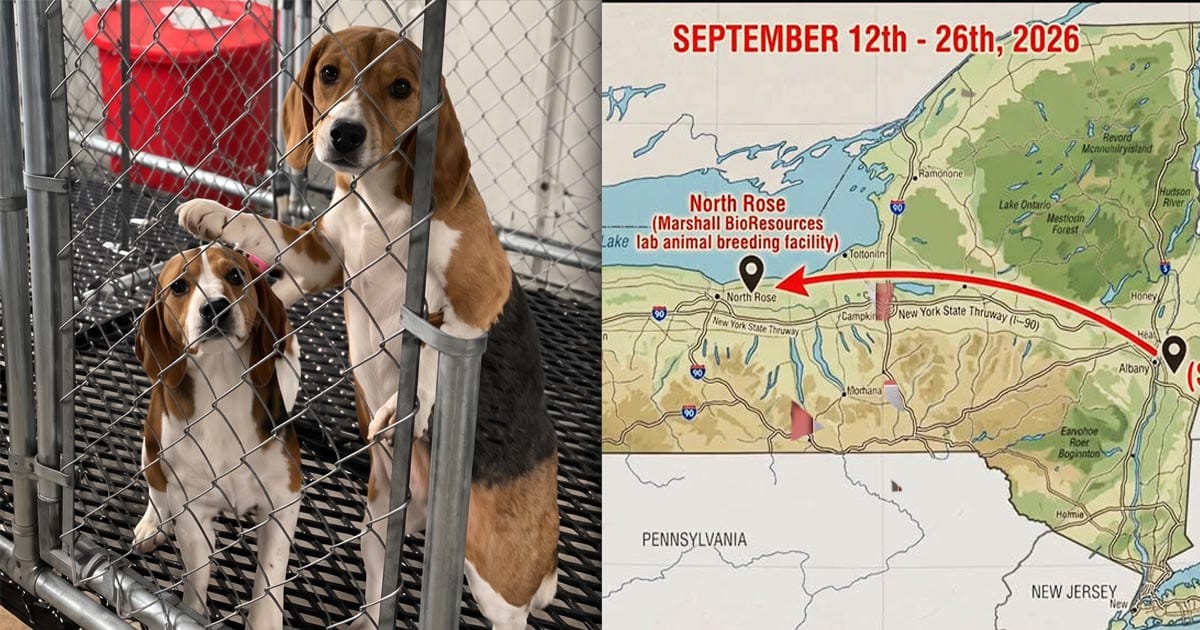
The March to End Animal Testing is a 14-day demonstration kicking off on September 12th and running 207 miles across New York State to call for the end of animal testing

Jane Velez-Mitchell, Ella Magers, and Allison Melody
Los Angeles, CA — July 15th, 2026 — With the momentum against animal testing reaching a fever pitch, a group of high profile animal lovers plan to send the nation a definitive message: animal testing is toast. They hope to kick the entire concept of animal experimentation to the curb with a dramatic march by hundreds, even thousands, of people.
Organizers of the March to End Animal Testing (MAAT) told UnchainedTV that their campaign to abolish animal research and testing will cover more than 200 miles across New York State, running from September 12th to 26th, 2026. The 14-day demonstration will begin at the New York State Capitol in Albany and end at the gates of Marshall BioResources, reportedly the country’s largest supplier of beagles for laboratory research. The organizers stress that anyone can march for any distance, for as little as half a mile or as long as the entire 207 miles. The key, they say, is to sign up and show up for at least some of the journey. They expect there will be a lot of media coverage along the way. UnchainedTV has committed to repeated LIVE coverage over the course of the two week event.
The outcry over animal experimentation has gained traction in recent months, building directly on the momentum from the Ridglan Beagle Rescue Saga in Wisconsin, a series of dramatic rescue efforts that drew viral international media attention, especially after law enforcement used tear gas and rubber bullets on the animal activists.
To join the March to End Animal Testing, register at MarchForAnimals.org
As for the upcoming march, hundreds of participants have already signed up, and organizers expect the trek will become the biggest march for animals in U.S. history. The campaign reflects a broader shift, as consumer behavior and public sentiment increasingly turn against experimentation on dogs and other animals. UNCHAINEDTV’s Jane Velez-Mitchell discussed this event with March to End Animal Testing campaign co-director Ella Magers and social media powerhouse Allison Melody. You can watch their conversation here:
The Movement to End Animal Testing Gains Momentum
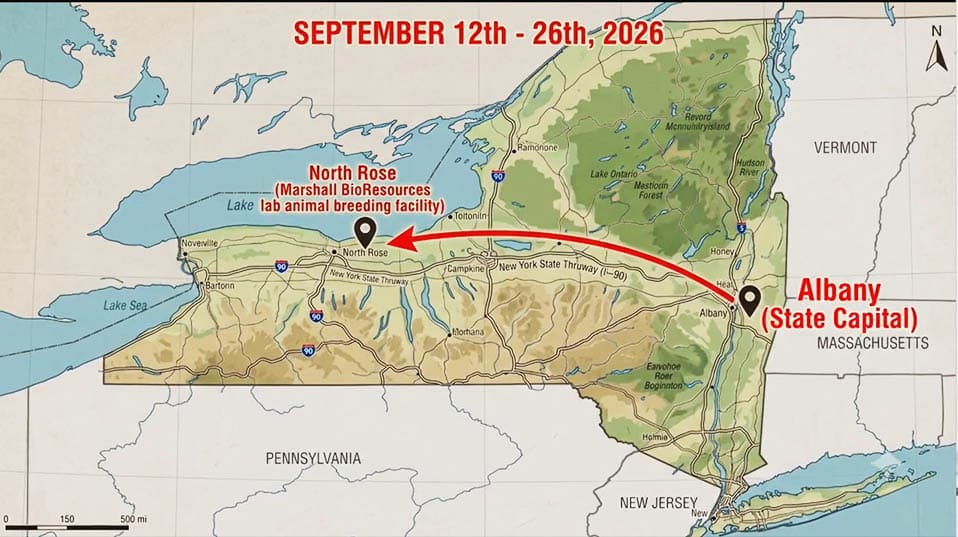
Map of the March to End Animal Testing
The September march will span 207 miles, a route Magers describes as a deliberate line drawn “from the seat of power in New York – Albany – all the way to Marshall BioResources.” The scale marks an expansion of activism that began in Wisconsin. There advocates helped secure the release of roughly 2,000 beagles from Ridglan Farms, a troubled facility that had long bred beagles for experimentation. Ultimately, the facility agreed to close down for good.
Attention has since pivoted toward upstate New York. According to published reports, the Marshall facility may house as many as 22,000 beagles, along with tens of thousands of cats, ferrets, and mini pigs. “So we’re talking 10x Ridglan,” Magers said. “And we plan to get every single one of those dogs out, just like we got the dogs out of Ridglan.”
Animal testing has been a standard practice in biomedical research for decades. Recent shifts in public opinion, amplified by graphic footage of rescued dogs, are challenging its legitimacy. The World Animal Foundation estimates that more than 110 million animals are killed in the United States annually for experimentation purposes, a figure that has helped drive the push to end animal testing into mainstream conversation.
The coalition behind the march unites rescue organizations, legislative advocates, and public figures under a single banner. Campaign co-director Magers will be joined by social media podcaster Allison Melody, both of whom adopted beagles rescued during the Wisconsin actions. Melody, who adopted a rescued beagle named Dolly through Beagle Freedom Project, framed the strategy around proven results.
“This is different because we’ve already proven that this direct action does work. We got Ridglan Farms shut down,” Melody said. “So there’s no reason we can’t get Marshall shut down.” Organizers have emphasized that the New York march carries no risk of arrest, distinguishing it from the earlier Wisconsin rescues, where confrontations with law enforcement escalated sharply.
NYC Rally against Dog Testing
Modern Science Is Mainstreaming Opposition to Animal Tests
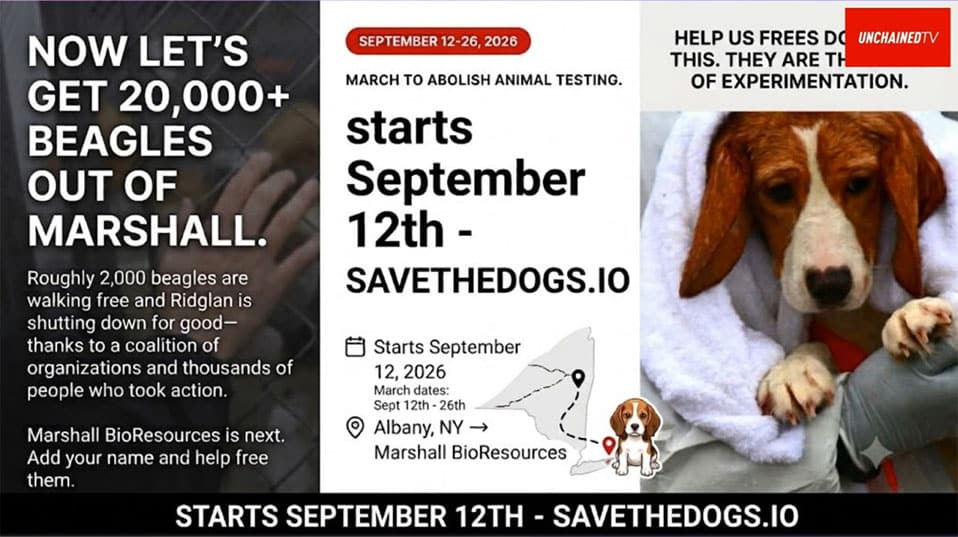
Poster of March to End Animal Testing
The demand to end animal testing is being driven by two forces converging at once: growing ethical concern and rapidly improving scientific alternatives. Social media has mobilized public support faster than traditional advocacy channels, while celebrity and influencer endorsements have expanded the campaign’s reach well beyond established animal rights circles.
The scientific argument has strengthened alongside the moral one. Magers pointed to the high failure rate of animal models, noting that roughly 92 percent of drugs that appear safe and effective in animals ultimately fail in human clinical trials. The World Animal Foundation similarly reports that 95 percent of drugs which prove potent in animals have failed in humans.
Institutional behavior is shifting as well. The National Institutes of Health recently launched a new office called ORIVA dedicated to advancing alternatives such as organoids, organs-on-chips, and AI-based predictive models. The U.S. FDA’s Center for Drug Evaluation and Research has accepted a letter of intent for an artificial intelligence tool designed to help predict drug-induced liver injury, a leading cause of trial failures. Researchers have also developed the world’s first cervix organ-on-chip model, enabling real-time monitoring of cell responses that animal models cannot replicate.
Ridglan to Close! Beagles Out!
Industry Response and the Broader Debate

Protest against beagle experiments
Marshall BioResources has defended its operations. In a statement, the company said that breeding animals for medical research in the United States is highly regulated and subject to ongoing oversight, adding that its most recent unannounced USDA inspection in May resulted in “a clean report with no citations or observations.” The company also cited accreditation through independent nonprofit organizations.
Campaign leaders disputed the framing, arguing that Ridglan Farms made similar assurances before undercover footage and whistleblower testimony contradicted them. The exchange illustrates the central tension of the debate: regulatory compliance on one side, and welfare concerns documented by activists on the other.
The stakes extend beyond a single facility. Advocates argue that non-animal methods are more predictive, faster, and cheaper, a view echoed by researchers who note that many chronic human diseases are poorly modeled in animals. Yet critics point out that funding remains lopsided; the roughly $150 million the NIH is directing toward alternatives amounts to less than 1 percent of what it spends annually on animal research.
Whether the upcoming march accelerates policy change will depend on sustained public engagement after the rally in September. What organizers have made clear is that the campaign to end animal testing has moved from risky rescues to mainstream public events designed. They make a good case that the culture has shifted and animal testing has begun its own march into the dustbin of history.
To join the March to End Animal Testing register at MarchForAnimals.org.
We invite Marshall BioResources to comment further at any time.
Beagle Rescue Foiled by Tear Gas!
Check out this show and more at UNCHAINEDTV
Share This
About the Author: Jordi Casmitjana



Latest News




Stay Tuned In
Be the first to know when new shows drop! Plus, get the hottest headlines, inspiring stories, and behind-the-scenes extras. Sign up and keep streaming!
you might also like

After roughly 15 miles, 40,000 steps and more than a few blisters, marchers reached Schenectady on Day One of a two-week journey across New York aimed at putting animal experimentation—and one of its largest suppliers—squarely [...]

Spanish seafood company Nueva Pescanova has abandoned its plans for a proposed commercial octopus farm in Gran Canaria after years of scientific criticism, animal advocacy, and international public pressure.

Renee King-Sonnen, founder of Rowdy Girl Sanctuary, embarks on her rancher-to-vegan book tour in Los Angeles, featuring sponsorship from Beyond Meat and a signing at Gentle Barn.