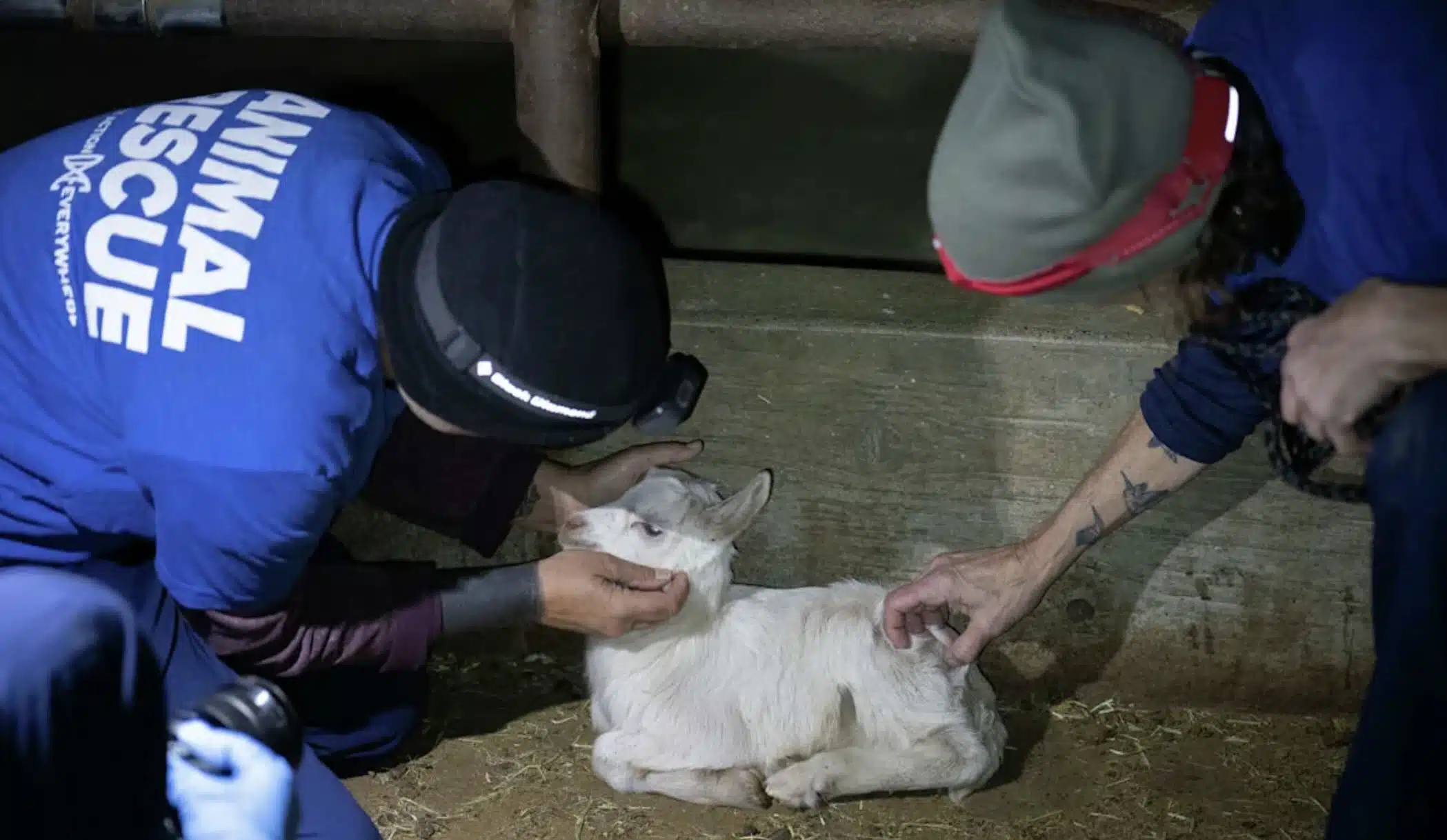
The NY State March to End Animal Testing Could Be the Biggest in US History

Published On: July 15, 2026
Share This
The march to end animal testing

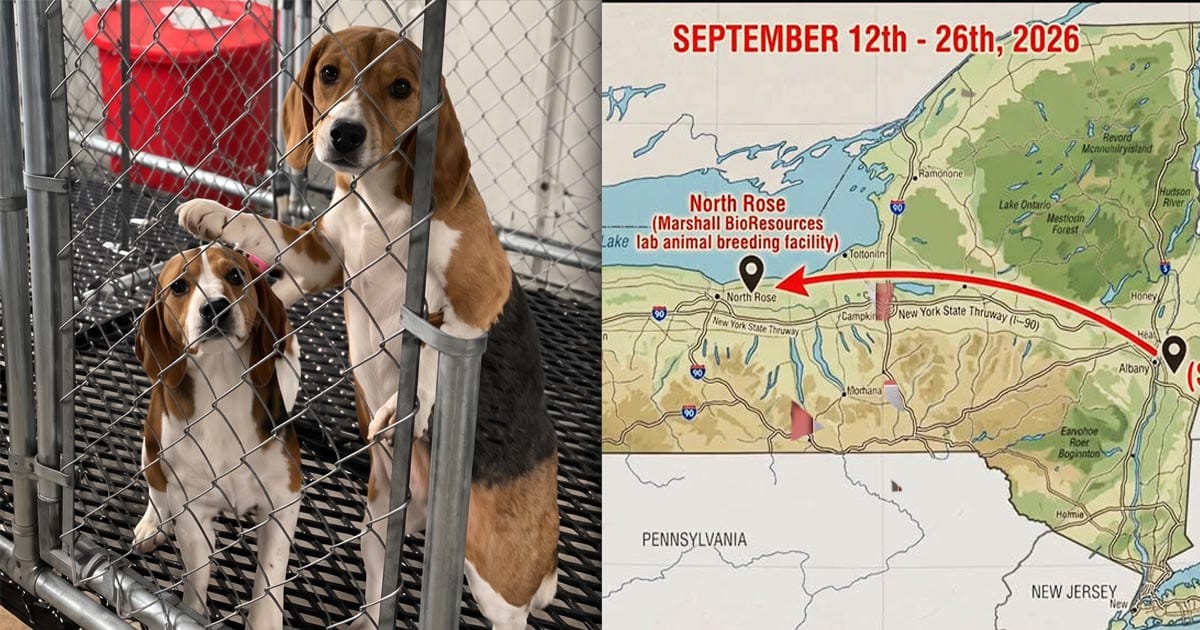
The March to End Animal Testing is a 14-day demonstration kicking off on September 12th and running 207 miles across New York State to call for the end of animal testing

Jane Velez-Mitchell Ella Magers and Allison Melody

Jane Velez-Mitchell, Ella Magers, and Allison Melody

Los Angeles, CA — July 15th, 2026 — With the momentum against animal testing reaching a fever pitch, a group of high profile animal lovers plan to send the nation a definitive message: animal testing is toast.  They hope to kick the entire concept of animal experimentation to the curb with a dramatic march by hundreds, even thousands, of people.

Organizers of the March to End Animal Testing (MAAT) told UnchainedTV that their campaign to abolish animal research and testing will cover more than 200 miles across New York State, running from September 12th to 26th, 2026. The 14-day demonstration will begin at the New York State Capitol in Albany and end at the gates of Marshall BioResources, reportedly the country’s largest supplier of beagles for laboratory research. The organizers stress that anyone can march for any distance, for as little as half a mile or as long as the entire 207 miles. The key, they say, is to sign up and show up for at least some of the journey. They expect there will be a lot of media coverage along the way. UnchainedTV has committed to repeated LIVE coverage over the course of the two week event.

The outcry over animal experimentation has gained traction in recent months, building directly on the momentum from the Ridglan Beagle Rescue Saga in Wisconsin, a series of dramatic rescue efforts that drew viral international media attention, especially after law enforcement used tear gas and rubber bullets on the animal activists.

To join the March to End Animal Testing, register at MarchForAnimals.org

As for the upcoming march, hundreds of participants have already signed up, and organizers expect the trek will become the biggest march for animals in U.S. history. The campaign reflects a broader shift, as consumer behavior and public sentiment increasingly turn against experimentation on dogs and other animals. UNCHAINEDTV’s Jane Velez-Mitchell discussed this event with March to End Animal Testing campaign co-director Ella Magers and social media powerhouse Allison Melody. You can watch their conversation here:

The Movement to End Animal Testing Gains Momentum
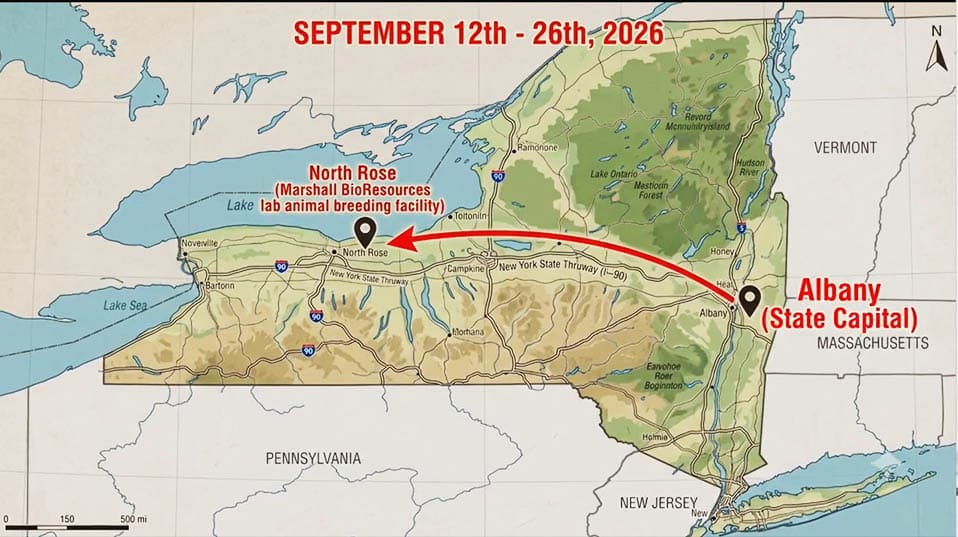
Map to March to End Animal Testing

Map of the March to End Animal Testing

The September march will span 207 miles, a route Magers describes as a deliberate line drawn “from the seat of power in New York – Albany – all the way to Marshall BioResources.” The scale marks an expansion of activism that began in Wisconsin. There advocates helped secure the release of roughly 2,000 beagles from Ridglan Farms, a troubled facility that had long bred beagles for experimentation. Ultimately, the facility agreed to close down for good.

Attention has since pivoted toward upstate New York. According to published reports, the Marshall facility may house as many as 22,000 beagles, along with tens of thousands of cats, ferrets, and mini pigs. “So we’re talking 10x Ridglan,” Magers said. “And we plan to get every single one of those dogs out, just like we got the dogs out of Ridglan.”

Animal testing has been a standard practice in biomedical research for decades. Recent shifts in public opinion, amplified by graphic footage of rescued dogs, are challenging its legitimacy. The World Animal Foundation estimates that more than 110 million animals are killed in the United States annually for experimentation purposes, a figure that has helped drive the push to end animal testing into mainstream conversation.

The coalition behind the march unites rescue organizations, legislative advocates, and public figures under a single banner. Campaign co-director Magers will be joined by social media podcaster Allison Melody, both of whom adopted beagles rescued during the Wisconsin actions. Melody, who adopted a rescued beagle named Dolly through Beagle Freedom Project, framed the strategy around proven results.

“This is different because we’ve already proven that this direct action does work. We got Ridglan Farms shut down,” Melody said. “So there’s no reason we can’t get Marshall shut down.” Organizers have emphasized that the New York march carries no risk of arrest, distinguishing it from the earlier Wisconsin rescues, where confrontations with law enforcement escalated sharply.

NYC Rally against Dog Testing

Modern Science Is Mainstreaming Opposition to Animal Tests
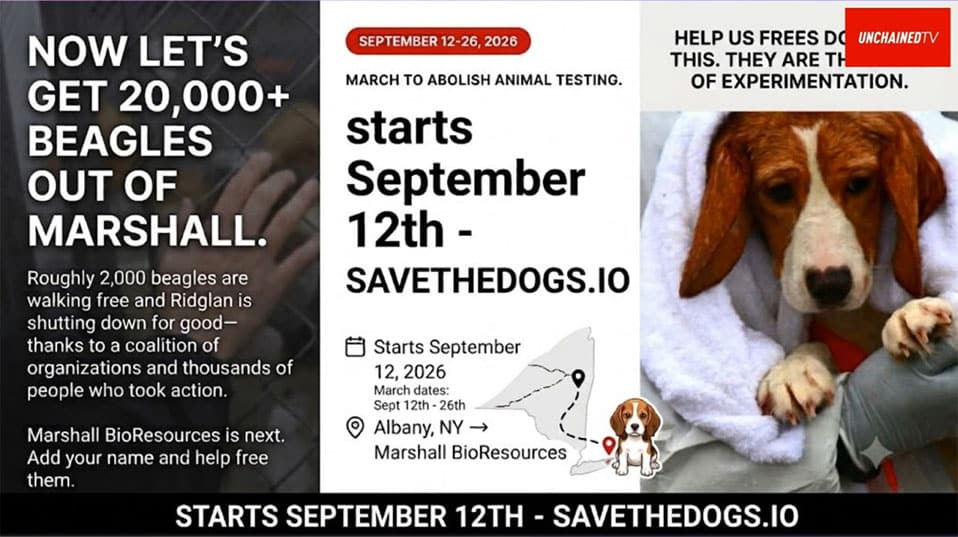
Poster of march to End Animal Testing

Poster of March to End Animal Testing

The demand to end animal testing is being driven by two forces converging at once: growing ethical concern and rapidly improving scientific alternatives. Social media has mobilized public support faster than traditional advocacy channels, while celebrity and influencer endorsements have expanded the campaign’s reach well beyond established animal rights circles.

The scientific argument has strengthened alongside the moral one. Magers pointed to the high failure rate of animal models, noting that roughly 92 percent of drugs that appear safe and effective in animals ultimately fail in human clinical trials. The World Animal Foundation similarly reports that 95 percent of drugs which prove potent in animals have failed in humans.

Institutional behavior is shifting as well. The National Institutes of Health recently launched a new office called ORIVA dedicated to advancing alternatives such as organoids, organs-on-chips, and AI-based predictive models. The U.S. FDA’s Center for Drug Evaluation and Research has accepted a letter of intent for an artificial intelligence tool designed to help predict drug-induced liver injury, a leading cause of trial failures. Researchers have also developed the world’s first cervix organ-on-chip model, enabling real-time monitoring of cell responses that animal models cannot replicate.

Ridglan to Close! Beagles Out!

Industry Response and the Broader Debate

Protest against beagle experiments

Protest against beagle experiments

Marshall BioResources has defended its operations. In a statement, the company said that breeding animals for medical research in the United States is highly regulated and subject to ongoing oversight, adding that its most recent unannounced USDA inspection in May resulted in “a clean report with no citations or observations.” The company also cited accreditation through independent nonprofit organizations.

Campaign leaders disputed the framing, arguing that Ridglan Farms made similar assurances before undercover footage and whistleblower testimony contradicted them. The exchange illustrates the central tension of the debate: regulatory compliance on one side, and welfare concerns documented by activists on the other.

The stakes extend beyond a single facility. Advocates argue that non-animal methods are more predictive, faster, and cheaper, a view echoed by researchers who note that many chronic human diseases are poorly modeled in animals. Yet critics point out that funding remains lopsided; the roughly $150 million the NIH is directing toward alternatives amounts to less than 1 percent of what it spends annually on animal research.

Whether the upcoming march accelerates policy change will depend on sustained public engagement after the rally in September. What organizers have made clear is that the campaign to end animal testing has moved from risky rescues to mainstream public events designed. They make a good case that the culture has shifted and animal testing has begun its own march into the dustbin of history.

To join the March to End Animal Testing register at MarchForAnimals.org.

We invite Marshall BioResources to comment further at any time.

Beagle Rescue Foiled by Tear Gas!


VIDEO TRANSCRIPT – the march to end animal testing

the march to end animal testing! (540p)

[Speaker 1]

Live from the Unchained TV headquarters in Los Angeles, California, this is Truth Files with Jane Velez Mitchell.


[Speaker 4]

And Julie was on the bottom row in a two foot by four foot metal cage, standing on wire her entire life. She lived there for about a year. In over a two hour time period, every single time we looked towards Julie, she was spinning exactly like this for two hours.


All three of the dogs we rescued farms. There’s video footage of these dogs after a rescue game, struggling to even walk. And this is one of them, Julie.


[Speaker 1]

Now there is an effort to rescue more dogs. The scene of action has moved from Wisconsin, which is Ridgeland to upstate New York. And now there is going to be a march, a Gandhi style march, September 12th through September 26th.


And you can learn all about it because we are so thrilled to have one of the organizers with us here today, Ella Majors.


[Speaker 2]

Yes, we’re talking about the march to abolish animal testing happening in September, September 12th through the 26th. We are trekking 200 miles, 207 miles to be exact, from the seat of power in New York, Albany, all the way to Marshall Bioresources, which is the country’s largest breeder of animals, and especially of beagles for animal testing. So we are going to be building the momentum, keeping the momentum that we started with Ridgeland and the 2,000, roughly 2,000 beagles we were able to rescue there.


And we’re on a mission to shut down Marshall Bioresources and to end dog experimentation in this country.


[Speaker 1]

We have footage of protests that have been occurring outside Marshall Bioresources as the battle to stop animal experimentation hits New York. The original scene of the confrontations was in Wisconsin at Ridgeland Farms. And so there was a lot of drama surrounding that.


But that ultimately ended in victory for the animal activists. And now the focus moves to New York State. You’re looking at protests that are happening right now outside Marshall Bioresources.


And when I say right now, I mean in recent days. And people are just saying, we want this facility shut down as well. The facility in New York is much bigger than the facility in Ridgeland, where there were 2,000 beagles and they are all in the process of being released.


There are, according to published reports, up to 20,000 beagles in the New York State facility.


[Speaker 2]

Yes, the numbers are a little, we’re not sure exactly the numbers, but it’s up to 16,000 to 20,000 beagles. There are also tens of thousands of cats and ferrets and mini pigs as well at that facility. And this is Jane here.


Jane is looking at me. Jane is one of the beagles we rescued from Ridgeland Farms. And yes, they had about 2,000.


So we’re talking 10x Ridgeland. And we plan to get every single one of those dogs out, just like we got the dogs out of Ridgeland.


[Speaker 1]

Just to give our viewers a little backstory, it was way back, I think it was 2017, that Wayne Shum, who you see here, went into Ridgeland and documented conditions that he said were horrific and took just one or two or three beagles out, a very small number. And that just triggered the drama that was to continue for years. He was originally charged, and they were going to put him on trial.


And at the last second, they dropped the charges. And instead of saying, whew, I’m so glad that I’m not going to get charged and I’m going to go home, he stayed and insisted on justice for the Ridgeland dogs. And they staged a rescue.


And we’ve got some footage of the rescue, which is absolutely extraordinary. Take a look at this rescue that occurred this spring, in which approximately 31 beagles were taken out by animal activists, and about eight were recaptured by law enforcement. But this was what they call an open rescue.


They videotaped it themselves. They wanted to show to the world what was happening inside these facilities. And they got 24, approximately, to safety.


Animals who are now living in homes. Ella, just to clarify, is Jane the dog that you have one of those?


[Speaker 2]

She is not one of those 22 to 24 dogs. So after the second rescue attempt, that’s when some negotiations happened. And it was agreed that they were going to release 1,500 of the beagles, which I went back up there to help with that evacuation.


And she was one of those dogs. When she got carried, I carried her out of the bus that took them to the safe house. And she fell asleep in my arms.


Yes, at this location. And I hadn’t planned on adopting. But when she melted into my arms, it just felt like she was home, and that she needed to come home with me.


So at home she is.


[Speaker 1]

And these are images of beagles who were released from Rigeland as part of this ongoing saga. I want to go to Allison Melody. You also have a dog with you.


Tell us about the dogs, plural, that you have.


[Speaker 3]

So right in front of me, this is Dolly. She’s rescued when Ella and I went to Wisconsin for the second rescue. That’s the one she came out of.


And you actually helped me, Jane, adopt her. Thank you so much through Beagle Freedom Project. And this is Lily.


She’s my OG beagle that I’ve had for years. And I’ve had beagles almost my whole life. I’m on my third beagle here.


So I’m just a beagle mama for life. What can I say?


[Speaker 1]

In between the first rescue and the happy ending, there was this extraordinary drama that got global attention. I will play just a little clip of it.


[Speaker 2]

The whole world is watching you.


[Speaker 4]

Do you know that?


[Speaker 1]

So after the first open rescue where 24 beagles were freed and taken to good homes, the sheriff said, if you ever try that again, we’re going to crack down. And what he did was unleash tear gas and rubber bullets on the almost 1,000 people who came to the second open rescue. And it was a major drama.


And it got major news coverage. And it created such a firestorm because people were showing their injuries with the rubber bullets hitting them and collapsing on the ground that it really kind of changed the equation. There were negotiations going on behind closed doors.


And then suddenly the Center for Humane Economy and more mainstream groups announced that all the beagles, it was a process, several different news conferences and events, but eventually it was announced that all the beagles would get out of Ridgeland Farms and that facility in Wisconsin would close down.


[Speaker 2]

Yeah, that was, it felt like a war zone. And my co-lead at Ridgeland that day is ex-military. She’s a veteran.


And she said this, it literally was like a war zone. The tear gas hit. And I have never been in anything like that before, but it was suffocating.


It was hard to breathe. And then seeing other people get hit. I mean, elderly people, people carrying white flowers, getting hit with rubber bullets and getting huge, massive wounds and people collapsing.


And there are people that are still suffering some of the consequences from the tear gas. I was speaking with somebody who ended up in the hospital and has had respiratory issues ever since. So it was extreme and nothing like we had prepared for at all.


And at the same time, it’s like what we went through there, we can all say everyone who was there is like, you know what, that was nothing compared to the pain and the suffering that is happening behind the closed doors of that facility. And that’s happening at Marshall Bioresources. And, you know, what these animals are going through once they’re sold into experimentation, having painful experiments done on them and then being killed afterwards.


It’s horrific. And a lot of people don’t even still didn’t know until now that we use beagles and we use them because they’re so docile and because they don’t fight back. And it’s heartbreaking and it’s wrong.


And it’s time to be on the right side of history. And that’s what we’re doing with March to Abolish Animal Testing, is helping everybody take action so that we can be on the right side of history and do right by animals finally.


[Speaker 1]

So if you want to join the march, there’s very easy. Just go to save the dogs dot i o or you can go to March for animals dot org. And so you can sign up to be part of the whole march or you could be part of one mile.


But the key is to sign up and hopefully this is going to get media attention without anybody being arrested, without anybody being injured. You know, a lot of people are afraid to get involved because they think, wow, I see these tear gas canisters and I see these rubber bullets being directed at activists. What makes this different?


[Speaker 3]

Understand that because I would have been afraid to when I went to Richland. Ellen, I were right there on the front lines of that footage you showed Jane. Ellen, I were not there.


We’re right there. And had I known that I probably would have been scared to. We had no I had no idea we would be tear gas and everything like that.


I had never been on the wrong side of the law before. So the first thing is, I would say I understand the hesitation. However, this is different because we’ve already proven that this direct action does work.


We got Richland Farms shut down. Right. So there’s no reason we can’t get Marshall shut down.


And in this case, Ella’s event, there’s no risk of arrest. So in our case, we had teams, a red team, yellow team, green team and red team risked arrest. And yes, people did get arrested and they are facing charges.


But we know that the court of public opinion will not let them serve time because this is such an human rights issue. It’s an animal rights issue. It’s a bipartisan issue.


It’s an issue that everyone can get behind and everyone cares about. Can you imagine the public outrage if they actually give people jail time for rescuing docile, sweet beagles? So we don’t believe that anything is going to happen in that regard.


And to Ella’s whole point of her event is no one’s risking arrest. This is to get the public even more involved. We made so much progress with this.


This got so much national news attention. It was all over the news. It was all over the social media.


So now we’ve seen what we can do and we’re ready to take this to the next level.


[Speaker 1]

When I hear a march, I always think of Gandhi and the famous salt marches in India. And of course, he preached nonviolence. He preached just as you are preaching.


Let’s accomplish whatever we need to accomplish in terms of research in a nonviolent way. What these animals are subjected to, obviously painful, often, if not usually fatal. But I do want to read Marshall Bioresources’ statement.


Greeting animals for use in medical research in the U.S. is highly regulated and subject to ongoing oversight. Our facilities are regularly inspected by the USDA to ensure compliance. Our most recent unannounced USDA inspection was conducted in May, resulting in a clean report with no citations or observations.


And they maintain accreditation through independent nonprofit organizations. What is your response?


[Speaker 3]

So much to say, so much to say. So first of all, in the case of Ridgeland Farms, they said the same thing. Our facilities are safe.


We don’t abuse the animals. But we have the testimony from the and we have the footage from our undercover investigators who went in. We have all the documentary footage.


We have the audio. And they went in and they found all of that to be untrue. They found out about all of these surgeries being performed without anesthesia because these facilities are cheap and they don’t care about the welfare of their animals.


So please tell me that’s not going on at Marshall. Plus, why in the world are we still doing this? Ninety percent, I think it’s ninety two percent of drugs that appear safe and effective in animals fail ultimately in human clinical trials.


These animal models fail over and over. In fact, there’s all of this research that has been done. All of this money has been put on Alzheimer’s, ALS, cancer, stroke, all of these things, hundreds of treatments that actually did succeed in animals and then completely fail in humans.


And that doesn’t even mention all of the failed trials that they do on animals that then kill them for no reason, because it’s like ninety two percent doesn’t work. Humans and animals are biologically different. We metabolize drugs differently.


We don’t need to do this anymore. In fact, in twenty twenty six, the National Institutes of Health launched a new office just dedicated to advancing alternatives. There’s organoids, there’s organs on chips, AI based models that can do better than an animal trial ever can.


The only reason that these companies are still doing business is because this is how they’ve always done it. Better alternatives now exist. Right.


And so we don’t need to do this anymore. So, Marshall, we’re done here. Right.


Find another way to make money.


[Speaker 2]

So all these animals that are being tested on, it’s for nothing. And we need to move forward. And we’ve got now the government behind us.


We’ve gotten so many politicians and public figures and scientists that are speaking out, speaking up. And we’re going to be utilizing those for this march. This is the time.


The momentum is here. We need to show our support. So we’re asking all of you who can come, whether it’s for a few hours, for a few days or the entire two weeks, come join this march.


Whatever we experience along the way, the hardships we go through, it’s nothing compared to what these animals, what these dogs are going through. So we’re going to make a huge statement here and make a huge impact for animals.


Check out this show and more at UNCHAINEDTV

Share This

Support Free Vegan Media

When Animals’ Lives Are on the Line, FREE Vegan Media Matters

UNCHAINEDTV exists to shine a light on stories mainstream media often ignores. Stories that impact animals, people, and the planet. We believe access to vegan media should be free for all.

Donations from readers like you help us produce investigative, educational, and entertaining content, amplify vegan voices, and keep our streaming platform free worldwide

Support free vegan media today by making a one-time or recurring donation. 

About the Author: Jordi Casmitjana

Jordi Casamitjana is a vegan zoologist, author, and animal protection advocate. He is widely known for the landmark UK legal case that recognized ethical veganism as a protected philosophical belief. Through his writing and advocacy, Jordi explores the science, ethics, and philosophy of veganism while championing the rights of animals.
Caveman eatingHow About Them Apples? Early Humans Were Likely Vegan

Stay Tuned In

Be the first to know when new shows drop! Plus, get the hottest headlines, inspiring stories, and behind-the-scenes extras. Sign up and keep streaming!

you might also like