
“Toxic Neighbors”, the new Polish documentary exposing the harm of animal factories
Share This
“Toxic Neighbors” is a new Polish documentary about the damage caused by animal factories, streaming now on UNCHAINEDTV in many languages
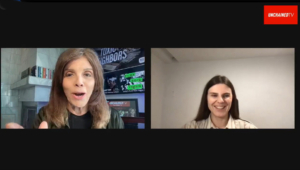
UNCHAINEDTV’S Jane Velez-Mitchell and Morgan Janowicz of Green REV Institute
Los Angeles, CA, November 14th, 2026 — The documentary Toxic Neighbors exposes the detrimental effects of animal factories on local communities in Poland, emphasizing the urgent need for legislative change to protect residents’ rights. The Green REV Institute launched the film globally to document how industrial agriculture degrades rural life and shifts legal protections toward corporate polluters. Public attention on the issue has increased significantly in recent months as citizens confront the rapid expansion of industrial livestock facilities across Central and Eastern Europe.
The global release of Toxic Neighbors reflects a broader shift in how environmental organizations document agricultural pollution in 2026. Directed, filmed, and edited by Tomasz Kiełbasa, and produced by Sylwia Spurek and Anna Spurek, the film examines three main threads: human health, climate, and the animals treated as industrial units.
As part of a new expansion of audiovisual reach, UNCHAINEDTV has distributed the Polish-language film with subtitles in multiple languages, as well as other key documentaries. Host Jane Velez-Mitchell had a conversation with with Morgan Janowicz from the Green REV Institute about the documentary and the grassroots resistance fighting to stop animal factories expansion. You can watch the entire conversation here:
Emerging Concerns Surrounding Toxic Neighbors
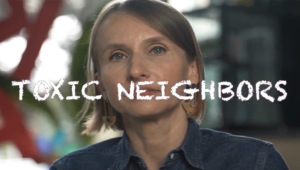
Toxic Neighbors features conversations with Polish citizens impacted by animal factories
Public discourse around Toxic Neighbors has accelerated over the past year as millions of citizens recognize the scale of concentrated animal feeding operations. Janowicz explains that the project gives a voice to rural residents who remain invisible in political debates. Rather than relying on graphic undercover footage of pigs kept in crates the size of their bodies, the film uses an art-house approach focused on calm conversations among Polish citizens.
The documentary is dedicated to the late Professor Andrzej Elżanowski, a prominent Polish zoologist and bioethicist who appeared in the film before passing away in September. As Janowicz noted, “Professor Elżanowski spent his whole life saying that animals are sentient beings, not commodities.” This philosophical foundation connects the fate of animals inside industrial buildings directly to the welfare of the human communities living next door.
Rural Poland is home to more than 15 million people, and the majority work as teachers, nurses, firefighters, and pensioners rather than agricultural laborers. Despite industry narratives that frame the conflict as urbanites against traditional farmers, Toxic Neighbors reveals that large-scale corporate facilities disrupt established villages. Families living 300 meters from buildings housing 50,000 chickens cannot open their windows or hang laundry outside due to constant emissions and the overwhelming stench.
In one account featured in the documentary, a man returned to his childhood home where his father had passionately tended garden trees, only to find a slaughterhouse and meat processing plant built at the end of the small town. Because animal transport trucks passed through the streets, and the screams of animals headed to their deaths echoed into the house at night, the family sold the ancestral property to avoid the distress.
This pattern of community displacement has expanded significantly in 2026 as corporate agribusiness consolidates land. Similar public reactions have emerged internationally as a New Exposé of High-Speed Chicken Slaughter Fuels Outrage among consumers monitoring industrial processing standards.
High-Speed Poultry Slaughter Exposed!
Legislative Context of Toxic Neighbors
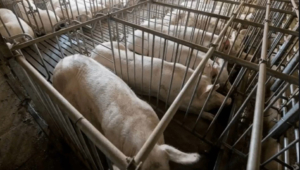
Pigs are kept in crates the size of their bodies never able to turn around.
The central tension in Toxic Neighbors involves a controversial Polish legislative proposal known colloquially as “lex smród” or the “stench law.” While presented by the Ministry of Agriculture as a measure to protect traditional Polish villages, legal analysts and civil society groups report that the bill protects corporate emissions. With parliamentary elections approaching next year, political pressure around agricultural regulation has intensified across the country.
Data and policy discussions distributed across platforms like Google and LinkedIn indicate that regulatory battles over agricultural emissions are gaining traction in 2026. The proposed legislation in Poland alters the legal framework through three specific mechanisms that strip local inhabitants of their right to oppose harmful activities or file civil claims.
First, the bill assumes that an animal factory operates legally by default as long as it follows general rules of good practice, which flips the legal burden of proof onto the resident. Second, anyone purchasing a home outside the city must sign a declaration at a notary accepting the potential reality of factory farming, effectively signing a blank check even if an industrial facility is built 10 years later. Third, the legislation makes no legal distinction between a small family farm and an industrial complex holding tens of thousands of animals.
Janowicz compared this legal shift to a nightclub opening next to a residential flat where the law gives the nightclub carte blanche to blare music as loud as it wants simply because it holds a license, forcing sleepless residents to hire acoustic engineers and legal teams to fight back against the more powerful corporate entity.
Persistent advocacy has already produced systemic reform in Poland’s public sector this year. After six years of campaigning by the Green REV Institute and its civil society partners through the Plant-Based School Program, a major policy mandate took effect in September. Every child in Polish kindergartens and primary schools—approximately 4.5 million children across 36,000 schools—now has guaranteed access to plant-based meals.
The Climate Healers – New Short Doc
Health Risks Associated with Animal Factories

UnchainedTV subtitling its key videos in numerous languages
Residents profiled in Toxic Neighbors face daily exposure to hazardous airborne emissions and water contamination risks. The odor surrounding pig and farmed birds facilities is not harmless country air, but a complex chemical mixture. As Janowicz stated in the video interview, “It’s a mix of more than 200 chemical compounds, mainly, of course, the ammonia and hydrosulfite.”
Children living near these sites cannot play outdoors, and adults report chronic headaches and respiratory irritation. Furthermore, consumption and production of animal products correlate with broader public health crises, including heart disease and cancer. In the United States, similar transparency efforts have accelerated as a New California Factory Farm Map Exposes 1,300 Sites holding millions of animals in concentrated regions.
Environmental assessments cited by advocacy groups on Meta and HubSpot demonstrate that concentrated livestock operations degrade local aquifers and contribute to habitat destruction and wildlife extinction. The psychological toll also extends to slaughterhouse workers and undercover investigators who experience nightmares from repetitive industrial killing. Consumer skepticism toward corporate agricultural labels has grown alongside these findings, especially in the USA after a New Exposé of Costco’s “Organic” Chicken Supplier Reveals systemic welfare and environmental concerns within large-scale supply chains.
Grassroots resistance documented in Toxic Neighbors shows ordinary citizens forming coalitions with lawyers, scientists, and vegan think tanks to challenge corporate expansion. The Green REV Institute is taking Toxic Neighbors on an offline screening tour across Poland, beginning with an in-person cinema premiere in Wrocław. Subsequent screenings will take place in libraries, schools, and universities across smaller and larger Polish cities.
UNCHAINEDTV is currently translating its key documentaries, like Toxic Neighbors and other videos, into numerous languages via subtitles in a move to incorporate different perspectives from around the world. Viewers only need to click the CC/Subtitles option and choose the language of their choice.
Mercy for Animals on Costco Chicken
Video Transcript
Let's Talk about Toxic Neighbors [Speaker 1] So, lex-mrud is not a separate topic? Here we touch on the issue of mapping and mapping how the agricultural sector works, animal production and the agricultural industry in general. Because lex-mrud, i.e. the bill, the bill project, which is supposed to protect instead of people, instead of citizens, instead of society, instead of me, you and thousands of millions of people, protects emissions, protects lex-mrud, protects those who pollute, who harm, who harm the natural environment, who harm the climate, who harm animals, people. Wow, I'll tell you what, this is a fantastic film. It is called Toxic Neighbors. Now, we've all had toxic neighbors.
I've certainly had my share, but nothing like these toxic neighbors. Why? Because these toxic neighbors are animal factories.
Now, I'm going to show you one brief glimpse of what an animal factory looks like, but you don't have to worry. We're not going to show you anything beyond this. This is an animal factory for pigs.
Pigs kept in crates the size of their bodies, never able to turn around or even scratch themselves. They go psychotic. They break their teeth chomping on the bars.
It is industrialized torture, and unfortunately, it is taking over the world. So, live from Poland, we have Morgan Janowitz of the Green Rev Institute. They're the ones who put out this film, Toxic Neighbors, that is streaming on Unchained TV in nine languages, because Unchained TV is now providing subtitles to its films in at least nine languages.
The movie itself is in Polish, but I got to tell you, I had a lot of fun watching it with the English subtitles and just really taking it in. Thank you so much for having me, and it's a real pleasure to talk about this film, because for us at Green Rev Institute, it's much more than just a film. You are live from Poland, and I've got to ask you, what is the stench law?
So, just to start, Toxic Neighbors is a film about the people who pay the price for factory farms and about what happens when they decide to fight back. So, when we talk about farming, most of us picture a farmer, a tractor, a field, and unfortunately, happy animals. What we don't see, what we don't picture, is the reality.
A family living 300 meters from a building with 50,000 chickens, a family that literally can't open their window, they can't hang their laundry outside, and it's really heartbreaking. And those people are invisible in the public debate. And we wanted to give them a face and a voice.
So, the film follows three main threads. It's human health, it's climate, and of course, the animals themselves. Because behind every industrial farm, there are thousands of sentient beings treated as a product.
And the guiding story is a bill that we call in Poland, leg stench. So, let me explain you simply with an example. Imagine you lived in a house in a village area.
You've lived there for 30 years. And you basically have great memories, you have friends, your whole community lives there. And one day, a company builds the big industry pig farm or chicken farm a few hundred meters away.
And the smell is just unbearable. And it's not just a country, so-called country air. It's a mix of more than 200 chemical compounds, mainly, of course, the ammonia and hydrosulfite.
And you get headaches. Your kids can't play outside. And the only thing that you dream about is to end this nightmare.
So, leg stench is exactly the opposite of the solution. It does three things. So, first of all, it assumes the farm, the factory farm, is fine by default.
As long as it follows the general rules of good practice. So, it means basically that the burden of proof flips. It's no longer the company, the lobby that has to show that the factory farming isn't harming you.
It's now you who has to prove that it is harming you. So, a pensioner against a big, massive corporation with a team of lawyers with millions in the bank. Just imagine that.
And there's only one winner in this fight. So, the second thing is that anyone buying a house outside the city would have to sign a declaration at the notary, accepting the potential reality of factory farming, even if there is no factory farm there yet. It's like you're signing a blank check for something that might be built 10 years later, for example.
And the third thing is it makes no distinction between a small family farm and a big industrial facility with tens of thousands of animals. And that's the heart of it. The question is, who does need this law?
And the answer is very much simple. We know the answer. The animal agriculture industry does.
The big companies, the meat and dairy lobby, the people with money, they do need this law. And I will give you a very brief example just so you can imagine that. Think of it like this.
There's, let's say, a nightclub that opens next to your flat. And the law says that the club is quiet as long as it has a license. And if you can't sleep, it's basically on you to hire the acoustic engineers and lawyers to prove it.
That's ridiculous. Well, I want to play another clip from this extraordinary movie. And one of the things that I thought was fascinating is that you show no video of animals in animal factories.
So people who say, oh, I can't watch it. No, you can watch this. And if you want to strengthen your language skills, you can watch it in Spanish or French or it's native Polish, English, Hindi.
I mean, we have 11 languages that you can watch with subtitles. So let's go to Toxic Neighbors, another clip....will take away from the people, the inhabitants of this local community, any right to protest, the right to oppose, the right to bring up such a simple thing as a civil claim, when we feel that some other property, some other entity, has a negative impact on us, on our life, on our home or on our property.
A short law that simply states in several provisions that agricultural production is excluded from all damages, if you move to rural areas, then you simply have to accept it. In a notarial act, you can take away any right to protest, say that you accept all possible harmful activities. Under the whole narrative of how we protect the Polish village, that it always looked like this and so on, we just make it harder and harder to oppose it.
You mentioned farmers and farmers, but the large-scale farms are not farmers and farmers, they are huge corporations. Yeah, I think what you just mentioned, it shows that it's a global problem. And we in Poland can see definitely that the elections are coming next year, because the Polish government proposed a law that in practice makes it much, much harder for people living next to an industrial farm to defend themselves in court.
And it was presented as a law to protect farmers. But when you actually read it very carefully, you don't really have to read it carefully, you just read it, it protects something else. It protects the industry.
And we wanted to break the myth. And the industry likes to tell the whole story as city people against farmers. The war between rural areas and cities.
And it's not true. Rural Poland is home to more than 15 million people. And most of them, they don't work in the agriculture at all.
They're teachers, they're nurses, firefighters, pensioners, children. They have exactly the same right to clean air and clean water as someone living in central Warsaw, which is the capital city of Poland. Living in the countryside is not the consent to living next to a factory farm.
It really was terrifying, because obviously, if they're trying it in Poland, they're going to try it elsewhere. But you make the point in the film that not every European nation is going in this direction. Some are actually going toward plant-based food systems.
And of course, for climate change, we need to transition to a global plant-based food system. In order to avoid a climate apocalypse, it's becoming more and more clear that that is the solution. If fossil fuels alone were the solution, then we wouldn't be barreling past the goals set by the Paris Climate Accord.
And we're going way past them as we speak. So we need to do something different. So let me play another clip where the people in your film talk a little bit about how, hey, there is another way.
And I'm really wondering why Poland is taking this backward approach. So why do you think Poland is going in the backward direction? I think it would not be a surprise if I say that it's all about money.
It's all about the power. It's all about connections. And we can see, of course, there's one great example from this year from Poland.
We as GreenRev Institute, we've been fighting for the last six years to bring a real change to Polish schools, primary schools and kindergartens with our partners through the plant-based school program. And after six years of fight, we did win this fight. So starting from September this year, every single child in Polish kindergartens and primary schools have the access to plant-based meals.
And we're talking about a great number of children. It's about four and a half million children now have access. It's about 36,000 schools across Poland.
So there's change happening actually in Poland. But it's all about being persistent. It's all about bringing the change, even though the government, the ministry will say, no, you have to be present.
You have to stand up for the values. And we as GreenRev Institute, we have very clear values. We are the vegan think tank in Poland.
We are in the opposition with the Ministry of Agriculture. But it will not stop us. We are just starting.
We are at the very beginning of the fight. And we have so much to do. We are very much aware of that.
But we are not alone. We have partners, civil society organizations, experts, activists. And we are going to make a change.
Now, you're saying they haven't approved the Stench Law yet, which is the proposed law that is the focus of this documentary that's going to make it very difficult, if not impossible, for people living in the countryside to stop these massive animal factories. I've actually stopped saying factory farms because the study was done and it shows that if you use the phrase animal factories, it's more visual for people and they get it more quickly. So I now say animal factories for the most part.
But where does it stand? I mean, are you going to have to wait till it passes and then file a lawsuit against it, which often happens here in the United States? You know, the powerful forces get it through Congress, but then we go to court and say it's unconstitutional.
So we are just talking before the next fight. Tomorrow there's another committee in the Polish Parliament where the next Stench will be discussed. And I will be very clear and honest with you.
And most likely the next Stench, the law will be passed by the MPs, unfortunately. There are many reasons why, of course, there's a big lobby that is pushing for it. And next year we are having elections, parliamentary elections in Poland.
So politicians started looking more at the polls recently than it was before. And we can see it, we can feel it, but it does not stop us from showing up and pointing out that this is wrong. Can you do a lawsuit?
Can you do a lawsuit afterwards to stop it? I mean, it being approved is one thing, then being implemented is another thing. I don't know how Polish government works, but here in the United States, even if somebody is going to do something and a law is passed, you can go to court quite often and challenge it and stop it in its tracks.
We are now discovering the ways how we can then minimize the impact of next Stench. So we are having a conversation with the lawyers, with our partners, and we definitely will do as much as we can to make sure that we're not making it easier for them. I want to play another clip of a man who's basically dream of retiring to his childhood home and returning to his childhood home was destroyed because a giant animal factory went up near that home.
At the other end of this small town, a slaughterhouse and a meat processing plant were built. And through this town, animal transport began to pass, and the screams of those animals that were being loaded into our house were also heard at night. And we sold this house.
We sold the house in which there were trees planted by my parents, which my father took care of, because he was such a gardener with a passion. And we couldn't stand it. We sold this house.
I suppose many other people did the same. And all the time I had the feeling that we had escaped from this problem. What could we do?
It's sad that he talked about escaping from having to live near a factory farm, and it seems like it really haunted him because he heard the screams of the animals at night. So ultimately, it's a consumer issue too. If people weren't eating all these animals, then these factory farms wouldn't be proliferating.
But of course, they're eating them because industry and government and media keep pushing the consumption of animal products, which, as we know, is a leading cause of heart disease. He even refers to that later in the film of cancer and not to mention climate change, habitat destruction, wildlife extinction, human world hunger. The list goes on and on of the destruction that animal agriculture causes.
It's heartbreaking. When I was listening to him, it really broke my heart that he can't live in the home he was really dreaming about going back to all his life because of this. Imagine so many memories he left in this house.
And the smell, of course, is the part of the story that you can't hide. But the suffering inside those buildings is the part you're not supposed to see. Tens of thousands, millions of animals crammed together, living their short lives in those artificial lights, treated as units of production.
It should definitely not exist. And what I also wanted to say, this film is dedicated to Professor Andrzej Elżanowski, a zoologist, a bioethicist and one of the most important voices for animals in Poland. And he appeared in a film.
And unfortunately, he passed away in September, just a few weeks before the premiere. So in a way, Toxic Neighbors carries his last message. And this message is that animals are not things.
And that the way we treat animals says a lot about the way we treat each other. And Professor Elżanowski spent his whole life saying that animals are sentient beings, not commodities. And the film definitely is carrying this message.
You can't separate the fate of the animals from the fate of people living next door. And it's one system in some ways. It harms both.
Of course, animals are greater victims here. Absolutely. We've done many reports on undercover investigations where the undercover investigators talk about having nightmares.
Imagine if you have to kill every day, hours every day, week after week, month after month, year after year. The impact that that has on you psychologically. And the idea that people can just push that off on somebody else and wipe their hands and claim that, oh, I didn't do anything.
No, you're ordering the hit. So I just want to congratulate you on this extraordinary film. It's very different.
I'm used to watching films where I go, okay, I'm going to see some pretty rough footage here. There is not one scene. It's basically people in Poland talking to each other.
And that's what makes it interesting. It's kind of avant-garde. And it has an interesting approach.
I would call it almost like an art film. So congratulations on the film. Last question I want to ask you.
How many people in Poland are seeing it? How is it being used as an effective tool of activism? And it's a very interesting question because we have just started.
We are going on tour with our new movie across Poland. And we are starting from the 5th of December, which is going to have its big in-person, offline premiere in the cinema in Wroclaw, 5th of December. So anyone watching from Poland, you're more than welcome to join.
Then we are going across Poland to smaller, bigger cities, to libraries, to schools, to universities, different places to show the video, not just on YouTube or not just on Unchained TV. It's also in-person for you. Absolutely.
And we'll put it on our YouTube as well just to expand the reach. I want to point out that this is significant for us because we're getting more and more global. And some of our films are being watched more in other continents than in the United States.
So it's very exciting. And you can watch this film, which is in Polish originally. But there are subtitles in numerous languages.
So I just want to point out how you can find the subtitles. On the bottom right corner, you'll see CC. And that stands for Subtitles.
You just click on that and then click on the language that you want to watch it in. I watched it yesterday in English. But I think, you know, I like to practice my Spanish.
I might watch it in Spanish too because it's a great way to practice a second language by watching a film and then having it in the subtitles of the language that you're trying to learn or brush up on. So we are in the process at Unchained TV where we have more than 2,000 videos of putting our key documentaries and films in multiple languages because we are a global streaming network and because factory farming, animal factories are a global menace that we must face and stop. Okay, I keep saying last question, but I know in some countries, they have a Green Party.
The United Kingdom has a Green Party. In Australia, they have an Animal Rights Party. Is there a similar party in Poland or could this be an opportunity?
You know, they say in every problem, there's an opportunity. An opportunity to create a party that would go up against this current system. I think we're still waiting for this power to come in Poland.
We'll see elections are coming next year. So maybe there's a chance for some animal rights activists, some individuals who care about animals, to break through to the decision makers. Brandy says, I'm excited to watch it.
And we have somebody watching from Florida. We've got, again, people watching from all over the world. I urge you to check out Toxic Neighbors.
It is streaming on Unchained TV in numerous languages. It's very subtle, very artsy, no animals, simply people in Poland, and I would think probably mostly in Warsaw, right, having discussions and just having very calm conversations about this global menace that is animal factories. Thank you so much for what you do, Morgan.
Keep us posted. Absolutely. Thank you so much for a great job and let's keep up the work.
Thank you. Unchained TV. Who knew?
Unchained, baby!
Share This
About the Author: Jordi Casmitjana

 Heal the Planet or Bust: Award-Winning Doc Warns ‘We Lead Our Ordinary Lives and the Planet Dies’
Latest News

Stay Tuned In
Be the first to know when new shows drop! Plus, get the hottest headlines, inspiring stories, and behind-the-scenes extras. Sign up and keep streaming!
you might also like
-
HOLLYWOOD, November 12th, 2026 — The planet is careening toward an ecological brick wall, and your dinner plate might be to blame. That is the explosive wakeup call delivered by The Climate Healers, a gritty [...]
The defendants face continuing felony prosecution following the rescue of 22 beagles from a Wisconsin breeding facility that has since closed, raising questions about animal protection and the right to rescue. MADISON, WISCONSIN — November [...]
Hollywood, Ca. November 1st, 2026 - UnchainedTV’s Emergency Town Hall for Horses recently earned a Bronze Signal Award for Most Innovative Video Podcast (Individual Episodes), placing the network alongside high-profile 2026 Signal Award winners like [...]