
NYC’s Historic Vote to Ban Horse-Drawn Carriages: Animal Rights Victory
Share This
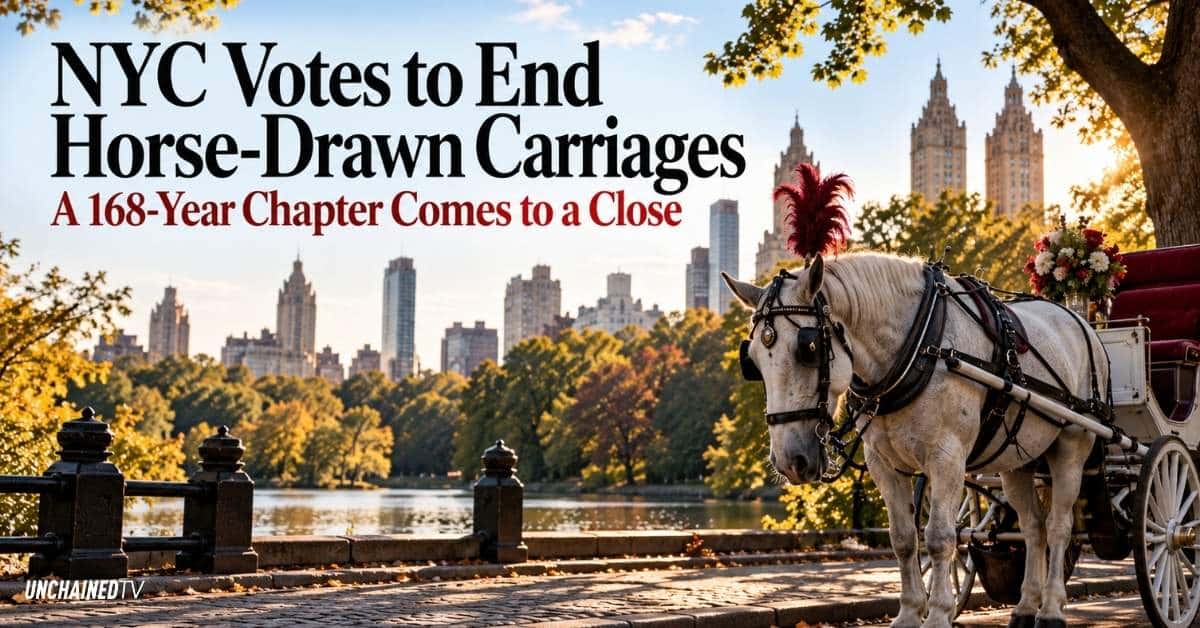
New York City’s historic vote will phase out horse-drawn carriages by 2028, affecting 180 horses and ending a decades-long battle in a victory for the animal rights movement
NEW YORK CITY — October 23rd, 2026 – After decades of legislative battles, New York City has voted to end its horse-drawn carriage industry. On October 22nd, the City Council approved Romanch’s Law in a decisive 40–7 vote, with two abstentions, establishing June 1, 2028, as the deadline for removing horse-drawn carriages from Central Park. The legislation now heads to Mayor Zohran Mamdani, who has publicly supported the ban.
The decision marks a significant victory for animal rights organizations that have spent years documenting accidents, protesting working conditions, and challenging the use of horses in one of America’s busiest urban environments. According to ABC7 New York, the industry currently includes approximately 180 horses, 150 active drivers, and 68 carriage medallions. For the horses, the vote could mean retirement from an industry that has operated in Central Park since 1858. For the workers, it begins a complicated transition that has already prompted threats of legal action.
The legislation is named for Romanch Mahajan, an 18-year-old tourist from India who died in June after being thrown from a runaway horse-drawn carriage in Central Park. Mahajan was visiting New York with his family to celebrate his high school graduation when the accident occurred. His death intensified calls for reform, and his family became vocal supporters of legislation to prevent similar tragedies.
A Victory Decades in the Making
New York’s horse-drawn carriage rides have been a familiar sight since the nineteenth century, offering tourists a nostalgic trip through Central Park. But nostalgia has long collided with concerns about animal welfare, traffic congestion, extreme temperatures, and public safety. Animal advocates have spent decades arguing that horses – animals who spook easily – should not be forced to navigate treacherous streets with fast moving cars, sirens and continuous big city chaos. This is what the horses have to do just to get to Central Park for their daily rounds. Additionally, say activists, antique-styled electric carriages exist that offer the exact same route with similar nostalgic touches.
The battle over whether horses should be used as transportation has been fought for – literally – centuries and the issue is what sparked America’s earliest animal rights organizations. The New York City Council’s official account of the legislation traces back to a 2007 carriage ban proposal, when Council Member Tony Avella introduced legislation to eliminate the industry. Subsequent efforts stalled, including proposals during former Mayor Bill de Blasio’s administration. The campaign gained renewed attention in August of 2022 when Ryder, a carriage horse, collapsed on a Manhattan street, sparking public outrage and inspiring a proposed ban bearing his name.
That legislation evolved through several unsuccessful attempts before returning in 2026 as Romanch’s Law, sponsored by Council Member Christopher Marte. Council Speaker Julie Menin became the first sitting speaker to support a carriage ban, helping secure the overwhelming majority needed for passage. Such legislation has long been championed by well-known activist Edita Birnkrant, executive director of NYCLASS, with the support of the PETA, Voters for Animal Rights, and the Central Park Conservancy.
For longtime campaigners, the vote represents far more than a change in city regulations. It is the culmination of years spent challenging the idea that a tourist attraction’s historical significance automatically justifies subjecting animals to exploitation and danger. After all, New York has managed to modernize just about everything else since 1858.
UnchainedTV covered the historic vote and the campaign behind it, with Rachel Ejsmont reporting from New York City and longtime carriage horse advocate Jodie Wiederkehr providing insight into the movement. Hosted by Lindsey Baker, the special report examines the work of animal protection organizations, including NYCLASS and The Partnership to Ban Horse Carriages Worldwide, and the decades of advocacy leading to the Council’s decision.
The End of an Era, and a New Beginning for Horses
Under Romanch’s Law, formally 943-A, horse-drawn carriage licenses will expire permanently on May 31st, 2028, effectively ending the industry the following day. The legislation includes provisions intended to protect horses from being sold or transferred for slaughter, returned to another carriage business, or otherwise disposed of inhumanely.
By June 1st, 2027, licensed horse owners must certify that their animals will not be transferred for prohibited purposes. Owners may retain their horses, while city officials will work with them to identify humane retirement options, such as animal sanctuaries. The legislation does not automatically require every horse to enter a sanctuary, leaving important questions about individual retirement arrangements to be resolved during the transition.
Animal welfare organizations have already begun discussing retirement opportunities. PETA announced a $50,000 commitment toward helping carriage horses retire, while advocates have identified rescue organizations and sanctuaries interested in providing homes. The challenge now is ensuring that the 180 horses affected by the decision receive appropriate long-term care.
Carriage Drivers Prepare for a Legal Fight
Not everyone is celebrating. Transport Workers Union Local 100, which represents horse-drawn carriage drivers, has strongly opposed the ban, arguing that it threatens workers’ livelihoods, investments, and businesses. The union has threatened to challenge the legislation in court, calling its provisions unconstitutional and insufficient to protect those who depend on the industry.
The legislation requires the city to develop a workforce transition plan by April 1st, 2027, including employment referrals, career counseling, job fairs, and educational opportunities. Officials must also consider financial compensation for carriage owners, including the value of licenses, businesses, and equipment, although no specific compensation package has been guaranteed.
For advocates, the possibility of legal challenges does not diminish the significance of the vote. This vote, so long in coming, is a major victory for the animal rights movement, marking a cultural shift whereby the fate of animals is given weighty consideration. For horse advocates, their biggest regret is that it took the death of an innocent 18-year old tourist from India to move New York City into the 21st century.
For a closer look at the controversy surrounding New York City’s horse-drawn carriage industry, watch Blinders on UnchainedTV.
Video Transcript
BREAKING NEWS: Will NYC Ban Horse Carriages? Historic Vote Ahead Oct 23, 2026, 2:17 PM BREAKING NEWS: Will NYC Ban Horse Carriages? Historic Vote Ahead Play
Mute
Settings Lindsay Baker here with Unchained TV and we have breaking news. Will New York City finally end horse-drawn carriage rides? Advocates are rallying today ahead of a historic council vote on Romanche's Law, named for an 18-year-old tourist who died following a runaway carriage accident. The union is fighting the proposal, but if enacted, regular rides would end June 1, 2028.
Rachel Etchmont is on the scene and Jodi Whittaker joins us in the studio. What happens to the horses and could electric carriages offer workers a future? Welcome, everyone. We are witnessing history in the making.
We're here with Jodi Whittaker and Rachel Etchmont and we are going right out to Rachel because she is at City Hall. Can you hear us? Yes, just go ahead, take your finger off, please. Can you get any closer?
It's really soft. No, no, I can't. Well, we can hear her. Yeah, we're having trouble hearing her.
So we're at City Hall in New York and they're out by the fountain and there are several speakers, councilmen, and Adita Bernkrant, who is the founder of NY Class, and we're having a little bit of technical difficulty here and a lot of difficulty hearing you, Rachel. Rachel, if you could any way get any closer and keep the camera steady, otherwise I'm going to ask you to flip it to yourself and move away because we can't hear.
Yeah, I'm getting hell from all the press right now. If I move an inch, I'm going to get kicked out. I'm sorry. Yeah, well, I've already got hell from everybody.
And Adita's mic is not working for some reason. Okay, why don't you flip the camera and just talk to us for a moment? So what we're seeing here, folks, is we are at City Hall and Speaker Julie Menon is about, she's a council member and she is along with Adita. There are speeches going on, but we're having a little trouble hearing, so we may have Rachel come on and just commentate for us because it's not working right now.
Rachel, I'm going to come back to you in a minute. Yeah, please do because they're really upset that I'm in the way. Hi there, Jody. Thank you for joining us today.
You also work with Carriage Horses. You've been doing it a long time, trying to shut it down. Tell us a little bit about how you feel about what's going on here today. Yes, go ahead.
Yes, thank you for having me on. I'm thrilled that it's gotten to where it is today, and I certainly hope that today is the day that it finally ends or at least they pass the law, the vote, to phase out the horse carriage trade in New York City. New York City has so many horses dying on their streets, and it's unbelievable that it hasn't been done yet.
So it's far beyond time to end this archaic, unnecessary trade. I couldn't be happier for this ban. Yes, it's unfortunate that it had to take the death of a young man to really bring attention to what is going on. Let's take a look at some footage for people that don't know how tragic this is and what actually happens.
I'm going to play a little footage here. So horses are very close to my heart. It was about 20 minutes, and with a three-year-old, that's perfect. We saw a carousel and where they go ice skating.
I think the horses and the carriages bring a special element to New York. It reminds me of old movies and old England and the old days when there were no cars, so I think it's a charming feature of the park and of the city. We're going to come up here on a strawberry field. I thought it was scenic.
I thought it was a New York experience. It was worth the money. New York is just a beautiful city, and going on the carriage ride is just perfect. I did want to go back to the city, but this was better.
Now I'm going to show you another part of the business, which is lurking in the streets. I think this is what people believe because they are not informed about the bad. You know, there's the pro and the con, the bad side of it and the injuries that happen and so forth. They see the romantic side of it and they don't understand what the horses go through.
Jodi, you're really well informed about this. Can you just describe the life of a carriage horse? Well, I can't tell you about every city. Every city is a little different, but for Chicago, for example, there were clear laws on the books for how long the horses could work.
They could only work six hours in a 24-hour period. What we documented starting back in 2015 is that they were worked more than double what the law allowed. They were sometimes working 12 to 14 hours a day. Then they went back to what I call a cage, a stall for a horse, which is just bigger than the horse's body, in a ramshackle warehouse in the city.
They had to walk after working 10, 12 hours a day. They had to trot back to the stable or warehouse, which was a half hour or so, and then they were stuck in a cage. In New York City, I believe that they have to go up into the warehouses there upstairs. Many cities don't require turnout, which requires that they have access to grass and free to be away from all of the straps and the blinders that they must wear and the bit in their mouth.
Let's go back for a moment and see if we can hear now. Try to keep the camera steady, Rachel. What? Please try to keep the camera steady.
We are not hearing. If you could, I think the best thing is to move out of the area a bit and talk to us on camera, because we are getting no sound. Our legislation requires that there be a transition plan for workers in the horse carriage industry, helping them find new jobs over the next two years, including civil service training, career counseling, and referrals to other employment opportunities, because whether they are medallion owners based in the stables or driving the carriages themselves, all of these workers all call our city their home, and they deserve to keep working, growing,
and thriving here. Today, we are taking common sense steps to protect both the horses and the people of the five boroughs. Yeah. And we are proving that our commitment in the same form for a livable city is one that goes well beyond the words we are willing to say.
It's a commitment that shows up in the actions that we take. So today is the day. Let's get this done. Is that Julie Menon that's speaking right now?
Yes, I know. Rachel, can you hear me? Thank you. She appears to not be able to hear me right now, folks.
And, you know, this is live. This happens. We are trying to bring this story to you as best we can. But a spirit that would never be broken.
I am Ramonchez Onco. I stand on these steps today speaking for my beloved nephew. I speak for his devastated parents, Viva and Ria. And I speak for his brave little brother, Monic.
We are standing outside City Hall because the hour of justice has finally arrived. In just moments from now, inside that chamber, a historic vote will be cast. Today, October 22nd, New York will choose compassion over tragedy. And let us be honest about why we are really here.
This isn't just a piece of legislation. This is a sacred vow written in the tears of a family whose world was shattered in a million pieces. No family should ever have to endure the suffocating, silent grief of losing a vibrant, beautiful child. Yet, looking at you today, through our tears, we see a roaring fire of hope.
Thank you to every New Yorker, every soul across the world, who wept with us, marched with us, and demanded a change. When we were entirely broken, your love kept us standing. We send our deepest appreciation to Mayor Mondani and Speaker Julie Mellon for their vital leadership in bringing this historic bill to the floor today. We honor our relentless sponsor, Council Member Christopher Marte, who carried Romance's memory in his heart and fought for him with unyielding resolve.
Thank you, Niklaus, Peter, and every beautiful soul who refused to let the world forget Romance's. Law will fiercely protect the safety of our lives, both humans and the innocent animals who cannot speak for themselves. From where he is now, I know Romance is looking after these voiceless, beautiful animals, guiding us to finally lift the heavy burdens from their shoulders. By granting them the peaceful, green pastures they so deeply deserve, we fulfill his purpose.
We are turning our shattering loss into an unbreakable sheet of kindness for the city. For months, our family hasn't been allowed to just grieve. We've had to fight. We've had to channel our devastating sorrow into a war for change.
But today, once this law is passed, the battle can finally stop. Today, Deepak, Priya, and Mani can finally step back. We can finally hold each other, grieve and mourn our beautiful boy. Giving ourselves over to the grief we can no longer hold back.
As the council members prepare to vote, I ask you all to look up. I know with absolute certainty that Romance is looking down from the heavens right now, smiling and wrapping his blessings around everyone who stood up in his name. On behalf of his parents and his brother, I leave New York with one final sacred request. Please do not forget Romance.
Never, never. His mic is cutting out. Today, let our love become action. Let our grief become change.
The time is now. Let's pass Romance's law. Thank you, and God bless you all. Rachel, can you fill us in on who's speaking and what's going on there?
I'm going to wait a second or two here to see if the sound comes back. He died as a son of this city. Two months ago, I stood before you with Councilmember Marte and Speaker Mennon and told you that his death will not be in vain. And today, thank you to the efforts of Speaker Mennon, of Councilmember Marte, of NyClass, of all the people that have worked all these years.
Think about all the incidents that happened with horses going back to 1980. Think about all the injuries to human beings, to residents of this city, to tourists of this city, Today, we bring this to an end. And I want to thank everyone to do it, but please do not forget Romance Mahajan. He and his legacy will not be in vain.
We have a lot more work to do, his family and his estate, in holding the people responsible for causing his death. That work will not end. But today, thank you to everyone that worked to bring solace and peace and some form of tranquility to this family whose life has been shattered. Thank you.
I'm going to put you down for one second, please. Okay, I'll go back to Jodi for a moment here. Obviously, very emotional time for everyone. We see people crying.
This has been something that activists have fought for, I think, for 20, 30 years. And finally, finally, it looks like this may be a turning point. What are your thoughts, Jodi? I believe New York City has been working on a ban since the 1980s.
So to get to this point is, you know, important. And I certainly hope that the New York City Council and mayor do the right thing and finally do this. Because even if the horses were treated amazing and they had access to grass and turnout, the fact is it's a very dangerous trade. These are 2,000-plus pound prey animals.
You put them with the blinders on their eyes and all sort of straps. Their entire body is controlled. So they can flinch and frighten and spook at the smallest, most minor noise or movement. I know once, I think it was New York City, somebody opened an umbrella.
A simple act is opening an umbrella and the horse took off. And it sent people to the emergency room. So again, even if the horses are treated like gods, it doesn't matter. It's an outdated form of transport.
We're never going to get rid of cars and buses and ambulances and police cars. So to put these prey animals in these urban settings is just, it's an accident and fatality waiting to happen. I just looked up some recent accidents. The headline is, a seven-month-old child dies after being kicked by pony.
That was October 7th, 2026. The next one- Was that in New York? No, that was Minnesota. But it doesn't matter.
I tell people it doesn't matter where it happens. If you have horse carriages in your town, you're going to have an accident and you will likely have a fatality. And that means tragedy, obviously, for the family, but also a lawsuit that no city needs. And the next one, seven injured horse euthanized after SUV hits horse-drawn carriage.
That was September 7th, 2026. So again, this trade is the same in all cities. Some cities are bigger, some are smaller. It doesn't matter.
If you put the horses that are prey animals on the street, you're going to have accidents, you're going to have fatalities, and it needs to end. And there is a solution to all this, which is electric carriages. It's good for the environment. It's good for the horses, because they're not any longer going to be in this position of slavery.
And that's just my opinion. But why do you think it's taking so long to change? Because it really does look strange when you see 21st century traffic and then 18th century horses running around. It doesn't make any sense.
It can't be fun with all the pollution and everything. So why do you think it continues? Money. Everything boils down to money.
And the drivers have been doing it for decades and they don't want to lose their livelihood. And I understand that. Nobody wants to lose their livelihood. But again, if your trade, if your business is exploiting animals and harming both the animals and humans, then it's a trade that needs to be phased out.
And I know that New York City and most cities are willing to work with the employees to help them transition to new careers, which is great. Yes. That is, they are worried about the workers. They want the companies to succeed and continue operation if it can be done in a way that the horses are in the water and people are in the water.
Let's go back and see if we can catch the speeches. So we have another person coming up to the mic, it looks like. Rachel, you can comment in between and fill us in. If you could tell us what we're seeing and who's speaking.
My 18-year-old nephew. No words can express the pain of losing him so young, with his whole life ahead of him. But today, through the passage of Romance Love, his wife lives on. He has become wife to the innocent animals who cannot speak for themselves.
And his legacy gives us hope that his loss can bring meaningful change. I humbly request everyone, please do not let Romance become just the name of love. Remember the young life behind it, his dreams, his compassion, and the sacrifice that brought us here today. No love can bring my Romance back, but if his legacy can protect lives and prevent another family from experiencing this pain, then his life will come to be a shine.
You see people holding signs behind her to ask for Romance's love. It looks like there's a big crowd out there. Rachel, can you fill us in a little bit on what's going on? I don't know if she can hear me.
Hello, everyone. Thank you for coming. I didn't really prepare a speech. I just want to say thank you from the bottom of our hearts.
It means a lot, especially the New York life, for you guys to take out the time and to come here. It really means a lot. Everybody said, I just wanted to say that we're surrounded by these beautiful city hall buildings. Like the speaker said, time has changed.
It's not 200 years ago. Imagine if these buildings in the age of computers were still working on typewriters. So offices have evolved, policies have evolved, and it's time that this law should come into effect for the safety and the well-being of the city and to be in the age of today. So thank you again, and thank you to everyone.
The speaker, my class, our very supporting attorney, our law firm, thank you. I'm getting names right now, but thank you very much. There's a few more shout-outs. I want to thank a few council members that have joined us.
We have to give a huge thank you to Council Member Carl Wilson. And of course, the one and only Shekhar Krishna. And we have the person that introduced this bill 19 years ago. Let's give it up for Tony Apello.
We also have Bill Wong, Council Member Bill Wong. Of course, and we know this is a bipartisan bill. We have our great Republican here, Frank Morano. We're going to have one more speaker today.
We're so grateful for this organization that not just focuses here in New York City about animal welfare, but does it literally all around the world. Let's give it up for PETA. Thanks, everyone. This is the end of the road for a vile industry that has killed countless horses in the name of entertainment, brought gruesome accidents to the middle of Central Park, and claimed the lives of beloved teenagers for a long time.
Shekhar Menon stepped up and did what no Council speaker before her had the courage to do. She chose public safety and the welfare of her horses over political expediency, over what would have been the easy road. She did the right thing. And she delivered decisive leadership that brought us here today to the finish line, ready to pass her launching block.
After decades of advocacy to ban horse-showing characters in Central Park, PETA is proud to mark this victory by putting up $50,000 to help these horses have a safe and humane retirement. Yeah! Thank you all. To support this band, to put a stop to the suffering by this industry.
From the beginning, they were this tragedy hazard. They have been outspoken about the fact that it could never happen to another family, and about the care for the horses. They are an incredible example of strength and integrity. Thank you to NYPOP, Steve, Wendy, and PETA for your fierce, passionate, and unrelenting work.
And finally, for the two people who showed up, spoke up, and refused to give up. You are the reason this change is happening. You are the reason change happens. Keep fighting for a kind and just world.
Thank you. Let's all end this with a chant. Thank you, everybody, for being here. and I'll see you at City Hall!
Cheers! Thank you, sir! Thank you! We see a lot of people hugging each other.
There's a lot of emotion going on. I think they're going to be moving over to City Hall at 1.30, that's Eastern time. I think she's having a little trouble with the camera there. Jodi, jump in here and give us some of your insights.
Yes. Go ahead. Oh, go ahead. Do you have a question?
I guess I'm just wondering, if this passes, how will this affect the workers? Do you think, talk a little bit about the workers, because we do care about the workers. So I understand they have until April to come up with a plan to help the workers, and I think that's a very good thing. Do you want to comment on that?
Sure, yeah. Well, there's definitely a phase-out for both the trade itself for the rides, and so that gives employees time to work with the city for job training, or if they do purchase some electric carriages, then they could...
Share This
About the Author: Brandy Walt-Rose

 Experience Vegan Philly Through the Eyes of Locals
Latest News

Stay Tuned In
Be the first to know when new shows drop! Plus, get the hottest headlines, inspiring stories, and behind-the-scenes extras. Sign up and keep streaming!
you might also like

UNCHAINEDTV reports vegan Philly is surging in 2026, from a Michelin Green Star to a culinary college that requires vegan cooking to graduate.

The new documentary, Together Around Food, examines one town's 15-day experiment—and Climate Healers' ambitious campaign to make healthy, plant-based food free for everyone. CHIMACUM, Washington, October 19th, 2026 - A 15-day experiment offering free gourmet [...]

The provocative animal rights documentary Viral for the Animals is reaching viewers worldwide on UNCHAINEDTV with new subtitles, helping its message travel even further. Hollywood, Ca. - October 13th, 2026 - It’s called Viral for [...]