Amazing New Animal Rights Films!
[Speaker 2]
Welcome to an extraordinary episode of Truth Files on Unchained TV. We have now five fantastic new animal rights films that we are going to bring you little snippets of today, and we have five filmmakers and representatives of those films with us today. These are incredible animal rights activists.
You can see Billy is working, even as we speak, he is there working the phones to save animals. We’re going to start with a film that I saw the other day that completely blew my mind. It is called Cruelty for Clicks, Social Media’s Animal Problem Exposed, brought to you by Lady Freethinker, who we are so thrilled to have with us in the house today, aka Nina Jekyll.
Let’s play a little snippet of her extraordinary film and talk about it on the other side.
[Speaker 1]
I get tips all the time about so many kinds of animal abuse. Torture. Crush videos.
The fake rescue videos.
[Speaker 5]
People would not be harming animals online if there weren’t an audience for it.
[Speaker 1]
Mom cat fights a large python to protect his kittens. This is 188,000 views.
[Speaker 6]
People were paying for those monkeys to be tortured and abused and they were circulating the videos amongst themselves.
[Speaker 4]
Animal cruelty is kind of a big thing. It was flying completely under the radar.
[Speaker 3]
The consumers are global. The problem is it’s really hard to find somebody if you can’t identify where they are.
[Speaker 2]
Unbelievable film. Brilliant. Bravo.
Nina Jekyll, aka Lady Freethinker. Tell us a little bit about how you undertook this very courageously, this battle against cruelty online and on social media.
[Speaker 1]
Thank you, Jane. Thank you for having me and thank you for helping to raise awareness of this issue. Animal cruelty started appearing heavily on social media maybe around the start of the pandemic, 2019, 2020 is really when I started seeing this influx of fake rescue videos.
The problem escalated into some really sadistic content including animal torture which the documentary addresses. This is a global problem. There are multiple levels of attack.
You’re dealing with animal cruelty, protections that should be stronger to prevent these acts from happening. You’re dealing with an audience that is consuming this content and sometimes even unknowingly perpetuating it by sharing something because it’s so horrible or leaving a comment of disgust. And then, of course, ultimately we want the social media platforms to stop this content from being posted in the first place.
It’s really this massive ongoing problem that my team has been working on for years with some progress and a lot of work to go.
[Speaker 2]
One of the most extraordinary things that I took away was that when you see something involving animal torture on social media, when you comment and say this is terrible, stop. That just is like free advertising for them. That increases the algorithm.
So you are saying do not do that. Instead do something else. Can you outline exactly what you advise people to do when they come upon these videos?
[Speaker 1]
Yeah, exactly. So anytime you engage with this content in any way you are feeding the algorithm and you could actually be spreading it inadvertently. So do not interact except to report it using that platform’s online reporting system.
And each platform does have a method for you to flag, report, and let that platform know that this content exists and to remove it. Because this type of cruelty is banned on virtually all platforms in their terms and conditions.
[Speaker 2]
And they really are relying on us to report it to them. So this is the takeaway, people. If you see cruelty, you report the cruelty, but do not engage.
Do not be there as a keyboard warrior saying this is terrible, stop it, stop it. That only increases the algorithms and sends it out to more people. So that was one incredible takeaway I got from this extraordinary film that I think has just come out.
It’s going to make waves everywhere. We’re going to get back to it in a second, but I want to go to our second film and we’re getting to the fun ones that are hilarious and fun. So hang in there, but we’ve got to speak up for voiceless animals first.
And the next film that we are going to look at, I also saw this weekend, also absolutely brilliant. It is called Dogspiracy.
[Speaker 3]
This is nuts. It has to stop. I’m doing all I can to help change the law in America.
Down here, you’ve got no trespassing, no cameras, no video. Why? What have they got to hide?
We know.
[Speaker 4]
Good morning, I’m here to pick up the dog. The executive directive from the committee said I will never pass another dog bill.
[Speaker 3]
The easiest way to save millions of dogs lives is to end cruel puppy mills forever. And you could be part of the solution. You have to keep on fighting.
In safe hands.
[Speaker 2]
Now, Michael Torres, you are not a producer of the film, but you are representing because the actual star of the film, Mark Abraham, is actually continuing his undercover investigations as we speak right now. I watched this film in Beverly Hills this weekend. Very powerful.
The big shocker to me is that 65 million Americans have dogs, and apparently the overwhelming majority of them still come from breeders, from puppy mills, from pet stores. I was shocked by that.
[Speaker 1]
Yes. Thank you, first of all, Jane, for having me here. And it’s great to be amongst so many wonderful activists and filmmakers.
And yes, my name is Michelangelo Torres, and I’m from In Defense of Animals. And we recently had a screening. We were actually the West Coast premiere.
We had it the day before the Beverly Hills screening, which Jane appeared at. We had it in San Francisco at the Roxy Theater in the Mission District. And prior to that, I was able to do a little tour of San Francisco to some of the rescue facilities that we have here with Dr. Abraham. And we had a great time going to a lot of different places, including Muttville Senior Dog Rescue. And so anyway, so yes, that’s why I’m here today representing the film, because I thought it was amazing.
[Speaker 2]
Yeah, but it’s a problem, Michael.
[Speaker 1]
Yes.
[Speaker 2]
It’s a problem. Tell us about the problem.
[Speaker 1]
Oh, yes. It’s definitely a problem. It’s an amazing problem in the sense of that, and this is one thing that I think is very powerful about the film, is that it really brings home exactly the dangers and what’s happening to these dogs that are being bred.
And it happens so often when we have conversations with people, well-meaning people who still purchase dogs, who have no grasp of just the impact of breeding and what it does to animals. And they always feel like, or even those that do somehow know something about it, they always feel like their case or their situation is slightly different. But what this film does is it really lays on the line exactly what’s at stake and why we need to get involved and we need to have reform right now.
[Speaker 2]
Absolutely. And one of the things is that people say, well, I had to buy a dog because you don’t know where the dogs in the shelters, you don’t know where the dogs who are bred come from. And the problems that puppy mill dogs experience totally exceed the problems that dogs in shelters experience.
They’re often inbred, there’s all sorts of problems. So people buy these dogs, sometimes for a lot of money. One of the big shockers for me was that people are still spending like $10,000 going into severe debt to buy a dog when the exact same breed of dog is about to be put to sleep in a shelter.
It’s so crazy. But your film, the film that Indefensive Animals produced really exposes it. So I applaud you.
All right, we’re going to go to the next film. And this one, Dustin Brown has put out, and he is an amazing filmmaker. We’re very proud to say that several of his other films are streaming on Unshamed TV.
Well, let’s show you a little clip, and then we will discuss it because it really almost defies description. It’s very surreal. Wow, bravo.
I would love to also ask you about your use, and thank you for unmuting before you speak, Dustin. Your use of, was that artificial intelligence or what? How did you get those incredible images?
[Speaker 1]
Thank you, Jane. It’s a pleasure to be here and with all the filmmakers as well. Yeah, this was a combination of visual effects.
And the film started with the imagery in particular was real animal imagery. And all the billboard images that you see came from LCA’s Last Chance for Animals undercover investigations. And so that was the starting point, of course, is to show the reality, show the real footage.
And then we had a tremendous visual effects artist that was able to put the billboards in and do some compositing. And then we did use some other VFX tools and stuff to kind of do the morphs and to do that sort of thing. But it was important for us to, you know, we’re not creating things.
We didn’t create something that wasn’t there. Like, this is real footage of a fur farm, real footage of animal research, real footage from their pig investigation. So that was the starting point.
[Speaker 2]
What I loved about it is tells a story of a short order cook, a young girl who’s flipping burgers for a living just to make a living. Can you give us just a brief synopsis without giving it away?
[Speaker 1]
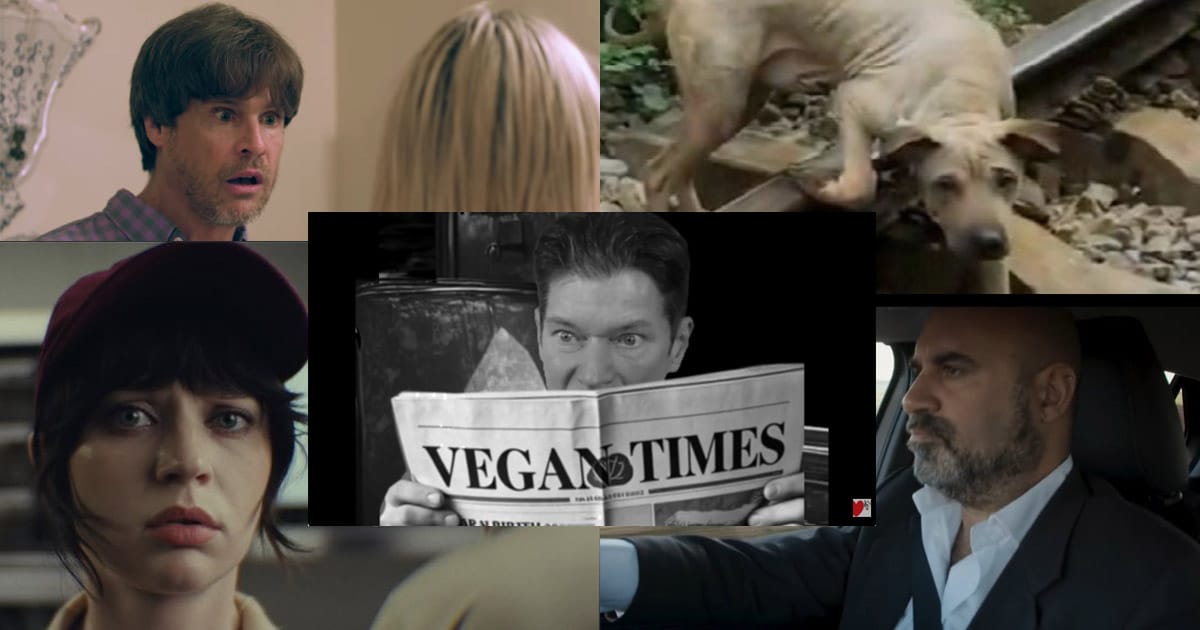
Exactly. Yeah, it takes place in a fast food restaurant and it’s a fast food cook whose reality starts to twist. And so she doesn’t know if she’s living in a nightmare or if she’s living reality, but she starts to see the hidden truth behind what she does in her work and advertising.
And so that was the first inkling of the film was to talk about the advertising that we see, the manipulation behind advertising in what we eat, what we wear, what we use as products. And so it’s peeling back that curtain and peeling back to reveal what if ads told the truth. That’s the central premise.
[Speaker 2]
I absolutely loved it. Congratulations. So creative.
Speaking of creative, and I happen to love old films, this one also blew me away for a different reason. It is so creative and so fun. And just as a hint, all the footage that you see is public domain now.
So this is a very creative compilation of public domain, classic films to create a new reality. It’s called Mystery on the Vegan Express.
[Speaker 1]
It’s a dream come true.
[Speaker 3]
Ironic vegan options on a vegan menu. And that fur looks uncomfortably real. Why is the food non-vegan?
It comes from cruelty. What’s going on with this?
[Speaker 2]
Oh my gosh. I love this so much. So brilliant.
David Giardina, tell us how you came up with this concept and tell us.
[Speaker 1]
Well, thank you, Jane, for having me on. And it’s great to be here with these amazing vegans and filmmakers. And yeah, the story of this, well, a little back history on me.
I’ve always loved 1920s and 30s culture, including the music and the films and everything. And being a vegan and a filmmaker, I figured let’s combine all of these things and do a film for the animals that has a message, but still is lighthearted and fun and a true homage to the old movies, which I love. So that’s how it came about.
And it’s a 30 minutes featurette.
[Speaker 2]
I just love it. It’s extraordinary. I mean, they’re all extraordinary in different ways, but I happen to be that person who watches Britbox at night and watches these old films.
So it really struck a chord with me. Now I want to play the final one and then we’re going to go back to Cruelty for Clicks. My dear friend, Billy McNamara, who is such a hero for animals, who literally risked his life during the Pacific Palisades fires rescuing animals and allowed us to use his extraordinary footage of him surrounded literally by flames.
This man put his life on the line to rescue animals during the fire. And he is a well-known actor who has some very famous friends, apparently. This movie called, or it’s actually, I guess, a reality series called The Trouble with Billy is another extraordinarily creative work of art.
Let’s watch it and talk about it on the other side.
[Speaker 4]
You’re not going out on auditions right now? No. So my niece threw me out of the house.
Right now, I live in my car.
[Speaker 3]
You want in into the winner’s circle?
[Speaker 1]
Remember this actor from the 90s, Billy Mack, a real rising star, worked with everyone, lived the California dream, you know? Then he disappeared. Yeah, I got abducted by aliens.
[Speaker 4]
Billy Mack, you’re back. I got you a snack. It’s not, it’s not a main course, but you’re who are fans of yours.
How does one cash in? Autograph conventions.
[Speaker 5]
Billy, Billy, Billy, Billy. Boo, are you all right? Unfortunately, Boo has an enlarged heart.
How long does she have? A couple of months. I’m doing heart transplants on dogs, but it’s very expensive.
Do it. Book it. How are you doing?
How’s your puppy?
[Speaker 4]
I told you, you would do whatever it takes.
[Speaker 5]
You’re a prostitute now. Getting bigger. The world’s not out to get you.
I mean, if you think that it is, then it is.
[Speaker 2]
I gotta tell you, this is so, and I was amazed at how many famous people. You gotta tell us, Billy, who were all the stars, and how did you do it?
[Speaker 1]
Well, first of all, it’s, it’s, unfortunately, it’s not a reality show. I wish it was because Green Actors Guild got an injunction against me because they claimed I didn’t pay pension and health. That’s a, that’s a long story.
So no, this is SAG, DGA, WGA. It’s all union. It’s not reality.
Reality, I could have done whatever I wanted, non-scripted, but so I’ve been in union hell for the last two years. But anyway, well, they’re all friends of mine. I’ve worked with all of them multiple times.
I was just with Billy Baldwin and the other guy, Randall Battencock, yesterday. We’re doing a cover, a photo shoot for the cover of a magazine because the show’s about to come out in about three weeks. And we were at, we used the ranch where I saved all the horses and the peacocks in, in return for helping them during the fires.
They told me that I could use their location for free. And it’s an incredible location. And I only seen it at nighttime because it was late at night.
We were getting the animals out. So it came full circle. And it was so nice of the people.
It’s called the Chesapro Canyon Ranch in Agoura Hills.
[Speaker 2]
But I have to ask you, it says, based on a true story, give us the elevator pitch.
[Speaker 1]
Well, based on a true story, it, that sort of gets people more interested. That’s kind of a marketing ploy. I’ve never lived in my car.
Actually, there are no heart transplants for dogs yet. So that’s completely, I’ve never been abducted by aliens. I’ve seen them, but I’ve never been abducted.
[Speaker 2]
Well, it’s, it’s, you are so creative. Everybody here. I mean, I think we all need to give each other, not me, but all of you a round of applause.
Bravo. I want to get back to, I would say the most disturbing film of all, but one that has the capacity to save many, many lives, voiceless animals. So I want to play another clip of Cruelty for Clicks, and we’re going to talk about it on the other side.
Fasten your seat belts.
[Speaker 4]
This is, you can’t get those images out of your head. They still haunt me today.
[Speaker 3]
These videos are the only content in my professional career that has ever given me nightmares.
[Speaker 1]
It’s actually been very hard. I started to look at people differently. You can’t ignore it.
You know, if you ignore it, then it’ll never stop. YouTube was seemingly not doing much about it, and I had no choice but to sue them. The media took notice, and for the first time, the public could see how rampant animal cruelty had become on mainstream social media.
If flagging a video using the steps they tell you to use does nothing, then what is your recourse?
[Speaker 3]
It certainly can hurt to publicize an exposure.
[Speaker 2]
A brilliant and courageous film. I honestly don’t know how you did it, and I would like to ask you to unmute and tell us how you did it, because I cannot imagine the amount of research that you had to do. Just looking at a couple of images left me disturbed for the entire night.
I literally tossed and turned. Not to say it’s not watchable. It’s very watchable, and I understand it’s very watered down from the original, but you’re my hero, Lady Freethinker.
First of all, you’ve gone a long way towards stopping this, so tell us about that.
[Speaker 1]
Yeah, no, thank you. Not only did we water down the first draft of the film, but even initially, there’s just so much horror that would have never been possible to include. For a while, when these groups were being formed, the baby monkey torture groups specifically, there were days when I really didn’t want to wake up, because I knew that there were going to be more torture videos in my inbox waiting to be reviewed.
That frustration and horror and kind of despair almost, I would say, is what really helped lead to that lawsuit, because there’s only so much you can take. When you are reaching out to people and trying to take all of the steps they tell you to take, and nothing is happening, what do you do when you’re faced with this horror? For me, at that time, it had to be a lawsuit.
I’m very grateful that I found an attorney willing to do that, because that was a whole other battle. It’s not a typical case, and most attorneys just don’t do things like that. Unfortunately, we are still dealing with the sadistic videos, but they are lessened.
I am happy to say that even though we didn’t win the lawsuit, it did get a lot of media attention, and eventually, YouTube did remove monkey torture content and did a pretty good job of cleaning up the really obvious and intentional cruelty. Of course, there’s platform hopping, and there are other resources that these people who are intent on posting horrible content use, but we have made inroads and continue to make inroads and stopping it.
[Speaker 2]
One of the many shockers that I took away, I was wondering, who are these people? We don’t need to name names, but there was a science teacher in the Midwest who was convicted of this. You see his bubbly face, smiling like for a school picture.
It’s like you never know. You don’t know who these people are, and that was part of the problem in fighting it, right? How do you fight somebody when you don’t know who they are?
[Speaker 1]
Oh, it’s insane. There are grandmothers, yes, school teachers, medical professionals. These are normal people, and I was really surprised by the number of women who were involved.
In the beginning, of course, they all used these fake screen names, and when there was a female screen name, I’d be like, oh no, that’s just somebody who’s trying to hide their identity, and then they started arresting grandmothers. I was like, wow, you just never know who’s involved. At first, I will say they were kind of sloppy, and it wasn’t that hard to track them down, which was very helpful.
Obviously, people get more sophisticated once they see others going to prison for doing it, but investigations are ongoing. There have been 33 arrests so far globally for the baby monkey torture, which I’m very happy about. Our federal law enforcement has taken this seriously.
FBI, HSI, Fish and Wildlife Services have all really joined forces to help combat this and prosecute the suspects. I believe there are more prosecutions to come, and yes, they could be anybody. They could be your neighbor.
You just never know. It’s really scary.
[Speaker 2]
Well, that is a perfect example of how cinema can become animal activism. Frankly, if it weren’t for Lady Freethinker, these monkeys would still be tortured at the scale that they were being tortured before you got into it, and I think that this film, as it’s distributed and hopefully gets media coverage, you were in the New York Times when you sued YouTube. Well, hopefully the New York Times documentary, that will get all the social media platforms hopping to stop this.
It’s brilliant activism, so I just want to do a round robin. How everybody has seen that this is the most important tool. With 8.3 billion humans on the planet, we can’t just sit down and have long conversations with every individual. David Giardina, let’s start with you and go around, and everybody, thanks for unmuting as you speak.
[Speaker 1]
Yes, absolutely. Film, the media such as film, it’s an amazingly powerful tool, and Orson Welles kind of suggested this when he was first starting out. He goes, it’s an amazing tool.
It’s fun, but it reaches people in very deep ways, so yes, I’m totally on board with using film as a means of activism to raise awareness, especially with something like animal cruelty, which is so rampant, as we’ve discussed, so insidious, and I think film is a great way to address that.
[Speaker 2]
Billy, you have been part of the Hollywood scene for so long. We know that films can also be a problem, like when they do films that feature a certain type of breed of dog, and then all these breeders start breeding that dog, and then the next thing you know, those dogs are all up in shelters, you know, on death row, because people bought them because they saw a movie and then realized, oh, it’s hard work. So film can be used to hurt animals, and of course, the cruelty videos, exhibit A, but it can also be used as a force for good.
How do we empower other people who may not have all the skills that you guys have to make these films and do this? And thanks for unmuting.
[Speaker 1]
I mean, really, it’s, you know, making films and TV things, that’s kind of old school. I mean, right now, it’s younger people are doing, you know, Instagram, YouTube, Facebook reels, that I think that’s way more impactful. Very few people, younger people are really spending a lot of time with the movies right now.
And so I do think social media is the way to, you know, to get the word out. And it’s, it has the most impact and you can do shorts, 30, 45 seconds. A lot of people can’t, first of all, some of the stuff is pretty gruesome and hard to watch for 90 minutes.
That was even true for me with Sean Munson’s, that original movie he did, Earthlings, it was very hard to get through it. And so, but you know, I think anybody could get through 15 to 30 seconds. It’s something that it gets the message across very quickly.
It’s very powerful. And, you know, two things, it’s, they don’t have to suffer through 90 minutes, and they have short attention spans. So I think the best way is the social, is viral videos.
Do, you know, do viral videos, positive stuff, as opposed to the gruesome stuff.
[Speaker 2]
I agree with you. And I also want to say short films, like Dustin Brown, you’re kind of a specialist in short films. You don’t necessarily make an hour and a half documentary, but you’re making films that are pretty short.
They’d be falling in the short film category.
[Speaker 1]
That’s right. I mean, my work with, with Last Chance for Animals, we’ve been lucky to make several short narrative films. And I think the thing, as Billy was saying, is that in the social media age, it’s, you know, pieces that can grab people’s attention, and that it’s easily shareable to get a concept across.
So this is not an ad is a four minute film. But each section, the opening 20 seconds is something that could grab someone’s attention, this clip that you showed, looking at the billboards is a 20, 30 second clip that can easily grab someone’s attention and be shared. Other films that I’ve done with LCA, Casa de Carne, or Super Cow, you know, these are all narratives.
So they’re not documentaries, they’re telling a story with the characters, but they’re designed to go beyond just the choir, the vegan choir, but oftentimes using genre like sci fi, or thriller, or horror, to grab people in immediately in those first five or 10 seconds to show something different or intriguing and, and pull people in who maybe are not, you know, vegetarian or vegan, but maybe they’re interested, or maybe they have pets that they love, or maybe they’ve never thought about it before.
Maybe they just don’t know. So I think awareness is the biggest thing. And everybody is, you know, can become aware from different things.
So somebody might see a documentary, like myself, when I was young, I saw, you know, investigation video, meet, meet your meat. And it was a graphic, you know, investigation. And that did it for me.
But a lot of people can’t handle watching anything graphic, and they maybe need something that’s more palatable, like an animation, or a stop motion, or something that shows, you know, more of a hopeful connection. So whatever the, the tool is, every, every individual is different, right? So we don’t know what’s going to be the thing to reach somebody.
But that’s why all of these different films, they’re all different, they’re all different styles, different genres, and each one of them has their place. That’s what’s so beautiful about it is that they reach a wide variety of people and can, can connect on that level. So I think it’s all important.
And it’s all useful. And everybody is doing a great job.
[Speaker 2]
Everybody’s doing an incredible job. Now, you mentioned, Billy, that, you know, short reels, of course, and you’re talking about short films. There’s also docu series.
If you look at Netflix and Amazon Prime, you see a lot of docu series. And you can take a long documentary and break it up into shorter segments for that short attention span generation. And I think I always say I feel a lot younger than my age.
I’m also a short attention span person. So there’s the reels as well. Let me go back to Nina, aka Lady Freethinker, Nina Jekyll.
Is there a way to take this extraordinary film that you did, produced and directed as well with top people in the industry? I went to the screening and the q&a afterwards. And the person who was really the man who made this happen has a lot of reality TV show Hollywood experience.
So it’s really top of the line. Is there a way to break this down and have a massive social media campaign as well as a docu series?
[Speaker 1]
Yeah, and first of all, yes, shout out to Kirk Murray, who directed this documentary, and he really did a phenomenal job. You know, we’re really taking it one step at a time. I think that there’s a lot of shorter content to be made about this issue as a whole.
And, you know, right now, our main focus is getting, you know, this documentary in its current form out there that screening that we had, it was a private screening, it was the first time that it’s ever been, you know, shown in a theater. And so we’re really at, you know, stage one at this point in getting the documentary out there. And there’s a lot of work to do on that.
And could I see it as a series? Could I see it made into, you know, social media reels? Absolutely, in the future.
Yeah. And I think that could be very effective.
[Speaker 2]
What is your goal with the film? Let me ask you that.
[Speaker 1]
You know, honestly, I just want it to be seen by as wide an audience as possible. And I want it to have an impact. You know, I’m an animal advocate more than I am a film distribution expert.
And I’m really open to various mediums and various platforms. I just really want it to make a difference because this has to stop. It’s been going on for far too long.
And there’s been so much work leading up to this. And I want to see it end. That’s it.
That’s the goal.
[Speaker 2]
You know, this viewer has a very interesting comment. It’s silly the amount of horror movies people watch, but they’re afraid to watch. They’re afraid of slaughterhouse footage.
And it’s true. People watch gruesome things, murders. I personally only like polite murders on BritBox where people have some champagne and then they lean back on their beautiful couch and that’s it.
But people love horror. And yet, when you try to show them the actual horror of what’s happening, they don’t want to see it. They’re terrified.
You mentioned Earthlings, Earthlings, which is also streaming on Unchained TV is probably, I would guess, turn more people vegan than almost anything else. Because if you can get through it or even halfway through it and you’re not vegan, that’s a question. It is.
I know people have watched three minutes of it and have gone vegan. So it’s really interesting, though, this whole idea that people can watch fake horror, but not real horror. David, do you want to take, I don’t want to say a stab, but a stab at that?
[Speaker 1]
Yes. You know, it’s interesting about, and I totally agree with what Nina said, taking it one step at a time as far as what I want to do with Mystery in the Vegan Express. But early on when I had a rough cut of this film, I showed a non-vegan just because I needed to have that input.
And they immediately said, oh, I loved it. It was great. And this is a quote, I appreciate that you weren’t pushy and trying to push your opinion and beliefs on others.
I like the humor. When I heard that, my heart sank. I really said I failed because that’s not what I’m about.
I am not here to make non-vegans comfortable about animal abuse, which is so normal. So I quickly said, you know, there are a lot of ways of reaching, putting the word out about how awful animal abuse and use is, and none of them are wrong. I said, some people are very in your face.
Look at Rigeland. I mean, they were amazing. They went there, direct action, risked their lives literally for these animals.
I said, some people are comfortable leaving funny little memes on social media. That’s perfectly fine. That’s activism.
Some people go into stores with signs and they do disruptions. That’s perfectly fine. You know, I did this movie.
A lot of times, you know, I’ve done all of those things. I’ve done a lot of direct action and things like that. But with this movie, I wanted to be available and accessible to people who weren’t reacting.
They weren’t responding in a positive way to other forms of activism. So I asked this person, I said, well, so what do you think? Did you get the message?
And they seriously said, yes, I did. I really did. I think it’s an important thing to think about and to consider.
So that made it better for me. So with that, what I want to do with Mystery on the Vegan Express is get it out there. Right now it’s in festivals and happily, it’s been in a lot of festivals.
It’s won nine awards so far. Yeah. So I’m very pleased with that.
And it’s still going. I’m still putting it out. Probably over the next eight months, I’ll be putting it out there.
Many other festivals that I want to get it into. So that’s the thing. Get a buzz going, get people to see it.
And hopefully it will, it’ll make an impact. It’ll make people laugh and then say, oh, wait a minute. Why am I actually doing what they’re talking about in that movie?
[Speaker 2]
Thank you so much. You said it so well. Well, final thoughts.
I know you’re all very busy writing the treatment for your next project, probably. So I don’t want to keep you. Michael Torres, what is your message with this incredible film, Dogspiracy?
[Speaker 1]
It’s just, it’s an amazing film and it’s got something for everyone. If someone isn’t really aware of the challenges that are facing animals, dogs in particular, they can look at this film. If someone is involved and needs some inspiration as far as next steps, how they can get more involved, look at this film.
This film, I really enjoyed it very much. I learned a lot from it. I know that the group that saw it with us at our West Coast premiere enjoyed it as well.
And I do want to point out another thing that I think it could be very successful. I can’t wait for it to start streaming in the US. Right now in the international movie database, it’s scoring about an 8.0, which is really, really great. We’re talking about Wizard of Oz and Citizen Kane territory here. But anyways, just for people to look out for it, you’ll learn a lot. It’ll inspire you on next steps.
It’ll give you some history. And most important, it brings attention to a problem that we really, really need to address.
[Speaker 2]
And I see it as a film to show anybody who’s saying, I think I’m going to buy a dog, show them that film. Strap them to a chair, show them that film. They will not.
Final thought, Billy McNamara. And I’m going to unmute you or unmute yourself.
[Speaker 1]
Just very grateful to be amongst this group. My show is just a comedy, but it is that Shelter Dog stars in it. She’s an Eastwood Ranch Foundation rescue, and she definitely rescued my life.
And that’s the thing. Shelter Dogs are the absolute best. Every experience I’ve had with the Shelter Dog has been life changing.
So I’ve never bought a dog, and this Shelter Dog changed my life. I made a TV series about her. So there you go.
[Speaker 2]
I don’t know what you mean. So this is one of my two Shelter Dogs. This is Wednesday, who actually was being dumped at a shelter, and the shelter said there’s no room.
And somebody saw that, grabbed her, and she’s the queen of my household now. All right, final thoughts. We’re going to go to Dustin Brown next for final thoughts.
Thanks for unmuting.
[Speaker 1]
Thanks, Jane. Yeah, great to be here and hear about all these great films. I’m going to go check out now.
And nice to see, I just have to say nice to see Nina, Lady Freethinker. So I don’t know if you guys know, your audience know that Nina was the one that hired me at Last Chance for Animals almost nine years ago now. So we go way back, but it’s great to see you, and I look forward to seeing your film.
[Speaker 2]
Oh, wow. Well, it’s full circle. Dustin, Nina has done so much incredible work.
I just sometimes, I cannot process how she put all that together. Again, the difficulty of having to watch all that, I just can’t, I just kudos to you. So Nina, your final thought, you can wrap it up for us.
[Speaker 1]
All right. Yeah, well, thank you, Dustin. It’s really good to see you too.
It has been a long time, and you were a great hire, and you’ve done amazing. So nice job. You know, I really love the diversity of genres and all of these films that were made so differently and have such different angles and styles, but really all serve the same purpose to further the cause and to help end animal suffering.
It’s really an honor to be here, and to everyone, just keep doing the good work.
[Speaker 2]
A great way to end. I would like to say you are all my heroes, and every single one of you is, of course, invited to have your film on Unchained TV, our animal rights streaming network, and we are a 501c3 nonprofit, mostly run by volunteers. I’m a volunteer.
We just want to celebrate these incredible animal rights filmmakers who go to the mat for voiceless animals. Remember, they can’t vote. They can’t go to Congress.
They can’t sue. We’ve got to do it all for them. So join it.
Let’s do it, and everybody watch these films. See you next time.
[Speaker 5]
Unchained TV is my go-to. Unchained TV. Who knew?
[Speaker 6]
Unchained, baby!