
Activists Celebrate Legislative and Campaigning Progress Toward Ending Animal Tests
Share This
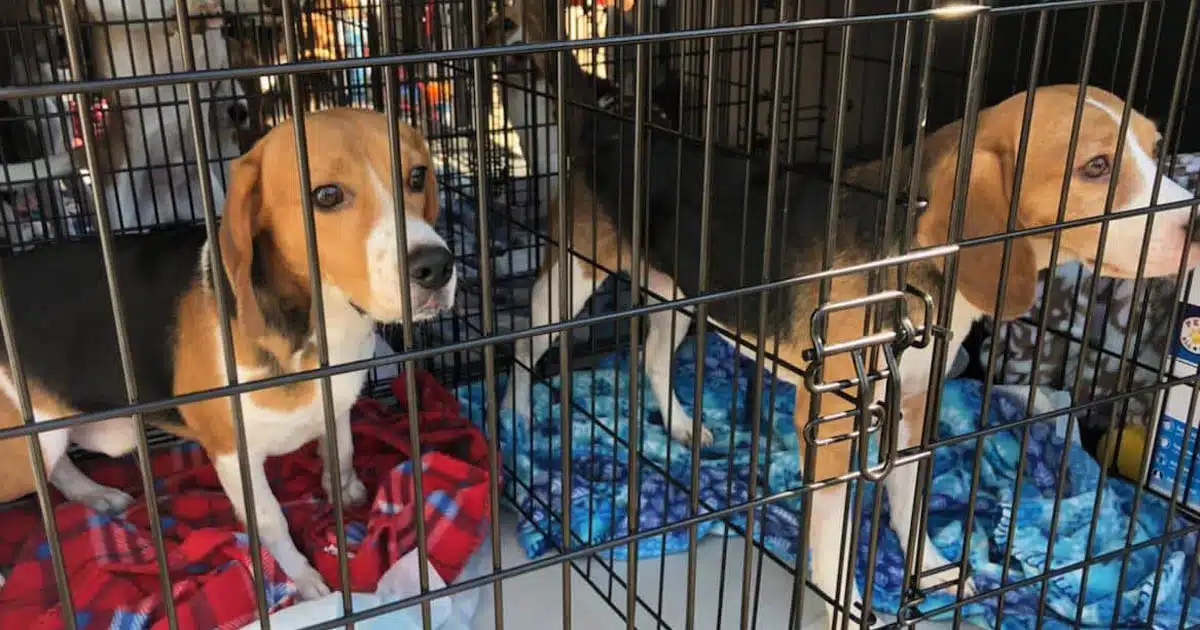
Ending animal tests in the USA is getting closer to reality with the progress of the anti-vivisection movement and the new COMPACT Act proposed legislation
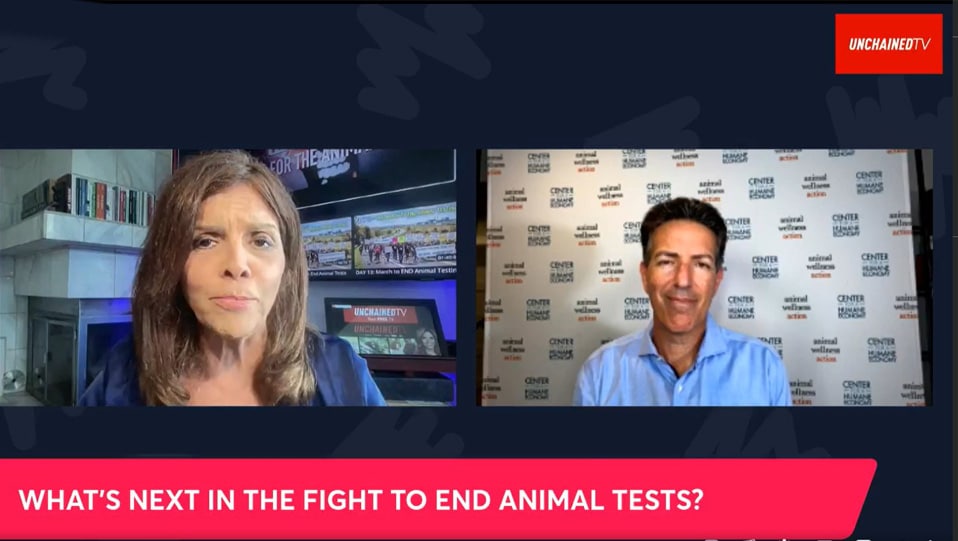
Jane Velez-Mitchell and Wayne Pacelle
Los Angeles, CA, October 2nd, 2026 — This week, the Center for a Humane Economy and Animal Wellness Action reported accelerating momentum toward ending animal tests in the United States. The progress follows the September 26th completion of the March to End Animal Testing that reached the gates of Marshall BioResources, America’s biggest breeder of lab beagles, and the introduction of the bipartisan COMPACT Act in Congress. The goal of both the proposed legislation and the march? End federal funding for animal experimentation, get animals out of pharmaceutical development pipelines, and free the roughly 42,000 dogs currently held in American laboratories or breeding facilities. Wayne Pacelle, the president of both animal protection organizations and a national leader in the effort to eliminate animal testing, talked to UNCHAINEDTV’s Jane Velez-Mitchell about this progress. You can watch the entire conversation here:
Legislative Momentum Builds Behind Ending Animal Tests
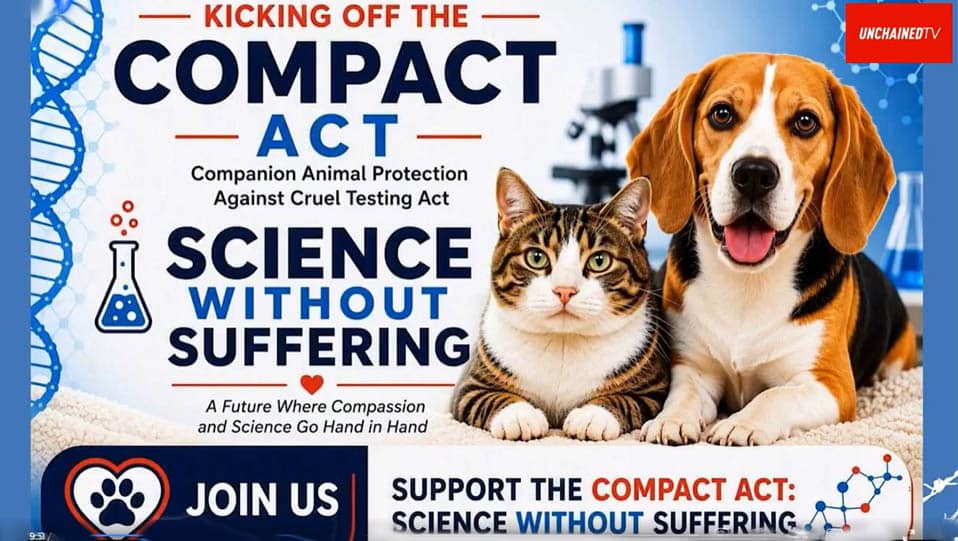
Support COMPACT Act
The Companion Animal Protection Against Cruel Testing Act, or COMPACT Act, was introduced on September 23rd by Representative Nick Langworthy, a New York Republican, and Representative Mark Pocan, a Wisconsin Democrat. The bill would bar federal funding for research involving live dogs and cats, redirecting those resources toward human-relevant methods. Animal lovers are urged to call their members of Congress at 202-224-3121 and tell them to co-sponsor and vote for the Compact Act.
Pacelle, President of Animal Wellness Action and the Center for a Humane Economy, described the bill as the central legislative vehicle for ending animal tests in the near term. “This bill will bar federal funding for research on dogs and cats, and it will then free up the resources to go to alternative methods; it will break this kind of norm, this custom, this habit of using dogs and cats in research; of course, we need to be thinking about the primates,” Pacelle said.
Pacelle added that, “Americans have been paying $40 million a year to fund cruel experiments on dogs and most have no idea.” The Animal Legal Defense Fund has endorsed the measure, stating the COMPACT Act “doesn’t just cut off funding for these cruel experiments — it requires that dogs and cats still in labs be protected and rehomed, not killed, once their use ends.”
The COMPACT Act follows the FDA Modernization Act 2.0, which Congress passed unanimously in 2022 with Senators Rand Paul and Cory Booker as lead authors. That law eliminated an 84-year-old federal animal-testing mandate dating back to the 1938 Federal Food, Drug, and Cosmetic Act. Work on FDA Modernization Act 3.0 has continued in parallel.
CLIMAX March to End Animal Tests
Federal Health Agencies Shift Toward Human-Based Methods
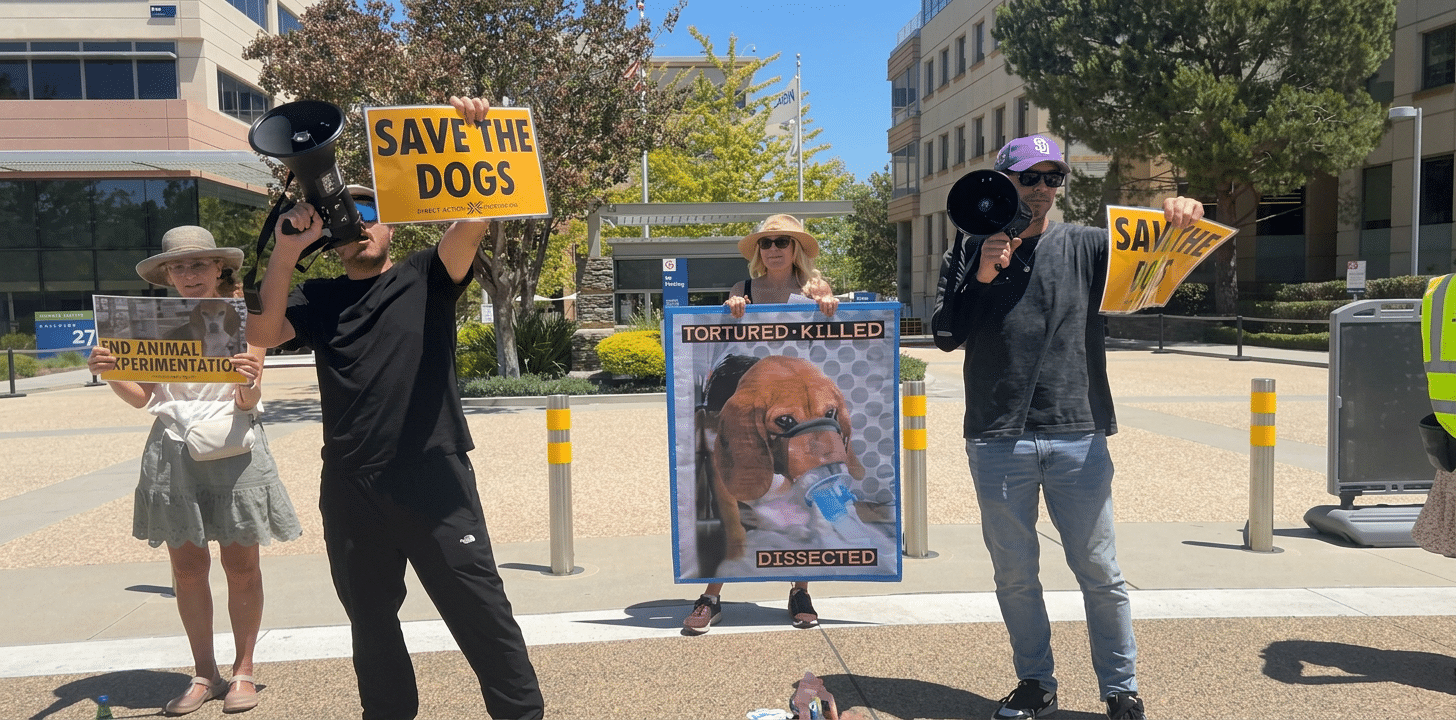
Animal advocates protesting to end animal tests
Health and Human Services Secretary Robert F. Kennedy Jr. recently announced a federal commitment to reducing animal use in biomedical research. “We are putting human biology at the center of American biomedical research and replacing unnecessary animal testing with better science,” Kennedy said in a video played during the interview, adding that the department will “invest in those methods, validate them rigorously, and remove unnecessary barriers to their use.”
The National Institutes of Health has moved in the same direction, committing more than $88 million in funding to pivot away from animal models and move towards human-based biomedical infrastructure projects nationwide. The NIH is also launching a challenge offering over $7 million in awards to demonstrate how quantum-enabled approaches can improve detection and measurement in New Approach Methodologies. Rise for Animals characterized the combined efforts as “a significant investment into human-based technologies as the future of preclinical science.”
Pacelle argued that the scientific case for ending animal tests is resonating in Washington. Roughly 75 percent of all animal testing is tied to drug development across cancer, pain, obesity, and Alzheimer’s treatments. “We have a drug-centered health strategy. We don’t focus as much on prevention.”
High-tech alternatives to animal experimentation have grown exponentially over the past five years. Pacelle pointed to organ-on-a-chip systems, organoids, computational toxicology, and artificial intelligence modeling as methods grounded in human biology rather than canine or rodent biology. “Why should this domain, this business, be different from any other business where it’s resistant to change?” he said.
DAY 13: March to END Animal Testing!
Ridglan Closure Sets Precedent for Marshall BioResources Campaign
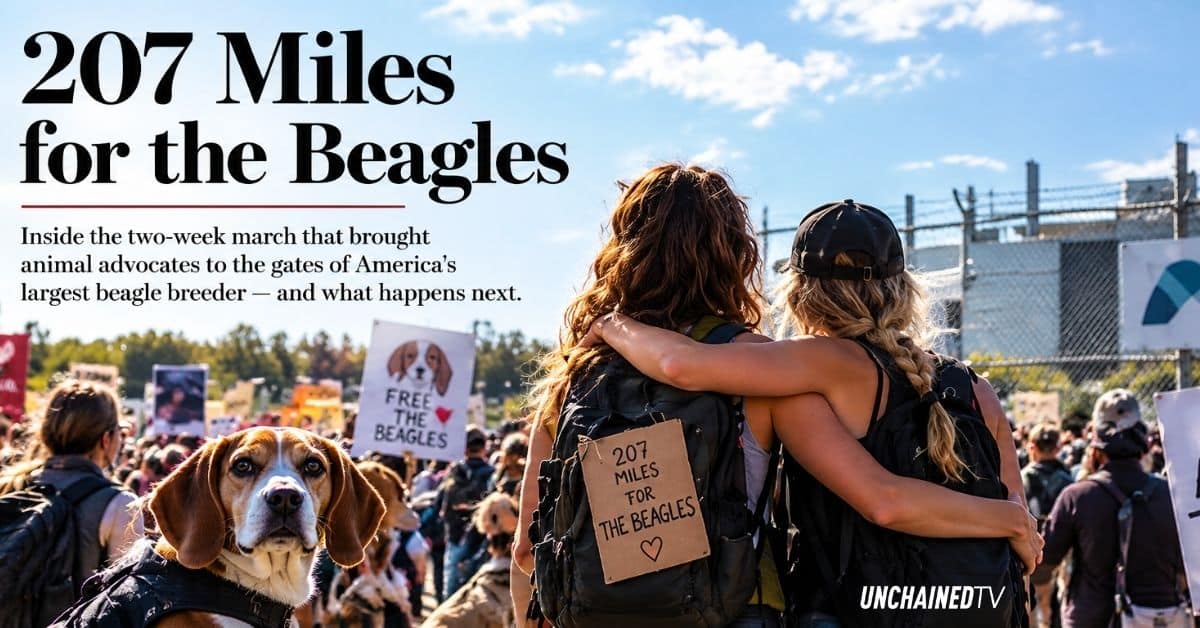
After 207 miles across New York, animal advocates reached Marshall BioResources for the final rally of the March to Abolish Animal Testing.
Ridglan Farms in Wisconsin, previously the nation’s second-largest breeder of dogs for research, shuttered last month after nearly a decade of activist pressure. Direct Action Everywhere (DxE) investigators, led by DxE Co-founder Wayne Hsiung, first exposed conditions inside the facility in 2017. Then, this past spring, two highly publicized beagle rescue attempts by DxE put the issue of dog experimentation front and center. When the second open rescue at Ridglan was foiled by sheriff’s deputies shooting tear gas and rubber bullets at about 1,000 animal activists, the story went global. Around the same time, Pacelle, working alongside Big Dog Ranch Rescue, negotiated the release of more than 1,500 beagles and the closure of the business.
Marshall BioResources (MBR) in Wayne County, New York, now stands as the largest remaining breeder of dogs for biomedical research, holding an estimated 14,000 beagles along with cats, pigs, and ferrets. Pacelle described the complex as roughly ten times the size of Ridglan. Marshall has defended its operations, stating that its most recent unannounced inspection in May 2026 resulted in a ‘clean report’ with no citations or observations. In the UK, at least three beagle puppies were rescued from another MBR facility on September 29th, which led to at least one person being arrested.
Pacelle outlined a multi-pronged approach to getting thousands of beagles out of MBR, modeled on the Ridglan campaign. “His company is going to be sued. His company is going to be protested. His company is going to be regulated by the feds. His company is going to be the focus in Congress,” he said of Marshall BioResource’s owner.
Americans are increasingly turning against laboratory use of companion animals. “People have learned how beagles are confined 24/7 in wire cages and subjected to painful procedures without anesthesia, and the public is overwhelmingly against this cruelty,” one organizer stated following the march.
Marchers covered 207 miles across New York State, from Albany to the Marshall facility over roughly two weeks. Coordinated protests took place on the final day of the march in San Diego, Massachusetts and other locations. The New York Times covered the New York march, noting that the backlash against animal testing is reflected in the bipartisan Langworthy-Pocan legislation.
Ending animal tests will not happen in a single legislative session. The COMPACT Act represents the most comprehensive federal effort yet written, and its passage would mark the clearest structural break from a research model that has operated largely unchanged since 1966. Companies and agencies named in the broadcast are invited to comment at any time.
UNCHAINEDTV invites any organization mentioned in this report to comment at any time.
The March to End Animal Testing!
Video Transcript
What’s Next: Ending Animal Tests! [Speaker 1] Our drug development system is broken. It's broken because we've been relying on animals.
[Speaker 5] 90% of the drugs that pass animal testing still fail in human trials.
[Speaker 7] Right now, more than 42,000 dogs and 12,000 cats are confined in U.S. laboratories.
[Speaker 1] Thousands more are held at industrial facilities that breed puppies and kittens specifically to sell to When you go to Ridgeland, you saw, you open these barns, these factory farms for dogs, and you see a cage elevated from the ground, so the waste falls through on the ground, and there are hundreds of dogs in each one. You look at Marshall Bioresources from a drone, and you see that it is an enormous complex, 10 times the size of Ridgeland.
[Speaker 5] Their life is trapped in a small wire cage, never seeing the sun or touching the grass. These innocent beagles are bred purely for painful experimentation.
[Speaker 6] We believe rescuing animals after they've suffered is important, but rescue alone is not enough. We have to change the systems that cause such profound and prolific suffering in the first place.
[Speaker 5] The Companion Animal Protection Against Cruel Testing Act, or the COMPACT Act, is the most comprehensive effort ever written to end cruel, outdated animal testing and modernize the way we conduct biomedical research in this country, and we're going to get it done.
[Speaker 2] And what is next in the battle to end animal testing? We are talking to the man who perhaps knows more about that and can answer that question better than anybody on the planet. Wayne Paselli, President of Animal Wellness Action and the Center for a Humane Economy.
Wayne, what was the impact of the march to end animal testing? You spoke at the beginning, you spoke at the end. Give us a lay of the land.
[Speaker 1] Well, Jane, first let me tell you, thanks to you. You have been our voice for animals for so long, on Headline News and now with Unchained. I just want to thank you so much for your incredible voice.
And you were covering the march on both ends. I was privileged to be invited by the organizers. They did a great job, Jane.
There were so many people who participated in Albany, marched the 207 miles, and then closed right at the gates of Marshall. You know, sometimes our movement needs to stand up and be counted. We need to go to places where these things are happening and say no more, that this all has to change.
So I'm not sure we're going to see the full impact, Jane, for a while. This is really the beginning of a much bigger political march that we must take to turn around American policy when it comes to testing and experimentation on animals. And I would ultimately want to address all animal testing, but I think this is a very good start to focus on dogs and cats.
We're talking about 42,000 dogs a year. We're talking about more than 10,000 cats. And what this exposes is a broken system of health in America.
We are using billions and billions of dollars on animal tests every year. That was a government mandate from 1938 through 2022. And the drugs that are being examined, the experimental drugs that are supposed to help patients with palliatives and cures, the animal testing is showing that the drug passes muster with them.
And then in nine of 10 cases, when it goes to human clinical trials, it fails. I mean, this is a horrible system. It's not just that the animals are being tormented.
It's that it doesn't work. So I think this is so important, Jane, for us to link together our compassion for these creatures, but also to note that this is not a good outcome for health in America.
[Speaker 2] Let's listen to what you had to say at the start of the march to end animal testing, and then we'll review, well, how do we get there? The goals that you mentioned.
[Speaker 1] On day nine, remember the dogs at the end of this road. They've waited their whole lives for us. And on day 14, you'll come over and rise in Wayne County and see it.
Marshall Bioresources. Long, low buildings built far from anywhere. So nobody quite knows what's going on inside.
Holding so many dogs, cats, pigs, and ferrets. The people who designed those walls in those cages built them on one assumption that no one would ever come for them. That no one would be focused on their plight and their pain.
But on September 26, you and millions of other Americans are going to prove them wrong. We closed Richland.
Marshall is next. Marshall is next, and on every day forward, you're going to get closer to that goal, and we are going to get closer to that goal. Millions of Americans are with you.
They will not relent until all of them are free.
[Speaker 2] Wow, what a speech. The goal, of course, to close, as you said, Marshall Bioresources, but it's a lot bigger than Richland. How are you going to do that?
Now we understand at least 14,000 beagles in there, possibly many more, along with ferrets. What's the game plan for closing Marshall Bioresources?
[Speaker 1] Well, Richland, Jane, fell because of the incredible activism that was on display. The fact that the national spotlight was placed on Richland and its exploitative practices, its exploitative business model, and that was combined with the fact that after we worked to pass the FDA Modernization Act 2.0, which you and I have talked about one-on-one, that law now is on the books. It was a bill until 2022 when the Congress passed it unanimously, and we eliminated, Jane, an 84-year-old animal testing mandate for all drug development.
75% of all animal testing is tied to drug development, cancer drugs, pain drugs, anti-obesity drugs, Alzheimer's drugs, you name it. We have a drug-centered health strategy. We don't focus as much on prevention.
We focus on palliatives and cures in the form of drugs. This system, as I said in our exchange just a moment ago, is broken. It doesn't work.
When we eliminated the animal testing mandate, now we're seeing the architecture of biomedical research starting to finally change. It's been on muscle memory for so long. The structures have been in place.
The grant-making process has been in place. Now we're breaking those norms and those routines, and we have 21st-century science. Jane, look at what you're doing with your show and how you're streaming and you're communicating.
Look at social media. Communications have changed so much over the last five years, no mind the last 84 years or 90 years. We've got to stop doing this stupid R&D on animals when we have AI, and we have organs on a chip, and organoids, and computational toxicology, and all of these new methods.
Why should this domain, this business, be different from any other business where it's resistant to change? Why are we tormenting beagles when we have much better strategies? Jane, I think that's the second answer to the question that the science is all wrong for them.
We've got the science right. We also have norms in our society that we don't want to hurt animals. We have anti-cruelty laws.
We're just asking those laws to be logically applied. When it comes to dogs and cats, those are our family members. This is so out of the norm for how we should treat them.
And then third is we have to do more than just march. The march was so important, and I love the people who participated and organized. We've now got to go to Congress because Congress and the federal public health agencies are the problem.
They are funding this nonsense. They are funding billions of dollars of animal tests every year, and we're just throwing this money down the drain. It's compromising our health system.
It's leading to early deaths of patients. It's leading to more pain for people in need of palliatives and cures. This process is not getting us there.
If you put enough money into a slot machine, you're going to get an occasional return, but it's not a good way to invest your money. This is not a good way for the United States to invest tens of billions of dollars in biomedical research. We can do better.
So I feel like, Jane, the COMPACT Act, this is a new bill introduced right between the start of the march in Albany and the close of the march at the gates of Marshall. This bill will bar federal funding for research on dogs and cats, and it will then free up the resources to go to alternative methods, and it will break this kind of norm, this custom, this habit of using dogs and cats in research. Of course, we need to be thinking about the primates.
That's ridiculous that we're using these primates. They cost $50,000 for one primate to get into the lab. So you're talking about if you have 20 primates, you're talking about a million dollars just for the so-called animal inventory.
All of this has to change. It is so broken, Jane.
[Speaker 2] Well, the New York Times wrote about the march. It wasn't a particularly flattering article regarding the marchers. However, they did talk about what you just mentioned.
Here's some clips of the article. Beagles are bred for research. Activists are pushing back Marshall Bioresources in western New York as the nation's largest breeder of dogs for biomedical research.
It is facing a campaign against using animals for that purpose, and then it says the backlash against animal testing is reflected in bipartisan legislation introduced this month in Congress by Representative Mark Pocan, a Democrat, whose Wisconsin district includes Ridgeland Farms, and Representative Nick Langworthy, a New York Republican, that prohibited the use of federal funds for research involving live dogs and cats. When the New York Times reports it, that means it's real.
It's something that is politically viable. So I know that everybody watching is urged to call your member of Congress at 202-224-3121. If you don't want to call right now, just whip out your phone and take a snapshot of this screen, or if you're watching on your phone, just take a snapshot so you can have that number.
Frankly, that's the number to the congressional switchboard. I have it in my phone as call Congress because I'm always calling Congress about something or other regarding animals. So I urge everybody, share this video out and call and say yes to the Compact Act.
So what I think is very heartening is that we are seeing a cultural shift when it comes to public attitudes toward animal experimentation. Just a quick anecdote, I talked to a friend that I haven't talked to in years, and he had told me years ago that he had allowed some protesters to be on his front lawn because they were protesting a vivisector, and he had called me saying everybody was so angry at him in his neighborhood. I just spoke to him and he said a Ridgeland beagle was coming back to that same neighborhood and that there was a huge party for the Ridgeland beagle and everybody in his neighborhood was celebrating.
And what was so interesting about it was that everybody was talking about wanting to adopt a Ridgeland beagle. That's a cultural shift of 20 years for being literally attacked for letting anti-vivisection activists be on your lawn to that same neighborhood celebrating a Ridgeland beagle arriving. So we're going to get back to Wayne in a second, but I want to play what Robert F.
Kennedy Jr., the Health and Human Services Secretary, said just a couple of days ago about what they want to do to wind down animal testing. Let's listen.
[Speaker 3] We have a clear mandate to modernize biomedical research across the federal government. Our standard is simple. Use the best scientific method for the questions that we're trying to ask.
And validated human-based methods can give us better information about human biology. Researchers should be able to use them. We will invest in those methods, validate them rigorously, and remove unnecessary barriers to their use while maintaining the rigorous standards that we use for safety and efficacy.
We are putting human biology at the center of the American biomedical research and replacing unnecessary animal testing with better science. Thank you all very much.
[Speaker 2] All right. So, you know, that is a huge, huge step forward. Now, there are those who say don't get too excited because they're still funding animal research.
And there are plenty of people who are extremely frustrated about the pace. But as Wayne Paselli and others have said, this isn't going to happen overnight. I wish it would happen overnight.
But it's not happening overnight. But if you want to take a look at the progression in terms of how this has evolved into a cultural shift, I think we can recap and review that for a second. Now, you know that we had the back in 2017, let's give credit where credit is due.
Wayne Shung, a different Wayne, went into Ridgeland Farms. And he took photographs and videotaped the conditions there. And he left with a couple of beagles.
They wanted to put him on trial. And they dropped the charges at the last second. Instead of being thrilled that he was not going to be put on trial, Wayne Shung remained committed to those beagles and demanded that the courts look into allegations made by a whistleblower that non-veterinarians were performing very cruel experiments, not even experiments, surgeries on beagles without anesthesia at Ridgeland.
Ultimately, it was Wayne Pacelli who was right here after one rescue, then a second rescue attempt that went awry. And I've got to show a little video of that before we go back to Wayne Pacelli. But I think we all know of the infamous confrontation between approximately 1,000 activists and the local law enforcement there in Wisconsin, where animal activists, would-be rescuers were hit with tear gas, rubber bullets.
And this is just video of what happened, people injured. But it was this catastrophe, this war zone that got global attention, global media attention. And simultaneously, Wayne Pacelli with Center for Humane Economy and Big Dog Ranch Rescue were negotiating.
And ultimately, Wayne, you got the place closed down, Ridgeland Farms, and you also got the 1,500 beagles out. So how did you do that? And how are you going to use that experience to try to get so many more beagles that are at Marshall BioResources, where there's at least 14,000 reportedly, how are you going to get them out?
What's the difference there?
[Speaker 1] Well, Jane, it took all of us. And I think that all of the attention that was drawn to Ridgeland really allowed us to win the national debate on this issue. And I didn't get anybody anywhere in my professional and social circles that said we should be doing this to beagles.
It felt like a consensus position. And Ridgeland was the second largest seller. So they were facing protests, those protests were going to continue.
They then agreed to discuss things with us. We reached out to them a couple of months before. It was slow going because they were dug in.
But eventually we broke through. They wanted money for the dogs. I would never, Jane, think of giving money to a puppy mill or a research facility or a factory farm or a kill buyer who's selling horses for slaughter.
But in this case, I basically knew that they were going to go out of business. They were going to give us their 2,100 dogs. It was clear to me that that was the trajectory.
So I wanted to give them as little money as possible, get those dogs out of there and shut that business down. And that's exactly what happened. And a lot of times in social reform movements, you have multiple strategies at work at the same time.
So we were doing major communications on this issue. We were working with lawmakers. We had lawyers who were negotiating with Ridgeland's lawyers.
We were talking to everybody we could. And it was just the momentum was with us. Now, Marshall, as you noted in your setup, is 10 times the size.
So we'll reach out to Marshall. We'll reach out to Scott Marshall, and I'll call him and see if he wants to talk. I just don't think there's any future for his business model at this point.
I mean, his company is going to be sued. His company is going to be protested. His company is going to be regulated by the feds.
His company is going to be the focus in Congress. There are going to be congressional hearings. That is not a long-term strategy for success for Scott Marshall.
We are not going away. Millions of Americans who are concerned about this are not going away. And he's the last one.
I mean, Charles River Labs breeds dogs and uses them in intramural research at the facility. It's a terrible company. They've got a lot of problems.
But Marshall's the last one that's breeding dogs and a few other species of animals just for research. So that's got to be a lonely island, Jane. And we are just beginning our campaign.
And it's going to be multidimensional, just like the Ridgeland campaign was. And you and I have worked a lot through the years, Jane. We brought down Ringling Brothers and its elephants in circuses.
And we brought down the fur trade that was vibrant at one point in the United States. And now you can't sell pelts anywhere, basically. We have had many successes in the FDA Modernization Act.
That's the first law that passed on animal testing, the first kind of comprehensive law since 1966, Jane. So between 1966 and 2022, there was nothing in terms of federal policy to crack down on animal testing. There was one important amendment that that related to making alternatives a priority for chemical testing, screening chemicals for the health threats that they deliver.
But this is an incredible moment. And now we have so many bills in Congress on so many subjects, but the COMPACT Act has to be our priority. Do not get distracted by other bills at this time.
This is the one that we all need to rally behind because it's so comprehensive. It deals with just a big category of animals, the dogs and the cats, and it's the way that we're going to grow our support with the American public. People do not want to see these beautiful beagles and these cats subjected to these torments for no good reason.
And the reason that we won the FDA Modernization Act, passage of that act in 2022, unanimously, you had Rand Paul was the lead author on the Republican side, a very conservative, libertarian-oriented conservative, and Cory Booker, and we had everybody in between. Everybody supported this because we won the argument on the science, not just on the animal welfare, which is hugely important. It's the reason, Jane, that you and I are in this cause with the passion that we have because we don't want to see these animals mistreated this way, that their lives matter to them just as much as our lives matter to us.
Each has a spark of life. They don't want to live this way. They don't want to be subjected to these torments.
But we also were really scrupulous about getting experts, PhD scientists, MDs, and we looked at the data and we presented the data, and it just isn't working. And one of the big issues in American politics now are the high cost of drug prices. I mean, people can't afford these drugs.
Health companies are denying claims for drugs. People are dying. We don't have cures for so many major maladies.
We have terrible side effects. You watch regular television, conventional television, these pharmaceutical ads, the whole commercial are the side effects for all these drugs. I mean, these are the drugs of past muster, and we still don't know if it's going to kill you.
So I just can't think how we think this is okay to have this drug development system with animals. We're at the center of it, because for 84 years between the Federal Food, Drug, and Cosmetic Act passage in 1938 during the Great Depression, and then the FDA Modernization Act 2.0 that eliminated that mandate, it was a requirement. You had to use the so-called higher mammals, dogs, primates for tests, and you also had to use the so-called lower animals, mice, rats, rabbits.
We're going to break this system down, and what it's going to do, it's going to liberate science, because we have so much better science that's grounded on human biology, not beagle biology, not mouse biology, not rabbit biology, not cat biology, on human biology. And Jane, we're learning so much that so much medicine is going in the way of personalized medicine that you may react differently to some things than I would. That is the precision that we're going to see in medicine, and drug development, and other realms of health promotion in our society.
The animals have to be left behind, morally, but also scientifically.
[Speaker 2] So let's talk a little bit about the two sides here. You were at the protest outside the District Attorney's Office for the county in which Marshall Bioresources is located. Let's hear a little bit of that loud protest.
[Speaker 4] Dogs feel pain, just like us. Dogs want to be free, just like us. Dogs deserve to be free, just like us.
Dogs deserve to be safe, just like us. There's no excuse for animal abuse. Science is no excuse for animal abuse.
Marshall Bioresources has no excuse for animal abuse. Money is not an excuse for animal abuse. There's never an excuse for animal abuse.
[Speaker 2] And then on the other side, you have a Marshall Bioresources statement. Breeding animals for use in medical research is highly regulated. Our facilities regularly inspected by the USDA.
Our most recent USDA inspection in May 2026 resulting in a clean report with no citations or observations. They also maintain accreditation through AALAC, International and Independent Nonprofit. So those are two very different interpretations of the same reality, what is happening behind the closed doors at Marshall Bioresources.
I want to say I invite Marshall Bioresources, any company, any agency mentioned here, anytime. We would love to dialogue with you. But what are your thoughts?
I know we only have a couple of minutes when you hear the two opposing sides.
[Speaker 1] Well, our laws with respect to the treatment of animals in laboratories are very rudimentary, Jane. They are housekeeping standards. They are not looking at the fundamental questions about the psychological health and the physiological health of the animals in laboratories.
Our U.S. Department of Agriculture, an agency that has a mission to promote American agriculture, kind of reluctantly has this animal care responsibility. It is not vigorously enforced and hasn't been across administrations, not just this administration, but prior administrations. They find housekeeping violations, or occasionally they find something worse, and they typically give the companies a slap on the wrist, and they are persisting.
It was Ridgeland, and it was a special prosecutor who was assigned, that really played such a key role in basically threatening to bring charges. In exchange for not bringing charges, he extracted a concession from Ridgeland that it would basically give up its state license to sell dogs to research facilities. That was the beginning of the end for Ridgeland.
So we have weak laws. Those laws need to be strengthened. And yes, even companies like Marshall are struggling to comply with the very minimalist laws that we have.
But we are going to work to upgrade those laws, but we are also going to work to defund dog and cat experiments. So Marshall has no market for its animals. That is how we are going to win.
We are going to shut down the supply chain of animals from this breeding facility to the labs that purchase them. And whether it is Merck or AstraZeneca or other pharmaceutical companies or its contract labs, get out of this business of buying animals from Marshall. This is an unethical company.
It is a business model based on pain and privation. Stop it. If you are a responsible company, you are not going to be doing business with Marshall.
And that is where this campaign also needs to go. Marshall is a supplier. We also need to think about the buyers.
And that is going to be part of this campaign as well.
[Speaker 2] Wow. Well, I just want to say thank you for taking the time. It is so great to have you on.
You are the man working behind the scenes to make all these changes. And obviously, so many people are watching with bated breath, hoping that we are going to change our culture. I feel that there has been a huge cultural shift on this issue.
So stay in touch. Please bring us latest breaking news when it comes to the battle to end animal testing once and for all. Thank you very much, Wayne Pacelli of Animal Wellness Action and the Center for a Humane Economy.
[Speaker 1] Great to see you, Jane. Thank you.
[Speaker 4] So it's a vegan Netflix. Okay, that's the craziest thing I've ever heard.
[Speaker 6] I love Unchained TV.
[Speaker 3] Unchained. Unchained TV. Your life will change.
It's just that easy.
[Speaker 6] Unchained TV has all sorts of content for everybody. Unchained TV changed my life. Unchained TV is crushing it.
I love Unchained TV. Unchained TV is my go-to. Unchained TV.
Who knew?
Share This
About the Author: Jordi Casmitjana

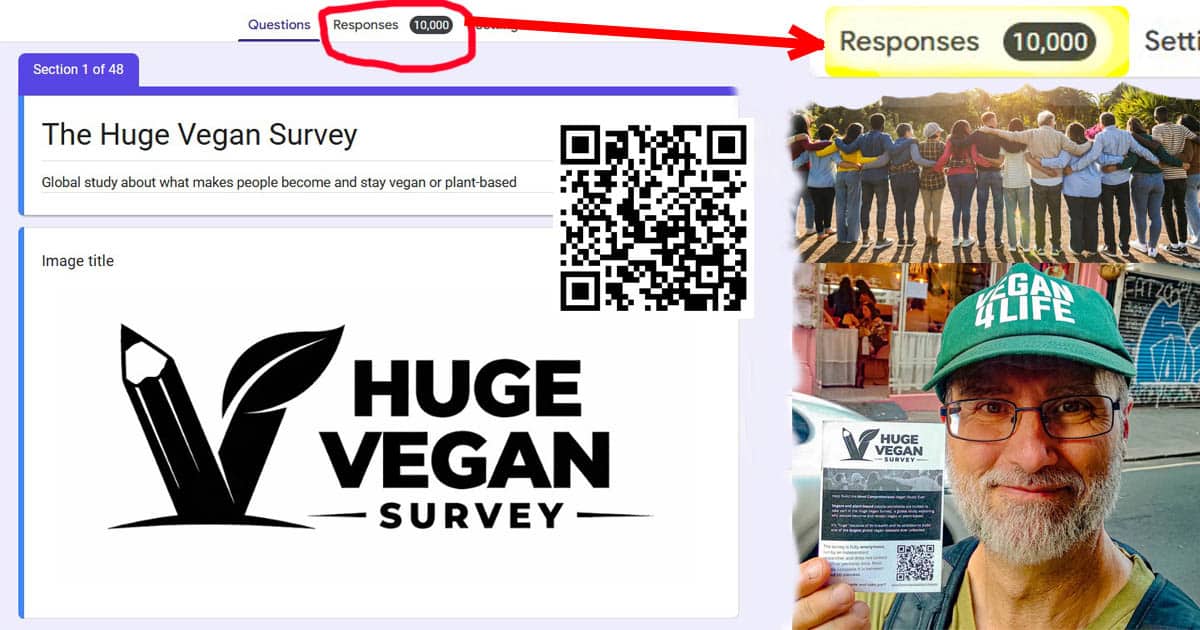 The “Huge Vegan Survey” Reaches 10,000 Participants Worldwide
Latest News

Stay Tuned In
Be the first to know when new shows drop! Plus, get the hottest headlines, inspiring stories, and behind-the-scenes extras. Sign up and keep streaming!
you might also like

The global study of vegans, the “Huge Vegan Survey”, has reached 10,000 participants but is still open to more Huge Vegan Survey logo London, England, October 1st, 2026 - The independently run Huge [...]

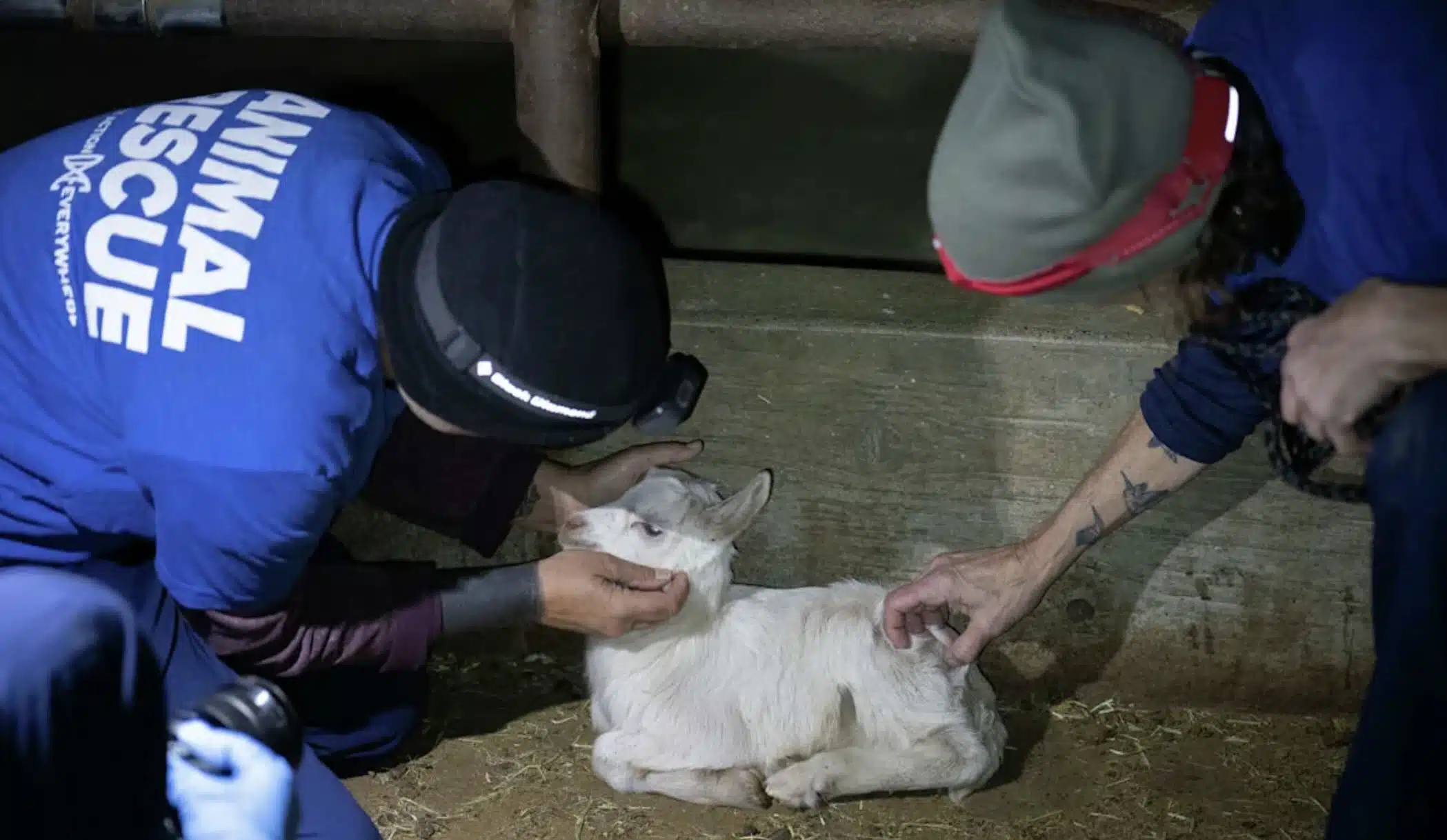
California judge grants judicial diversion for four activists in the DxE Goat Rescue Trial, leading to dismissal of charges after community service and probation.

After two weeks of blisters, rain, campsites, rescued beagles and a growing caravan of advocates, the March to Abolish Animal Testing reached the gates of Marshall BioResources Saturday. Organizers say the walk is over. The [...]