
Together Around Food: A 15-Day Experiment Could Revolutionize How We Feed the World
Share This
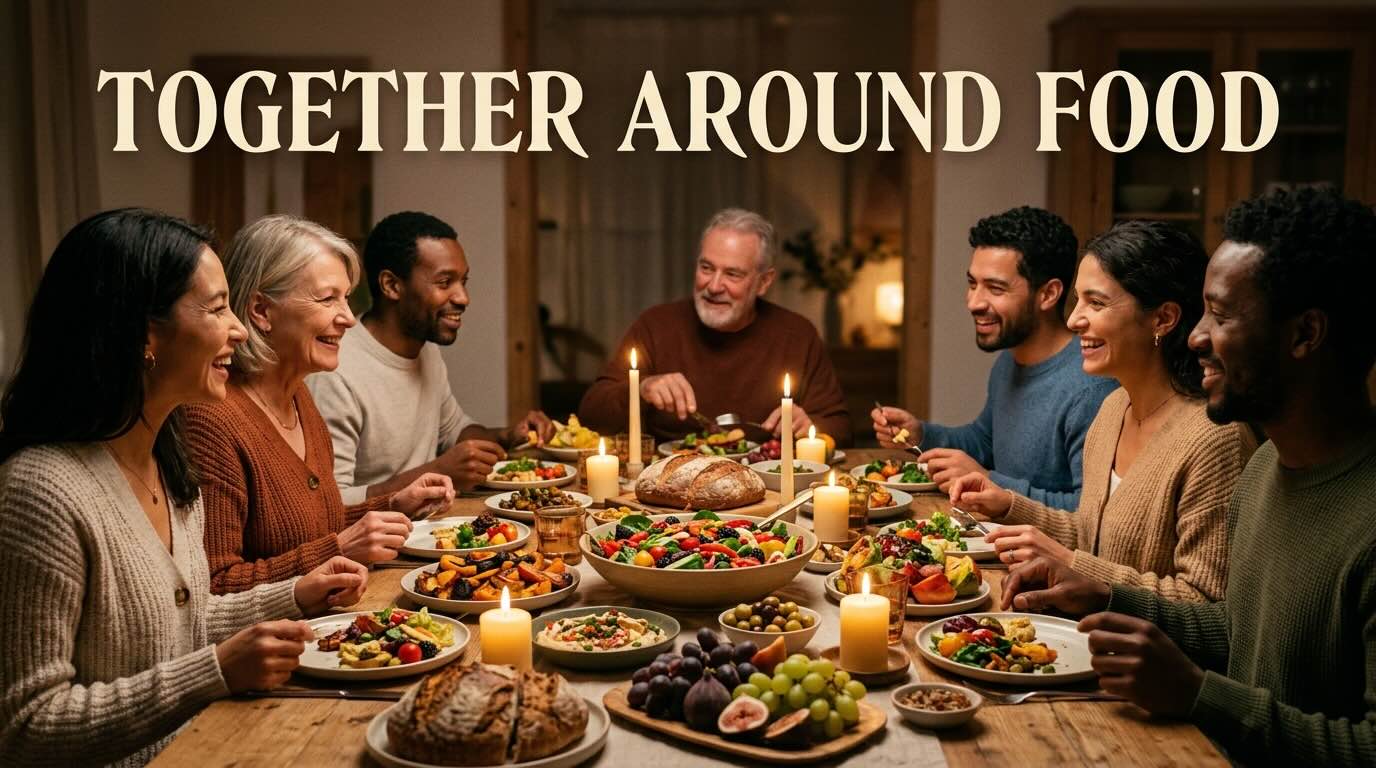
The new documentary, Together Around Food, examines one town’s 15-day experiment—and Climate Healers’ ambitious campaign to make healthy, plant-based food free for everyone.
CHIMACUM, Washington, October 19th, 2026 – A 15-day experiment offering free gourmet vegan meals in Jefferson County, Washington, served thousands of meals, attracted growing crowds, and inspired plans to bring the concept to other communities. And, it was all caught on tape. The fascinating new documentary, Together Around Food, explores what happened when organizers put an ambitious idea to the test: What if healthy, plant-based food were treated as a basic human right and given away for free?
Led by Dr. Sailesh Rao of Climate Healers, Together Around Food challenges a system in which access to nutritious meals often depends on income, while food production contributes to environmental degradation and animal suffering. The experiment lasted just two weeks, but its organizers envision something much larger: communities where nourishing food is available to everyone, regardless of financial circumstances.
TOGETHER AROUND FOOD
A Community Experiment
From June 20th through July 4th, 2026, the Tri-Area Community Center in Chimacum served free plant-based breakfasts, lunches, and dinners without income requirements or expectations that participants become vegan. People simply showed up, shared meals, and participated in an experiment positing that nutritious vegan food should be a community resource and a right rather than a privilege.
Chefs, volunteers, and community partners prepared meals featuring whole grains, vegetables, legumes, fruits, and other plant-based ingredients. According to the Together Around Food community guide, approximately 3,500 meals were served at an estimated ingredient cost of just $3 per meal. Attendance increased through word of mouth, eventually requiring additional dining space.
Apparently, offering delicious food without asking for a credit card isn’t a particularly difficult concept to sell. Sustaining the model, however, presents greater challenges. Ingredient costs represent only part of operating a community meal program, which also requires staffing, facilities, and reliable resources.
More Than Meals on a Plate
The Together Around Food documentary reveals something the numbers cannot: relationships forming around shared tables. Participants described enjoying unfamiliar dishes, meeting neighbors, and discovering new approaches to plant-based eating. For some, the experiment became as much about connection as nutrition.
One participant reported improved mobility, while another described improvements in their cholesterol levels after adopting a whole-food, plant-based diet. Together Around Food was a community initiative, not a controlled clinical trial but many were thrilled with the results.
Volunteers also described preparing increasing quantities of food as attendance grew. Participants exchanged ideas, discussed their health, and began asking whether the program could continue after the experiment ended. In a society where even casual social gatherings frequently involve spending money, Together Around Food offered something refreshingly uncomplicated: a place to eat, connect, and belong… for free.
Climate Healers’ Vision Beyond Together Around Food
For Dr. Rao, Together Around Food represents one component of a much larger movement. In its manifesto, Climate Healers calls for transforming humanity’s relationship with animals, the environment, and one another. The organization advocates replacing extractive systems with a cooperative society centered on compassion and ecological restoration, a vision Dr. Rao describes as Planet B.
Together Around Food offers a practical example of that philosophy. Rather than leaving individuals to navigate a food system dominated by financial incentives, the initiative proposes making nutritious plant-based meals widely accessible. Supporters believe such an approach could help address hunger, chronic disease, animal exploitation, and the escalating climate crisis.
The Jefferson County experiment does not resolve the economics of universal food access, but it demonstrates what one community accomplished by removing the distinction between those who could afford a meal and those who could not. For 15 days, everyone received the same invitation: sit down, eat, and connect. No paperwork, no income verification, and no financial transaction standing between a person and a plate of food.
Organizers hope this documentary will make it easier to replicate the experiment in other communities. As for funding, given that the U.S. government currently subsidies the meat and dairy industry to the tune of billions of dollars, a pivot to healthy, sustainable alternatives could actually save taxpayers money, even if the food were offered for free.
Making healthy food accessible to everyone, without conditions or financial barriers?
That’s the revolutionary part.
Video Transcript
Healthy, delicious food should be a basic human right and a shared community responsibility. Together around food. Together we stand.
Healing the planet with our own hands. The best things in life are free, it's true. A thriving Earth begins with me and you.
Eat plants, love animals, plant more trees. Growing a world that's healthy and free. Together around food, we're family. Create tomorrow's destiny.
Together Around Food is an exciting brand-new 15-day pilot program inspired by Dr. Sailesh Rao and Jamin Shively that will serve whole-food, plant-based vegan meals three times a day for free to everyone in the community.
To achieve this, the global organizations Climate Healers, the Human Ecology Project, Loving Hut, and the Rochester Lifestyle Medicine Institute united to see if we can make cities, counties, and even countries go vegan as quickly as possible. Will Jefferson County become the first fully vegan county in America? We'll find out.
We're in Jefferson County, Washington, in the city of Chimacum, and what we found is Chimacum is actually a farm city with lots of fresh organic fruits and vegetables growing all around us.
Today we have a delicious tofu scramble. This is something that is kind of familiar to people who would eat scrambled eggs, but it tastes much better. It's much better for you. No cholesterol, of course, no animals harmed. The goal of this program is, number one, the food has to be whole-food, plant-based vegan, because we know that that is the healthiest diet for humans on the planet. There's no question that eating a plant-based diet is the way of the future.
The blood is the life force of your body. Food makes the blood, blood makes the cell, cells make the tissue, tissue makes the organs. You can do it all through whole grains, beans, vegetables, fruits, nuts, seeds. Bingo. It's so easy. The reductions in cancer risk, stroke risk, heart disease, diabetes—you can actually cure these diseases simply through the foods that people are eating. What we're doing here in this Olympic Peninsula is we're changing lives by having people realize that eating a plant-based cuisine is so much more healthy. Well, they can't believe it's for free, and then they taste it and they can't believe, “Oh, vegan food is really good.” When people are eating this healthy food together in a community, they feel happy.
Not just from the food they're eating, but from the conversations they're having. Fantastic. Three thumbs up. If I had another thumb, it would be up here.
It was great food, interesting people. This meal is fabulous. I understand it's all locally provided vegetables and food, and [I'm] surprised at really how good it is. And my request was, “Where's the recipe book?”
What we envision the new food system to be is that community centers like this would offer whole-food, plant-based vegan meals that are the healthiest diet on the planet for human health, for the environment, for the animals, free of charge to the community. So that's the project that we have piloted here.
Well, whenever I hear the word vegan or plant-based or health, you got my attention. And this wonderful program combines all three of those important attributes. And when Dr. Sailesh Rao asked me to come in and say a few words, I couldn't say no. In fact, if someone asked me, “Doctor, in a word, what changes in the body when I change my food stream from an animal-based food stream to a plant-based food stream? In a word, what changes?”
Everything changes. Now, people say, “Well, I don't eat like that. I don't eat fast foods. I just eat salmon, I take the skin off the chicken, and so I'm free of this.” Not so fast. If you look and spend any time with this material, eggs are filled with TMAO and growth factors that stimulate cancer growth. Chicken flesh is full of carcinogens, endotoxins. Fish flesh has PCBs and microplastics that are just fed to the animals as well. Eating animals has become quite toxic in the 21st century.
Over the 15 days, we met with local press, did community outreach in town, and passed out flyers while many community members also helped spread the word about this innovative program. I've been promoting it as much as I can. Along with the three meals a day, we held nightly lectures and town halls to educate the community about the health, environmental, and social benefits Together Around Food offers.
You are actually only 43% human cells. The rest of you is 57% bacteria. So just think about how awesome we are as a design, right? You can change that 57% to healthy bacteria, feed your biome, and bingo, you've got great health, you've got a strong immune system. The closest that we get to the environment is in the intestinal wall. And so what you eat is literally what you become. Exactly the food that we're talking about, which can prevent disease and which can help heal disease and reverse disease, is also the food that is going to cure a lot of our planetary problems.
Yeah. Just by being vegan one day, you save 45 pounds of grain, 1,100 gallons of water, 30 square feet of forest, and of course, at least one animal life. So you can see that when you bring a community together around this whole-food, plant-based diet, that getting 100 people together and then hopefully 500 and 1,000, the impact on the environment is unheralded.
Currently, through the animal agriculture industry, about 100 billion land animals are killed each year for food. And what this breaks down to every day: 900,000 cows, millions and millions of pigs and sheep and goats, hundreds of millions of chickens are killed every single day unnecessarily for humans to eat. Almost half the land area of the planet is being used to feed human beings. That's it.
And then another 22% is used to produce timber for human beings and paper for human beings, and 1% is used for all our houses and things like that. Only 1%. Nineteen percent is unused land. So only 9% is forest where wild animals can live.
And even there, we are encroaching. We are taking away every year more and more, and they're literally dying in front of our eyes. So we're at a point where wild animals are literally asking, “Do you want us around or not?” You have to decide.
Initially, we were not sure if the community was going to accept it, how it's going to be received, and whether we can even pull it off. How many people will come? So the first day, we were encouraged when we served over 100 meals, and now we are serving 100 meals at each sitting. It's almost like it's doubled or even tripled the total number of participation. So that's a great sign that the community is accepting it, they're talking about it, and they are embracing it, and they want to continue it going forward.
We're going to be delivering lunch to vendors at the Chimacum Farmers Market today because they can't get here. So we're going to get the food to them. Free delivery, free food. Is that not crazy? Who does that? People in Port Townsend do that. We all come together. We help each other.
I loved it. I loved the little sauces, I loved the dressing, and I want to get healthy. That's the real truth.
Having an opportunity to read Sailesh's book, “Planet B,” and understanding more in a very clear way why this is really an urgent mission to make a difference in terms of our health individually as well as the health of our planet. You can have all the flavor, taste, and sensations, but no cows are hurt in the process. It's been amazing meeting the community, the locals. We love doing it, passing out free resources, education, food.
When they enjoy our food, we are so happy. And even if it means working all day long, it does not feel like work.
Every day I come here and I feel lighter, and my body now feels like I'm going to be able to go another 50 years. I was on a spiral down thinking, “Okay, you're 75 now. This is what you get to feel like. You get to feel like this is going to hurt every day, your arthritis, everything.” But through the diet, on the fourth day, I was noticing that I was walking down the stairs. Every day it feels different.
A lot of people that come to this way of eating come to it after they've already been diagnosed, after they've already been treated, after life has gone crazy on them, and then they went and then changed their eating, and that's good. We want more of that happening, but we want that to go upstream, right? What's happening with children's food? What's happening with food in hospitals? Yeah. For God's sake, sometimes you look at the food in the hospital and you think, “And you're eating the food that put them in there in the first place, right? They want them to stay here?”
Every time you look up at the waitperson and say, “I'll have the beef, I'll have the veal, I'll have the chicken,” every time you say those words, your grandchildren's world gets a little hotter and a little drier and a little deader. These animal foods do not come from the farm. They come from your children's future. So the best thing you can do for your children is become plant-based and set the example. Just do it yourself. You'll save your own life and probably the lives of the people you love as well.
So the way the food system runs now, its objective function is to maximize profit for someone. So food flows to where the money is, because that's seeking money, right? Seeking where the money is. And the most exotic food becomes available to the richest person at any given time.
That's what it's optimized to do. The objective function of the new food system on Planet B is to nourish everybody. To optimize for that, you have to design a different food system, and that food system is what we are testing out in Together Around Food initiative. Planet B is literally the world of Planet A turned upside down.
Planet A is the dominant system that we have today. The current system, the current dominant system, is all about how to extract from the planet and hold the wealth that comes back. And Planet B is a new operating system for humanity that's designed around the restoration of the planet, so on planetary health and world peace. So I consider Together Around Food as the prison break from Planet A.
When you do that, you can release 40% of the land back to nature, on which you can reforest the original forest that used to be there. You can bring back the 3 trillion trees that we cut, and those trees will suck up all the excess chemical pollution on the planet. Because peace begins on our plate, we can restore our planet if we all can act together, work together to save it together.
As important as plant-based diet is, with Dr. Rao's book, he is putting this in the context of a much bigger global crisis. So we are in a polycrisis. Since 2009—2009 is when they came up with this concept of planetary boundaries to describe the health of our planet.
So they identified nine systems that are supporting life on the planet. And of those nine systems, they said three of them, we have crossed the boundary, we are outside the green zone. Which means it's like the planet has three diseases as of 2009. And it became four diseases by 2015, six diseases by 2023, and now there are seven diseases.
The seventh boundary just got crossed, and that's ocean acidification. We turn a blind eye to 800 million people going hungry and 6 million people dying of hunger every year.
When you know how serious it is, it's real. An exciting experiment is happening right now in Port Townsend, Washington State, and it could take the world by storm. Here's where it's happening. It's just about a two-and-a-half-hour drive northwest of Seattle, and it's called Together Around Food. And the basic concept is that, well, vegan food, healthy plant-based fruits, vegetables, nuts, and grains, should they be a basic human right?
I know that we have a crisis. We have a crisis at many different levels with regards to what's going on in our society and what's going on with regards to our planet, and now is the time to act. And this was, for me, where I'm feeling sometimes very hopeless about some of the things that are going on, this was an opportunity to lean in and be able to do something that I thought was impossible three weeks ago when we started this whole discussion, and yet the community has just embraced it. The food has been amazing. The lectures and the programs that we've done have just really enrolled the community and have started a very important conversation of real substance.
Every governmental body knows the effect of the food that people eat and the effect on their health. It's not a secret. The United Nations knows, every government knows. It's time for people to pressure their government and those organizations to actually take action and stop the food industry from poisoning everybody. I'm pleasantly surprised at how the community has reacted to it. I was hoping it would be like this. People have been coming for every meal, and there are people who are calling their friends and bringing them over.
So there's a big buzz around it right now. Every day it's growing bigger and bigger. And what's taken place has been remarkable. It shattered my expectations. It's truly taught me what the new food system should be moving forward for all of humanity. Frankly, we had no idea how it's going to work out. We just knew we had the resources, we had enough money to do this. We had Costco cards, so we could go buy things. We had a place to do it, and we just said, “Let's come and try it out.” And the community responded. So ultimately, it only works when the community comes and says, “We are inspired by what you're trying to do, and we can help you out, too. We want to participate in it.”
My family, part of my family. But they're the reasons why it's so important that I can run and go and play with them every day. They want to walk at least five miles, and it's been really painful for me. So during the class, every day, I didn't want to say anything, but I do want to show you the measurable results. Every day I try a little harder. Today I tried to skip, and I'm 75. I haven't been skipping for about two years. So I just wanted to show you that I can do this now. These guys have got it dialed in. They've got experts in every field here.
The food is amazing. The conversation is so much fun with all the town people, and we're all getting inspired. It's been amazing. We've been getting more and more people coming in day after day, and so the last couple of days, we've had to use the overflow room for dinner, because it filled out in the main room. And we've been cooking more and more, so we know that more people are coming. Yeah. Love the food. Food is very good. And of course, this is a SOS-free meal that we're eating right now.
No added salt, oil, or sugar. And so we both came in jumping up and down, and she goes, and I noticed it, but I didn't want to say anything, and she said, “My knees don't feel stiff anymore.” Right. And I was just going, this is the first day that I have not walked down my stairs one at a time. I just got up and did it, and I go, “This is great. Let's just keep going.” But anyway, when I got acknowledged that both of us are doing that, it's just amazing. We have to prove that it works over 15 days, but actually, that the community responds so well to the program that they want to take it on into the future.
So last night on day six, we had a town hall where we asked the people who came to the dinner and to the presentation how they believe things were going, and if they really wanted to take this on after the 15 days. To answer your question, I want to see this go forward not only for my own health, but the health of my family and the community, but also the planet and the world.
So how do you continue doing something like this on a bigger scale? Let's take this momentum and build upon the ethos and the momentum that we already have in this community. We've done it. We have created this magic of community, of love and compassion.
So today is day 14. We've just had lunch. So this is the final day that we're doing breakfast, lunch, and dinner. We're all exhausted, but it's been, in my opinion, it's been a total success.
Already, we are getting inquiries from other cities asking if we could come and do this in their city. Time for change. So we need a revolution of the heart. We need to waken people up, and we're hoping that's what's going to happen during this program, and people embrace this and get on board, whether they do it for their own health, whether they do it for the animals, the environment, whatever.
But people have to step up to the plate now and do it and grow this project around the world. So whatever we can do to make eating a whole-food, plant-based diet the standard normal way to eat is progress in my eyes.
Oh, it will make health normal. Okay? It'll make health easily accessible. It's an attainable future that I have not felt before in this crisis of the world. This is a next step for me in terms of trying to look at eating healthier for myself and the planet. Tonight's exciting because Patty Schmucker, she will get her results tonight from Dr. Ted Barnett from the Rochester Lifestyle Medicine Institute, so we're excited to see the results. We're going to just focus on a couple of simple lab values, mainly her total cholesterol and her LDL, which is the bad cholesterol.
And when she started, her total cholesterol was 216. Her LDL, the bad cholesterol, was 137. So again, that's quite elevated. Her total cholesterol dropped from 216, and it's now 157, just from going on the whole-food, plant-based diet that you guys are on right now. And her LDL is down to 90. It is remarkable how quickly things can change.
Following the successful pilot program, Dr. Sailesh Rao and Jamin Shively authored the scientific paper “Planet B: A Polysolution for the Polycrisis Emergency,” highlighting Together Around Food as part of a mega-solution capable of addressing 26 existential crises simultaneously. It was peer-reviewed and published in the Journal of Sustainability. As we shared our final goodbyes, we reflected on the community transformation we saw take place right in front of our eyes.
In just 15 days, it became incredibly clear that when a community comes together, it reawakens a greater sense of peace, love, and inspiration within us all. And this is the most hopeful I've felt about humanity in a very long time. Over the 15 days, about 3,500 whole-food, plant-based vegan meals were served free of charge. The Together Around Food pilot program saved approximately 3,250 square meters of forest, 4.9 million liters of water, and 1,200 animal lives.
Now, imagine that on a global scale. To bring Together Around Food to your city or country, please connect with us through our website, togetheraround.food.
Share This
About the Author: Brandy Walt-Rose

 Viral for the Animals: The Film Going Viral Around the World
Latest News
Stay Tuned In
Be the first to know when new shows drop! Plus, get the hottest headlines, inspiring stories, and behind-the-scenes extras. Sign up and keep streaming!
you might also like

The provocative animal rights documentary Viral for the Animals is reaching viewers worldwide on UNCHAINEDTV with new subtitles, helping its message travel even further. Hollywood, Ca. - October 13th, 2026 - It’s called Viral for [...]

A federal strategy would gun down 450,000 barred owls. As shooting begins in Oregon, animal and environmental advocates are expressing outrage and charging the real reason is to help the timber industry. Los Angeles, CA [...]

PCRM celebrates $88 million in NIH grants for human-based research as FDA and EPA policy shifts mark a turning point against animal testing in 2026.