
New Exposé of High-Speed Chicken Slaughter Fuels Outrage over US Slaughter Standards
Share This
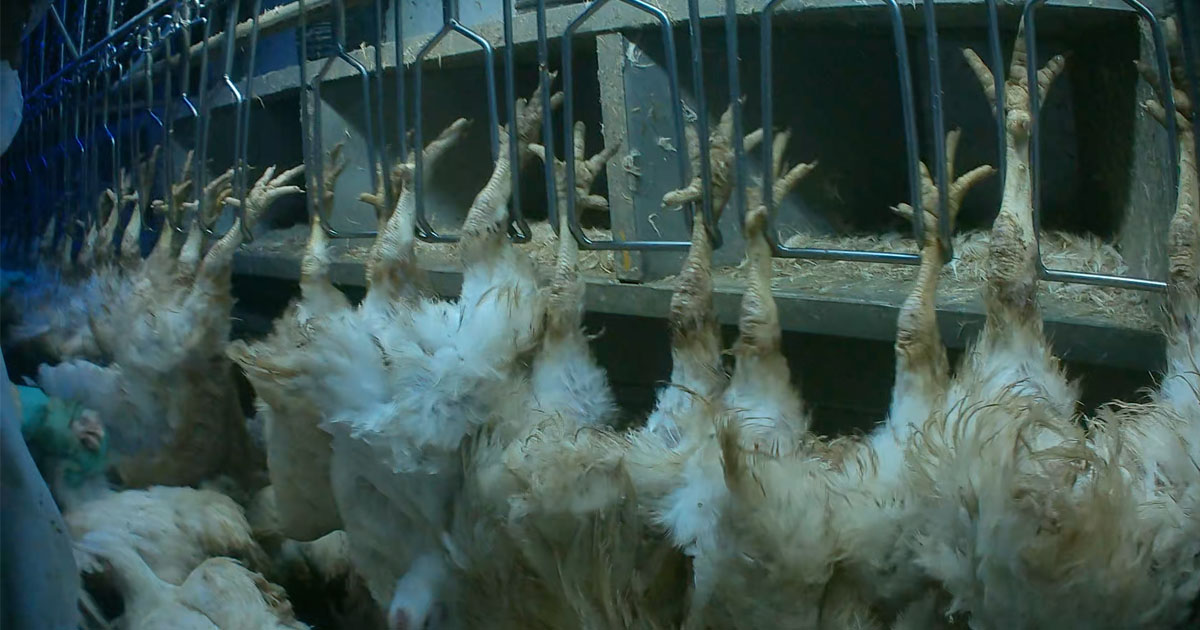
A new exposé by Animal Outlook of the high-speed slaughter of chickens in a North Carolina plant is sparking concern and outrage over the US government’s proposal to make higher-speed slaughter the national standard

Jane Velez-Mitchell, Animal Outlook’s Ben Williamson and the incognito undercover investigator discuss high-speed slaughter
Los Angeles, California, October 29th, 2026 — Recent undercover investigations into high-speed chicken slaughter are raising alarm about animal welfare and worker safety as the USDA considers increasing slaughter-line speeds to 175 birds-per-minute nationwide.
This week, Animal Outlook released undercover footage from a North Carolina slaughterhouse owned by Wayne-Sanderson Farms, the third-largest chicken producer in the United States which has reportedly supplied many of the nation’s best known supermarkets and fast food outlets. The investigation has accelerated public scrutiny as federal regulators weigh speeding up the animal slaughter lines nationwide.
In an exclusive interview with host Jane Velez-Mitchell on UNCHAINEDTV, Animal Outlook’s undercover investigator, who appeared incognito under the pseudonym “Daniel” with a disguised voice to protect his identity, detailed the operational realities of high-speed chicken slaughter. Over his four-month investigation, “Daniel” estimated that he hung approximately half a million birds and noted, “When you grab the birds, they’ll panic and they’ll sort of bend their legs around your finger, almost like a nutcracker. And that would lead to a lot of joint swelling. And of course, repetitive motions of grabbing the birds could lead to carpal tunnel.”
Animal Outlook Urges Americans to Sign Its Petition Against High-Speed Slaughter
In the interview, Animal Outlook’s Executive Director Ben Williamson urged citizens to sign a formal petition asking the USDA not to make 175-birds-per-minute kill lines the law. You can watch their entire conversation here:
New York Times Op-Ed Columnist Calls It “Industrial Cruelty”
The New York Times famed Op-Ed columnist Nicholas Kristof broke the news of this undercover investigation in his widely-read column. He wrote, “Ben Williamson, the executive director of Animal Outlook, agreed with Wayne-Sanderson Farms that the undercover video captured typical industry practices. But what he and I both see, above all, is not industrial efficiency but industrial cruelty. Some day, I suspect, our descendants will see our treatment of farm animals as a great moral blind spot of our age.”
Growing Concerns About High-Speed Slaughter
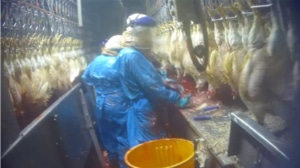
High-speed slaughter recorded by Animal Outlook
The debate over high-speed slaughter is intensifying following the release of four months of undercover documentation from the North Carolina slaughterhouse. Operating under a special federal waiver, the Wayne-Sanderson Farms facility legally runs its kill lines at 175 birds-per-minute, exceeding the current standard limit. According to a Federal Register regulatory notice, current Food Safety and Inspection Service (FSIS) regulations allow young chicken slaughter establishments operating under the New Poultry Inspection System (NPIS) to operate at a maximum line speed of 140 birds per minute (9 CFR 381.69(a)), while the agency proposes raising young chicken slaughter limits to 175 birds-per-minute and turkey limits from 55 to 60 birds per minute.
Animal Outlook says it analyzed footage recorded by “Daniel” and alleges that it showed the processing line operating at more than 180 shackles passing through the frame in one minute on certain days, surpassing the 175 birds-per-minute permitted under the plant’s federal waiver. The footage documented workers throwing birds, slamming them into metal shackles, and hanging them by a single leg. In several instances, the chests and heads of birds were caught between the shackles. Williamson observes, “When you take a line from the current standard of 140 to what the USDA is trying to implement, a new standard of 175 birds-per-minute, that just means more mistakes being made.”
According to the undercover investigator, improper shackling prevented birds from being properly stunned prior to entering the scalding tank, which is reportedly an issue for which the USDA had previously cited the facility. Furthermore, Animal Outlook alleges that birds from the undercover investigator’s shift were routed to a kill room for ritual slaughter where prior stunning did not occur, resulting in their throats being slit while fully conscious.
While Wayne-Sanderson Farms did not respond to our request for comment, the company recently published its 2026 corporate social responsibility report stating, “The health and welfare of our poultry are fundamental to our corporate objectives.” The company is invited on to comment further at any time.
In 2026, undercover investigations have increasingly challenged corporate transparency narratives. Animal Outlook‘s release follows other high-profile investigations into chicken supply chains, such as the exposé of Costco’s “Organic” chicken supplier.
Costco Chicken Exposé
Driving Forces Behind High-Speed Slaughter Practices
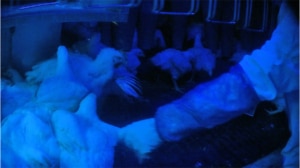
Workers handling chickens in high-speed slaughter recorded by Animal Outlook
The expansion of high-speed slaughter is driven by market demand for low-cost chickens and turkeys and a two-decade deregulatory shift within the USDA. As production costs rise across the agricultural sector, major poultry processors have sought regulatory flexibility to maximize throughput. In August 2026, the federal government outlined these priorities in the Unified Agenda of Federal Regulatory Actions, which addresses maximum line speed rates for young chicken and turkey establishments operating under the New Poultry Inspection System.
Alongside poultry deregulation, federal agencies have examined processing limits across other farmed animal sectors, including the New Swine Slaughter Inspection System, which evaluates the existing maximum slaughter line speed of 1,106 head per hour for swine establishments. Williamson observed that under the current system, the USDA has reduced the number of federal FSIS inspectors on the line, shifting monitoring responsibilities to plant employees who lack equivalent training and face disincentives to report employer violations. Consequently, says Williamson, the federal tracking of birds scalded alive has declined because incidents are categorized under unknown data classifications.
Inside the processing facilities, corporate incentive structures directly reinforce high-speed slaughter targets. Animal Outlook alleges that, at the North Carolina slaughterhouse, worker bonuses were tied to hitting line speed quotas, encouraging staff to cut corners to keep shackles full. The organization says it saw that workers crowded birds together, threw birds from a distance to hit moving slots, and hung chickens on the opposite side of the line to fill gaps faster.
As the debate over the treatment of factory-farmed animals grows, new transparency tools are emerging, including a new California factory farm map that exposes 1,300 sites holding millions of animals. These tools have further intensified scrutiny on industrial consolidation.
DxE’s New Factory Farm Map
“22 Birds Per Minute”

Worker’s injuries during High-Speed Slaughter as recorded by Animal Outlook
For slaughterhouse employees, high-speed animal shackling requires extreme physical exertion that critics say can lead to chronic injury. Animal Outlook says that, at the 175 birds-per-minute rate, each worker on the live-hang line is required to shackle 22 birds per minute, which equals 11 birds in 30 seconds, which equals 1.37 birds every 3.5 seconds for hours at a time. Workers are instructed to catch birds by placing their legs between the index and middle fingers, resulting in continuous bone-to-bone contact as the animals thrash. “Daniel” reported that his hands were rubbed raw, his fingers became swollen, and co-workers frequently experienced numbness, back strain, and eye infections from airborne debris. He says, during one shift, a co-worker passed out and fell backward on the line. The psychological toll was similarly severe, with “Daniel” reporting recurring nightmares of escaped birds cowering in the corners of his room.
The regulatory future of high-speed slaughter remains contested as the USDA conducts its public consultation process in 2026. While federal agencies have historically favored industry requests for permanently elevated line speeds, opposition from labor unions, consumer advocates, and animal protection coalitions has grown significantly this quarter. Animal Outlook has initiated a formal petition drive allowing citizens to submit comments directly to the federal government opposing the permanent 175 birds-per-minute rule.
UNCHAINEDTV invites representatives from any company or agency mentioned in this story to comment at any time.
Stop Live Market Animal Abuse
Video Transcript
High-Speed Poultry Slaughter Exposed! [Speaker 1] In 2026, an Animal Outlook investigator worked undercover at a high-speed chicken slaughterhouse in Dobson, North Carolina, owned by Wayne Sanderson Farms, the country's third-largest poultry producer. Wayne Sanderson runs its kill line at 175 birds per minute, higher than the current limit of 140, a speed the USDA is now trying to make permanent at every poultry plant in the country. Here's what that speed looks like in practice.
Workers at this slaughterhouse are expected to shackle about 22 birds a minute. They grab a bird and hang them over and over for hours at a time. High-speed slaughter.
You just saw a test case courtesy of the latest Animal Outlook undercover investigation. We're very excited to have the undercover investigator who went inside that facility and worked there. Join us.
He is not revealing his identity, and his voice is also disguised. We're calling him Daniel. You can see he's represented by the chair there.
But I want to start first with Ben Williamson, executive director of Animal Outlook. Now, I think it's important to point out that the speed was legal for this company because they got a special waiver from the U.S. government to increase the speeds. Because the government wants to make high-speed slaughter go nationwide.
What are the dangers of that?
[Speaker 2] Yeah, thanks very much for having us on, Jane. I mean, the dangers are quite literally speeding up the line will increase the amount of injuries, will increase the amount of suffering of birds. When you take a line from the current standard of 140 to what the USDA is trying to implement, a new standard of 175 birds per minute, that just means more mistakes being made.
It means more injuries, and yeah, it means more suffering of the birds. And when you see the speed at which these birds are flying around on this live hang line, you can just tell that they're not going to be stunned properly, they're not going to be hung properly, and they're not going to be slaughtered properly, which is going to cause enormous suffering for the birds. And as Daniel will speak to in a second, enormous amounts of suffering for the workers too.
[Speaker 1] Well, Daniel, I want to thank you for joining us. First of all, I want to thank you for taking the risk to go undercover and show us what's going on in America's third largest poultry producer in the United States that has supplied some of the biggest retail chains there are. Let's just start with a personal question.
What kind of a toll did this take on you to kill a lot of birds as part of an undercover investigation? Yeah, well, first of all, it's nice to meet you, Jane, and thanks for having me. And platforming us like this.
For me, I wasn't personally killing the birds, but I was, you know, I was hanging them and sending them to their deaths. They died shortly after. I mean, the toll, it's both physical and mental.
Of course, the injuries, tons of injuries on my hands, my fingers, bending over to grab the birds, my back. And that was common throughout the place. A lot of my co-workers had similar injuries.
Psychologically, it's not easy. It got a little bit easier as time went on, but something like that, I don't think anyone can truly get used to. I was hanging, we were all expected to hang 22 birds a minute, which, you know, doing some rough estimates during my four months there, that would have been half a million birds during the time I was working there.
And psychologically, I will say that I did have plenty of, you know, dreams about these chickens when I wasn't working there. There was one where it was common for the birds to sometimes pop off of a line and cower in a corner somewhere. And I would dream in the place I was staying that, you know, there would be a bird cowering in, you know, every corner of my room.
And yeah, I have to imagine the other workers probably had similar dreams too. Well, I want to play another clip of the Animal Outlook undercover investigation, and then we'll talk about it on the other side. Injuries are commonplace.
Our investigators' hands were rubbed raw from the repetitive labor. At this pace, birds are thrown and slammed into shackles. When the line stops, workers pull at birds' heads, wings, and feathers, and shove chickens into each other's faces.
Indifference becomes normalized when animals are seen only as parts on an assembly line. So that is disturbing on so many levels. I want to go back to Daniel, not his real name again.
You say you experienced some injuries and that it was common for workers to get, you know, hand roughage or hand injuries. What, can you elaborate on that? What exactly did you experience?
Yeah, so when you grab the birds, you're supposed to, I was instructed to grab their legs between my index and middle finger, sort of like around one of the joints in their leg. And when you do that, you know, their legs are very bony. And of course, our fingers don't have much, you know, protection.
They're bony as well. So there's a lot of like bone-to-bone contact. When you grab the birds, they'll panic and they'll sort of bend their legs around your finger, almost like a nutcracker.
And that would lead to a lot of joint swelling, that kind of thing. And of course, repetitive motions of grabbing the birds could lead to carpal tunnel. I definitely experienced some wrist pain.
Can I jump in for a second and ask you? Yeah, of course. It almost seems like I have to read these numbers over and over again.
And again, the 175 per bird speed is legal because this company got a special waiver. But according to the Animal Outlook report, each worker is required to shackle 22 birds per minute. So that's basic math, 11 birds in 30 seconds.
Or shackling five and a half birds in 15 seconds. Or two and three quarters birds in seven seconds. Or 1.37 birds every 3.5 seconds. And presumably this happens for hours. I don't even know how one could do that. Can you provide some insight into how you could even do that?
1.37 birds every 3.5 seconds over and over again? Yeah, it's not something that you can do on your first day there. They generally give workers about a month or like a little bit longer.
It took me about, let's say like a month and a half to reach 22 birds per minute. But yeah, just with the repetition, people do get faster. And it is possible to do.
It's hard to keep that pace for the entire day. But a lot of these guys, especially the more experienced ones, can do it. And of course, it's not easy.
It's to the detriment of their own bodies and their workers, of course. So one of the reasons this is coming up is because the US government wants to make high speed slaughter the norm. And you are leading the charge against this.
There is a way to write to the government and say, no, I don't want high speed slaughter. So you can just take a picture of the still image that's on the screen right now. There is a QR code right there.
If you scan that QR code, you can write directly. I tested it out. It works.
So I will put that up periodically to give people the opportunity to not just like be knocked on their heels by all this, but to take action and do something about this if they find it disturbing. I'm going to play one more clip, and then I'm going to come back to you, Daniel, and also to Ben. A bird who isn't positioned correctly is less likely to be stunned before slaughter and may face an agonizing death from the scalder while fully conscious, something the USDA has previously cited this plant over.
Our investigator was told that the birds from their shift all ended up being ritually slaughtered, where birds are not stunned at all and their throats are slit while fully conscious. Wow. I want to say we reached out to the company, which is the third largest chicken processor out there, supplies some of the biggest brand names, retail shops that you know of, did not hear back.
We invite them on any time, but they did release a corporate social responsibility report for 2026 just the other day where they talk about precision in every process, safety in every serving, and their commitment to animal welfare. Here's a direct quote. The health and welfare of our poultry are fundamental to our corporate objectives.
Delivering compassionate superior care is a strategic priority that requires seamless coordination throughout our operational network, supported by a significant commitment dedicated exclusively to ensuring optimal bird health. What is your response, Ben Williamson, executive director of Animal Outlook, to that statement by the company that you investigated?
[Speaker 2] Yeah, I mean, I saw the corporate social responsibility reports. The animal welfare takes up about two pages of the 44-page report, and given that chicken is its primary business, I think that's outrageous to have such little care and attention paid to the animals. They say that humane treatment is a non-negotiable, but frankly, the company hasn't been in touch with us.
It's been over a week now since we released this investigation. If they were serious about the treatment of chickens or even workers and wanted to know what we found and wanted names, we would gladly provide that to them, but they haven't reached out to us. My guess is that they just don't care who's been shoving chickens in each other's faces or throwing chickens or stacking chickens on top of the other.
I'd say that animal welfare is actually a very negotiable position at Wayne Sanderson and indeed every slaughterhouse that I've ever seen footage at.
[Speaker 1] Well, it's very hard to get mainstream news coverage on animal issues, but you managed to get coverage in the most important newspaper in the world, the New York Times. Let's put up what Nicholas Kristof said, and he wrote this after looking at your investigation. He called it a great moral blind spot of our age.
My takeaway from this glimpse is that even a well-run slaughterhouse is a sickening sight and that the comforting narrative of humane slaughter, as federal law terms it, bears little relation to the horror that livestock and poultry often endure in their final moments on the way to our dinner plates. First of all, it's a pretty big deal to get coverage in the New York Times. So congratulations on the coverage.
And then here's what he goes on to say. Again, under the heading a great moral blind spot of our age. The situation in American meatpacking plants could soon get worse for the Trump administration proposes raising the maximum normal speed of chicken slaughter lines from 140 birds per minute to 175 birds per minute.
The maximum pace for killing turkeys would also increase under the new rules. And there would be no maximum whatsoever for the slaughter of pigs. This is, wow, a very strong statement coming from a newspaper that often does not provide very friendly coverage to animal rights.
So first of all, your reaction to the Nicholas Kristof editorial.
[Speaker 2] Yeah, I mean, Nick is someone we've worked with before. He covered our Manning Beef investigation last year. He's been a brilliant champion for animal protection.
And just the salience of it in the news media, as you say, Jane, it's very rare now, especially with what's happening to newsrooms around the country over the last 10 years. It's very rare that you get such mainstream coverage. So we're just, I think animals are delighted to have Nick on our side.
And that headline, the great moral blind spot of our age, it's just such a great outlet. And hopefully a lot of New York Times readers will watch the footage for themselves. They weren't able because it's so graphic, they're not able to embed a link on their website.
But they sent a lot of people over to the Animal Outlook website. And we're really grateful for that exposure. And then obviously, just seeing the comments and not a single comment that sort of is justifying what people are saying that everything is shock and outrage.
But, you know, we need people to kind of put their money where their mouth is now and leave this kind of stuff off their plates. So that's my first reaction. And I think, you know, when he's talking about what's happening with the Trump administration, and it's actually, it's been the USDA's priority all along.
It's happening under the Trump administration now. But even under previous administrations, the USDA has been in this deregulatory mindset and giving the industry what it wants for about 20 years now. So not only are they proposing to increase line speeds, but they're also reducing the amount of federal inspectors that are responsible for maintaining the health and welfare of these animals that slaughter.
So you've got this really terrible compilation of issues, faster line speeds, fewer inspectors watching out for injured birds, sick birds, birds who are about to be going to the scalding hot tank, fully conscious, and just less reporting of those issues. Another thing that Nick raises is, you know, we used to count the number of birds who enter the boiling hot scalder alive. There was a Washington Post headline 10 years ago that said a million birds are scalded live every year.
Now they just don't count the data. There's no data that exists because it all gets lumped under unknown because these are individual plant workers, not FSIS inspectors, who are taking notes and who aren't trained in the same way that FSIS inspectors are and frankly have no incentive to call out their employer for these things. So it's a real troubling state of affairs for these birds.
[Speaker 1] And again, we invite this company on. We did reach out and we listed all your allegations and asked for their response, did not hear back, but we would love to dialogue with you and have you on anytime. So let's play another clip, again, of this animal outlook investigation that has now gotten media coverage in the New York Times and we're here exclusively with the undercover investigator who actually did the investigation.
We're not revealing his identity, his image, and his voice is disguised, but we are hearing from him. So let's take a look at another clip and talk more to Daniel, not his real name, on the other side. Workers at this plant are paid a bonus tied to hitting the line speed target.
That bonus structure gives workers a reason to cut corners and to cover for each other when they break the rules. One shift, our investigator asked a live hanger how fast the line was actually moving. We slowed our footage down and counted what could have been more than 180 shackles passing through the frame in one minute on certain days.
Even at 175 birds a minute, workers don't have time to hang every bird correctly. Heads and chests get caught in the shackles. Of all the things I saw, when I saw that bird's head popping up in between the shackles, it just was like a punch to the stomach.
Oh my gosh. So I'd like you to discuss a little bit, Daniel, this quote from this undercover investigation, quote, birds were sometimes hung up by only one leg. In some cases, birds' chests and heads appeared above the shackle line.
You just saw it there a second ago. What was your experience in that regard? Yeah, so when the line is moving that fast, sometimes for the workers, it's difficult to get both legs in the shackle when it's right in front of them.
Some of the shackles were bent in a way where, you know, one leg, some of the chickens have like thick ankles and they wouldn't fit in the slot. So when the shackle's going by, they can only manage to get one in and, you know, the shackle keeps going. Other times they might miss their shackle.
It's like to the right of them. So they throw the bird that they're holding at the shackle, hoping to get both legs in. They don't.
With the birds, their heads being stuck in the shackle like that, when you pick them up, they'll be thrashing around. And even if you do get both legs in the shackle, they'll bend their bodies in a way sort of like they're doing a sit up and that will cause their head to be caught in the shackle like that. Similarly, when these birds are moving around, their necks could get stuck inside of the slot where the leg is supposed to go.
And when that happens, whoever sees it first will yell head to head and whoever can is supposed to grab the bird by the neck and lift them up out of the shackle. And these things were pretty common. I saw these regularly, essentially every ship that was there.
So, you know, a lot of people who are not particularly into this issue say, I care about people, not animals. What would you say about the impact on people to do this job, Daniel? You did it for a couple of months.
There are people who are doing this for years. What what do you think it does to them? I think people suffer in like every way possible doing this job.
I mean, on my tweet there, one of my workers, one of my co-workers on the line actually passed out. He just fell backwards and steamed the line and the safety coordinators came in and we just, they resumed the line and we just kept hanging before they even pulled him out. The same things I experienced, you know, fingers swollen, a lot of my co-workers reported numbness.
I got sick a couple of times to the point where I couldn't go to work and that was common, too. It wasn't a regular loss of people, people missing from the line. One worker got an eye infection from some debris that one of the birds like kicked off and, you know, somehow landed in his eye.
Yeah, and just repetitive stress injuries, shoulders, wrists, back, they're unavoidable doing this kind of work, especially at this speed. What would you say to the government that wants to increase the speeds and make what you experienced for two months the norm? I would say that in doing that, workers are just going to suffer more, the chickens are going to suffer more.
Maybe it'll help their bottom line, bottom line piece companies, but I think the government should think more about the people that are working in these facilities and what impact it will have on them, as well as the chickens, of course. What's really ironic and sad is that sometimes people switch to chicken and they proudly proclaim, I don't eat pork or red meat, but I eat chicken. Chickens account for something like, correct me if I'm wrong, 95% of all the animals killed.
So of the 85 plus billion animals that we're killing every year, the percentage of animals that are chickens are the overwhelming majority. In fact, if people stopped eating chicken, the number of chickens killed, the number of total animals killed would drop by something like 95%. So obviously you want people to sign the letter.
Tell me a little bit more about how that works while we put up the QR code. It's right there on the right. If you find this high speed slaughter upsetting, you can just take a photo of that QR code, tap it right now and fill it out.
It takes five seconds and you are sending a message to the government not to implement high speed slaughter. Can you elaborate then?
[Speaker 2] Yeah, thanks very much for sharing the QR code, Jane, and please, if you can, we'd love you to sign it. So the government has basically put out a public consultation and is asking the public what we think. When these things happen, the government usually has in mind what it wants to happen anyway, but it's part of the process to ask the public what they think.
Overwhelmingly, when this has been done in the past, the public sympathises with animals and the overwhelming amount of comments are that any increase in animal suffering shouldn't happen, but we know that they don't always pay attention to that. So right now, we're asking people to sign our petition. This issue is going to go on.
It's not a done deal yet. The government will publish at some stage. It's final rule and say this is what we plan to institute and then at that time, we'll decide what action to take.
We're part of a big coalition of groups. We represent animal welfare along with other organisations, but then there's also food safety advocates because faster line speeds means possible increase in pathogens and spread of disease. Salmonella, you can't check for these things as quickly when the birds are going by so quickly.
So food safety and worker safety, we've got unions, labour unions on board as part of this coalition, which is spearheaded by the Vermont Law and Graduate School. So there's really this, as you've said, Jane, this issue touches on a lot of different aspects of life and really is something that we've all come together to say the USDA should slow down. It should rethink this proposed rule and really it should be abandoning.
It should be increasing protections and not reducing them.
[Speaker 1] So it's not too late if we get, if people get involved. By the way, I did sign it. I signed it because I don't believe in, I haven't eaten animals in almost three decades and look at me.
Here I am. Can't get rid of me. You know, I don't think there's any reason.
And in fact, a lot of our lifestyle diseases could be prevented with a reduction or elimination of animal products and eating whole food, plant-based. So I sign it because I think all this killing is unnecessary. That's my personal opinion.
And I would think that you could get organizations that care about workers' rights involved. Because a lot of the folks who work in these slaughterhouses are at the lowest rung of society and they don't have a lot of options for where they're going to work. So wouldn't you think that organizations that advocate for workers' rights would be the first in line to say, don't do this, Ben?
[Speaker 2] Yeah, absolutely. We do have a number of workers' rights groups who are part of the coalition. We've seen earlier this year workers striking at some plants because of conditions in those plants.
Workers are against this proposal. But unfortunately, the government doesn't always listen to workers or animal advocates or food safety advocates. It largely listens to industry.
And the industry wants this to happen because it can produce more birds. It can sell chicken cheaper. And at the end of the day, the injuries to food safety outcomes and animal suffering are all just part of the cost of doing business.
[Speaker 1] Wow. It's just such a wake-up call. Does the USDA have to listen to the people?
In other words, can they make this decision arbitrarily? Let's say, just for argument's sake, let's say they get 100,000 people signing the letter, which I did sign, and they decide, eh, we're going to do it anyway. What recourse do you have?
Because I find often the only recourse is in a courtroom.
[Speaker 2] Yeah. In the past, when this issue has come up, groups have sued. Animal Outlook is part of a group that is constantly suing the USDA on deregulation issues like this.
I imagine if the government does go ahead with increasing the line speed, then a lawsuit will result. But we're really hoping that we don't get to that. We're really hoping that USDA does consider all the public opinion.
I mean, it asked our opinion. It should listen to what we've said. And ultimately, it should decide to do the right thing without us needing to get into court.
But we're prepared to fight this till the very end, because as we've seen, this is normal. And as Nick Kristof said, this is normal. This isn't any egregious gotcha moment.
This is just what happens at these kind of places. And I'm really glad that it's been put out there for all to see.
[Speaker 1] Wow. Well, again, tremendous work by this undercover investigator who I think are the true heroes of our movement. It is extraordinarily difficult and in many cases dangerous to go undercover.
And then there's no credit. All there is is anonymity. And that's exactly what we're hearing from this person who you've named Daniel, which is not his real name.
So what would you like to say, Daniel, as we wrap up about this entire issue? Because ultimately, it is a consumer issue. At the very end of the day, nobody is forcing this down people's throats.
They could choose not to buy this particular product called chicken, which is everywhere. In fact, people don't even connect chicken. They just call it wings or they call it tips or they call it whatever they're going to call it.
It's not even in their minds a sentient being that is being killed so they can consume this animal. But what would you say to the people out there as somebody who has been in the trenches, on the line, shackling these animals? I have to read it again because it's hard for me to even assume.
22 animals a minute. 22 animals that you're shackling every minute. Yeah, it's like you said, these facilities, these companies only exist because consumers give them money.
And I would tell the consumers that all their food comes from somewhere. It doesn't just appear in a grocery store or in a restaurant or on their plate. There are workers making that food and they regularly experience physical injuries to do it.
And of course, there are animals, in this case, chickens, who suffer and die to become this food. And like Ben said, this all happens even when the system is working properly. But these line speeds, which they want to increase, just exacerbate everything that happens here.
And of course, if that does happen, there'll be more cut corners, more injured workers, more chickens being scalded alive. And I don't think anyone wants any of those things. And I don't know if American consumers will take that into account next time they're thinking about purchasing chicken.
And some of the people watching, sad news. Hope, common sense, and compassion prevails. Thank you for exposing the evil.
The fight for animals never ends. I want to remind everybody, thank you, Daniel. Amazing work.
Seriously, you deserve an award for what you've done. It's probably the hardest job there is out there. Even just doing it as a regular person is difficult.
Imagine doing it as an undercover investigator. I can't even imagine. So for those who are like, wow, this is sad, I urge you to now scan the QR code.
It's very easy. You just put up your camera. I did scan it, and I signed it.
I would urge everybody to scan it and then send that to other people. So you just tap on the QR code. It says, my QR code.
And then it goes right to the Animal Outlook petition entitled, not so fast, tell the USDA, don't make 175 birds per minute kill lines the law. So I'm leaving it up there. So everybody has a chance.
No excuses. Take that photo or screen grab it off your computer and take action because there's a large organization coming together. Last thing I'll say, there's also the fight against the Save Our Bacon Act, which seems like a lot of the same groups are gathering together.
And they've worked very hard, but so far been successful in staving off the horrific Save Our Bacon Act, which would bring back pig gestation crates and overturn many animal protection laws and states' rights to create those laws. So it shows that we can have results when the organizations unite and stop staying in their little silos and join forces. And so what are your hopes?
Are you hopeful that this can be stopped? Last question.
[Speaker 2] Yeah, I'm definitely hopeful. We've had, as you know, a lot of great organizational coming together over the last year or so fighting the Save Our Bacon Act. It's not law yet.
So we're hopeful that the midterms go our way next week and the right people are on the agriculture committees in both houses. And we know the industry is going to keep fighting. So we've got to keep fighting too.
We know that in one way, shape or form, they want to keep pigs in crates and keep hens in cages. And we've got to just be on the case. We've got to be using all the tactics that we have as a movement and be united as a movement.
And it's great to see so many groups now on board with this, with fighting Save Our Bacon. And we've got to be vigilant and we've got to be as a movement, just keep together and keep signing everything, keep calling legislators. And I think in the end, we will prevail.
[Speaker 1] Absolutely. Thank you so much, both of you. It was really great to meet you virtually and anonymously.
I couldn't pick you out if I saw you in person because I don't know who you are. But well done. Bravo.
And thanks for all the incredible work Animal Outlook does. We'll stay on top of this issue. Keep us posted, OK?
[Speaker 2] Thanks so much, Jane. Thanks for having us on.
[Speaker 1] Thank you. Unchained TV is my go-to. Unchained TV.
Who knew?
[Speaker 3] Unchained, baby, yes!
Share This
About the Author: Jordi Casmitjana

 NYC's Historic Vote to Ban Horse-Drawn Carriages: Animal Rights Victory
Latest News




Stay Tuned In
Be the first to know when new shows drop! Plus, get the hottest headlines, inspiring stories, and behind-the-scenes extras. Sign up and keep streaming!
you might also like

New York City's historic vote will phase out horse-drawn carriages by 2028, affecting 180 horses and ending a decades-long battle in a victory for the animal rights movement NEW YORK CITY — October 23rd, 2026 [...]

UNCHAINEDTV reports vegan Philly is surging in 2026, from a Michelin Green Star to a culinary college that requires vegan cooking to graduate.

The new documentary, Together Around Food, examines one town's 15-day experiment—and Climate Healers' ambitious campaign to make healthy, plant-based food free for everyone. CHIMACUM, Washington, October 19th, 2026 - A 15-day experiment offering free gourmet [...]